

What size bike do you get a 5 year old
For a 5-year-old, begin with a 14-, 16-, or 18-inch bike, then choose by measured height and an in-person fit check. XBikes starting ranges are 14 inch for 37–45 in (94–114 cm), 16 inch for 40–48 in (102–122 cm), and 18 inch for 43–52 in (109–132 cm). Age alone cannot determine the right size.
Measure before choosing a wheel size
Measure the child’s height without shoes, standing straight against a wall. Also measure inseam from the floor to the crotch while the child stands naturally. Compare height with the XBikes ranges below, then use inseam during the actual stand-over and mounting check.
A child may fall within two or even three height ranges. That overlap is intentional: wheel size is only a starting point because frame shape, saddle position, reach and the child’s confidence affect the final fit.
| Wheel size | XBikes age starting point | Rider height |
|---|---|---|
| 12 Inch | Ages 3–4 | 34–40 in / 86–102 cm |
| 14 Inch | Ages 3–6 | 37–45 in / 94–114 cm |
| 16 Inch | Ages 4–7 | 40–48 in / 102–122 cm |
| 18 Inch | Ages 5–9 | 43–52 in / 109–132 cm |
| 20 Inch | Ages 7–12 | 48–60 in / 122–152 cm |
Turn the measurement into a shortlist
If the child measures 37–40 inches, compare 12- and 14-inch models, while recognizing that the 12-inch age starting point is 3–4. At 40–45 inches, compare 14 and 16 inches. At 45–48 inches, begin with 16 and 18 inches. At 48–52 inches, compare 18 and 20 inches, but do not select a 20-inch bike merely to provide growing room.
These overlaps do not mean adjacent sizes fit identically. They mean the child should try the plausible sizes and demonstrate control. A shorter, cautious rider may fit differently from a confident rider of the same age, but confidence never makes an oversized or unreachable bicycle appropriate.
What to check during the try-on
Have the child mount and dismount without being lifted into position. Check that they can stand over the bicycle, sit in a controlled position, reach the handlebars without stretching, steer through a turn and operate the brakes comfortably. Their hands must reach and control the brake levers rather than merely touch them.
- Reject a bike if mounting, stopping or steering looks strained.
- Confirm that the child can place their feet as directed by the bicycle’s setup and manual.
- Compare current control on each candidate size; do not choose the larger one only because it may last longer.
- Use the exact product manual or a qualified bicycle mechanic for assembly, adjustments, compatibility, load limits and torque.
This follows the pediatric fit principle of having the child try the bicycle and avoiding an oversized purchase for future growth. If ordering before a try-on, keep the measured shortlist narrow and arrange a fit check before the first ride.
How the supplied XBikes options compare
The XJD Kids Bike for Girls – Pink, 12/14/16/20 Inch with Training Wheels offers four labeled wheel-size choices, while the XJD Pink Girls' Bike – Kids 12/14/16 Inch Training Wheel Bicycle offers three. Both can provide 12-, 14-, and 16-inch comparison points for a 5-year-old whose measurements lead there; only the first also lists a 20-inch option. Neither has an 18-inch label, so if the fit check indicates 18 inches, these products are comparison points rather than substitutes for that exact size.
 XJD Kids Bike for Girls – Pink, 12/14/16/20 Inch with Training Wheels
Offers labeled 12-, 14-, 16-, and 20-inch options with training wheels. The 14- and 16-inch choices are relevant starting comparisons for many measured 5-year-olds; the 20-inch option requires its own height and fit check.
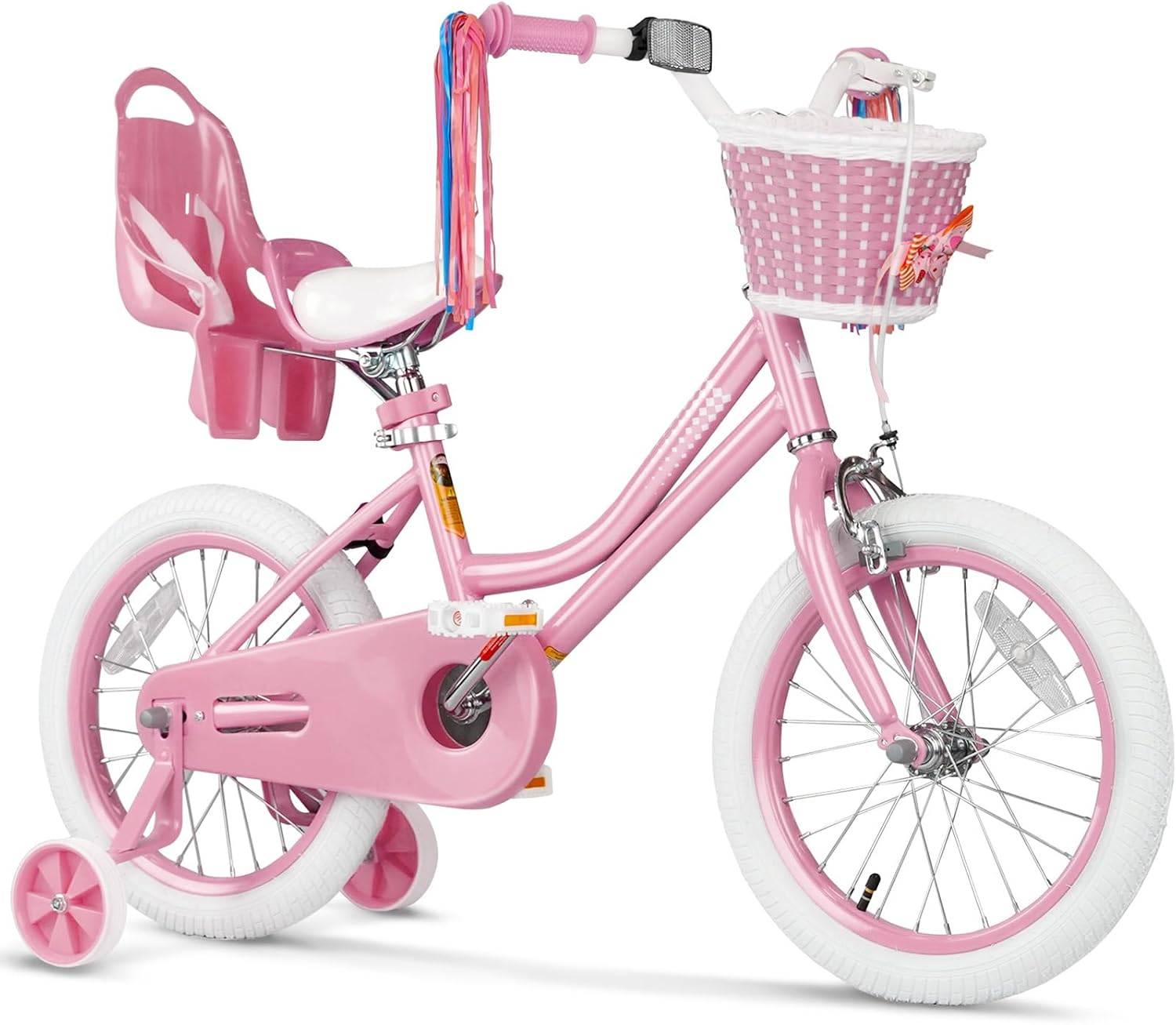 XJD Pink Girls' Bike – Kids 12/14/16 Inch Training Wheel Bicycle
Offers labeled 12-, 14-, and 16-inch options with training wheels. Its 14- and 16-inch choices can be compared when the child’s measured height falls within the supplied XBikes ranges, followed by an individual fit check.
The wording in each product title is a catalog label, not proof that a particular child fits it. The supplied facts establish wheel-size labels and training wheels only; they do not establish brake type, weight, material, assembly details, certification or an individual age fit.
Training wheels do not correct poor sizing
Both supplied bicycles are categorized as Training Wheel Bikes. That may make them relevant when the family specifically wants that format, but training wheels do not make an oversized frame, excessive reach or inaccessible brakes fit correctly. Compare the child’s balance and current confidence separately from the physical fit.
If training wheels are not wanted, these two catalog options may not match the intended setup. Follow the chosen bicycle’s exact manual for installation, adjustment or removal questions, or ask a qualified bicycle mechanic.
Before the first ride
Use a bicycle helmet that fits properly, sits level and has its straps positioned according to the helmet manufacturer’s instructions. Recheck bicycle control in a low-risk area before ordinary riding, particularly after saddle or handlebar adjustments.
For the 5-year-old in front of you, measure height and inseam now, shortlist the matching 14-, 16-, or 18-inch range—and any overlapping range—then buy only after the child can stand over, reach, steer and brake with control.
Bikes for your next adventure
-

Pink Girls' 12/14/16" Bike by XJD – Basket & Doll Seat
The XJD Pink Girls' Bike with Basket & Doll Seat is made for riders 71–122 cm ta…$75.99
$99.99 -

Light Purple XJD Toddler Bike Helmet, Adjustable, Size XS (46–51 cm)
This Light Purple XJD toddler bike helmet is made for the smallest riders — the …$20.39
-

Black XJD Toddler Bike Helmet, Adjustable – Kids' Protective Helmet
The XJD Toddler Bike Helmet in black is an adjustable protective helmet for kids…$20.39