

What size bike do you get a 6 year old
For most 6-year-olds, start by comparing 16-inch and 18-inch bikes. Measure the child first: 16-inch suits 40–48 in (102–122 cm), while 18-inch suits 43–52 in (109–132 cm). Choose only after checking stand-over clearance, reach, braking and confidence on the actual bike.
Measure height before choosing a wheel size
Have the child stand straight against a wall without shoes, then measure from the floor to the top of the head. Compare that result with the XBikes starting points below. Age six appears in several ranges, so age alone cannot settle the choice.
| Wheel size | Starting age range | Rider height |
|---|---|---|
| 14 Inch | 3–6 | 37–45 in / 94–114 cm |
| 16 Inch | 4–7 | 40–48 in / 102–122 cm |
| 18 Inch | 5–9 | 43–52 in / 109–132 cm |
| 20 Inch | 7–12 | 48–60 in / 122–152 cm |
A child near 43–48 inches overlaps the 16-inch and 18-inch ranges. That overlap means both sizes deserve a fit check; it does not mean they fit identically. A shorter six-year-old may fall within the 14-inch range, while a child at least 48 inches tall may be ready to compare a 20-inch bike.
Measure inseam and check stand-over clearance
Height narrows the options, but inseam helps reveal whether the frame is manageable. With shoes off, have the child stand with feet slightly apart. Place a firm book between the legs, gently raised to mimic a saddle, and measure from the floor to the book’s top edge.
Next, have the child straddle the actual bicycle with both feet flat on the ground. There should be comfortable clearance rather than contact with the frame. Because frame shapes vary, do not infer stand-over fit from wheel diameter alone. If the child cannot stand comfortably over the bike, reject that bike even when the height chart appears to match.
Test reach, steering and brake control
Seat the child on the bicycle and watch their posture. They should be able to reach the handlebar without locking their arms, leaning excessively forward or stretching away from the saddle. Ask them to turn the handlebar both ways while remaining balanced.
Check every fitted brake control on the individual bicycle. The child needs to reach and operate it confidently without losing their grip or shifting into an unstable position. A parent should also observe a slow start, controlled stop and simple turn in a suitable traffic-free area. Limited control or visible anxiety is a reason to try a smaller or differently proportioned bicycle.
When the supplied BMX option is relevant
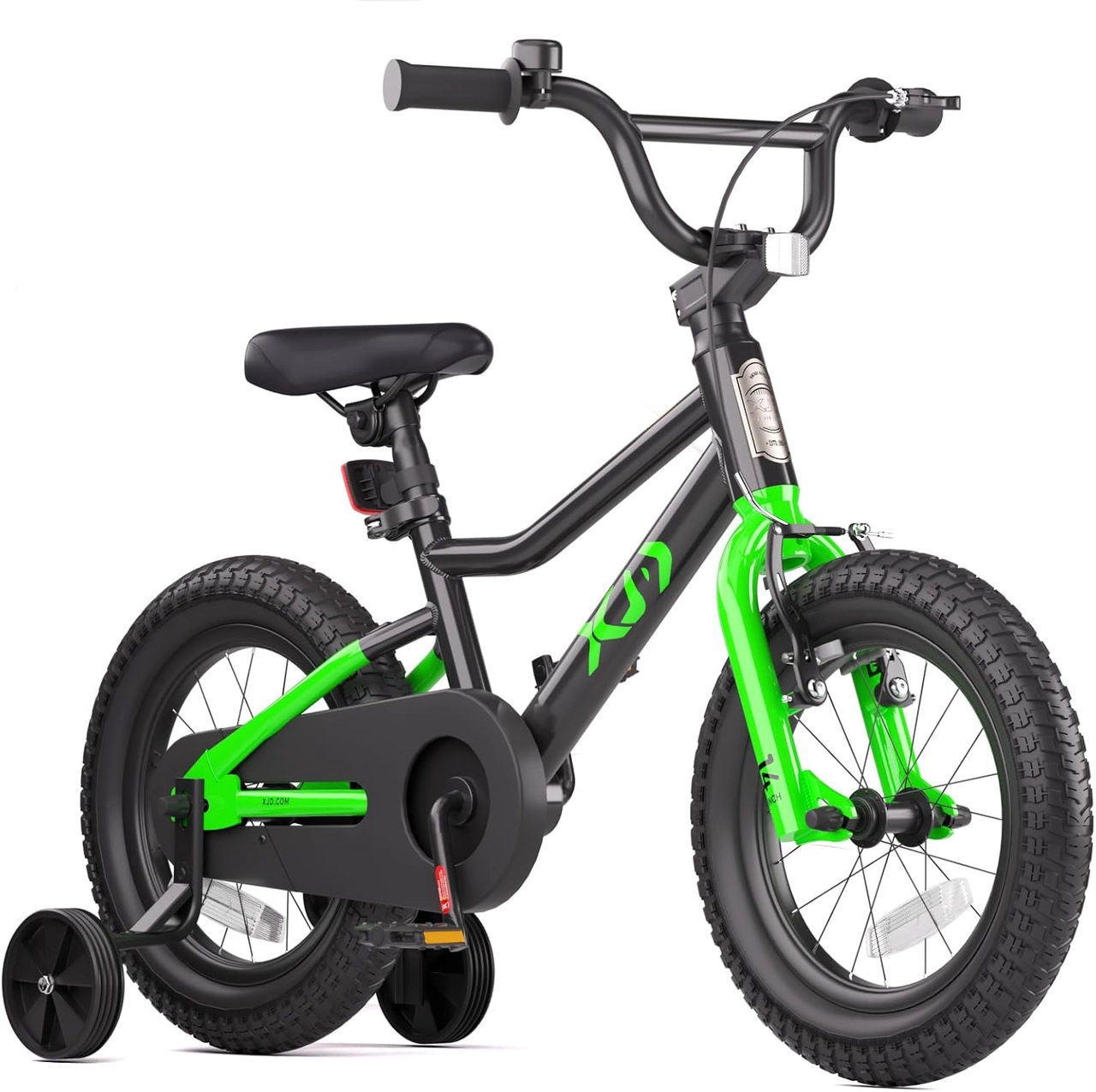
The Black XJD Kids' BMX Bicycle with Training Wheels is offered in 12 Inch, 14 Inch and 16 Inch catalog sizes. For this question, its 14-inch and 16-inch versions provide useful comparison points for a six-year-old whose measured height falls within those XBikes ranges. Its 12-inch version corresponds to 34–40 in (86–102 cm) and ages 3–4, so it will generally be outside the starting range for a six-year-old unless the child’s measured height indicates otherwise.
These catalog options help answer the sizing question because they let you compare two relevant starting sizes—14 Inch and 16 Inch—within the same exact product listing. The product does not offer an 18-inch or 20-inch label in the supplied facts, so it is not a substitute when the fit check points to either of those sizes.
Do not size up merely for growth
An oversized bike can make mounting, steering, stopping and recovering balance harder. Do not choose an 18-inch or 20-inch bicycle simply because the child may grow into it. The correct choice is the bike the child can control now, with adequate stand-over clearance and an easy reach to the handlebar and brake controls.
Confidence matters alongside measurements. A child who is still developing balance may control a smaller matching option more comfortably than the largest size within an overlapping height range. Conversely, do not keep a confident child on a bike that is visibly cramped or outside the appropriate measured-height range.
Make the final decision
- Measure standing height and inseam without shoes.
- Use height to shortlist 14-inch, 16-inch, 18-inch or, when at least 48 inches tall, 20-inch options.
- Have the child straddle and sit on each candidate bicycle.
- Reject any option that compromises clearance, reach, steering, brake operation or confidence.
- Follow the exact product manual for assembly, adjustment, maintenance and limits, or ask a qualified bicycle mechanic.
Before riding, provide a properly fitting bicycle helmet. It should sit level, and its straps should be adjusted according to the helmet manufacturer’s instructions. For a six-year-old, buy the size that passes today’s complete fit-and-control check—not the largest wheel size they might use later.
Bikes for your next adventure
-

Pink Girls' 12/14/16" Bike by XJD – Basket & Doll Seat
The XJD Pink Girls' Bike with Basket & Doll Seat is made for riders 71–122 cm ta…$75.99
$99.99 -

Light Purple XJD Toddler Bike Helmet, Adjustable, Size XS (46–51 cm)
This Light Purple XJD toddler bike helmet is made for the smallest riders — the …$20.39
-

Black XJD Toddler Bike Helmet, Adjustable – Kids' Protective Helmet
The XJD Toddler Bike Helmet in black is an adjustable protective helmet for kids…$20.39