

What size bike does 6 year old ride
Most 6-year-olds should start by trying a 14-, 16-, or 18-inch bike, with 16 inches often matching riders 40–48 in (102–122 cm). Measure the child and confirm the fit before choosing.
Which wheel size should a 6-year-old try?
Age gives you a shortlist, not a final size. Under the XBikes starting points, a 6-year-old may overlap three wheel sizes:
| Wheel size | Starting age range | Rider height |
|---|---|---|
| 14 Inch | Ages 3–6 | 37–45 in / 94–114 cm |
| 16 Inch | Ages 4–7 | 40–48 in / 102–122 cm |
| 18 Inch | Ages 5–9 | 43–52 in / 109–132 cm |
Compare the child's measured height with every matching range. A shorter 6-year-old may need a 14-inch bike, many will begin with a 16-inch comparison, and a taller child may be ready to try an 18-inch bike. Overlap is normal, so height alone still does not settle the choice.
Measure height and inseam first
Measure the child without shoes on a level floor. For height, have them stand upright against a wall and measure from the floor to the top of the head. For inseam, place a book upright between the legs to represent the saddle and measure from the floor to the top edge of the book.
Use height to identify likely wheel sizes, then bring the inseam measurement when checking the bicycle's stand-over clearance and saddle adjustment. Because frame shapes vary, wheel diameter cannot tell you whether a particular frame will fit.
Check the actual bike before buying
Have the child try the exact bicycle. The American Academy of Pediatrics advises against buying an oversized bike merely for future growth. During the fit check, look for all of the following:
- The child can stand over the frame with comfortable clearance rather than being pressed against it.
- They can get on and off without struggling or tipping the bicycle.
- They can hold the handlebar and steer without stretching, locking their elbows, or losing balance.
- They can reach and operate the brakes confidently with the controls fitted to that bicycle.
- They can start, stop, turn, and place a foot down in a controlled way.
If two sizes match the height chart, choose by stand-over room, reach, brake control, and the child's present confidence—not by which bicycle leaves more room to grow.
How the supplied XBikes options compare
The three supplied catalog options provide 14- and 16-inch sizes for the main age-six comparison, while two also offer 20-inch variants. Their size labels help narrow what to try, but they do not replace an individual fit check.
 Pink 12/14/16/20" XJD Girls Bike with Training Wheels & Basket
Available in 14- and 16-inch variants relevant to common age-six size comparisons, plus 12- and 20-inch options. Confirm the child's measurements and fit on the exact bike.
 Black XJD Kids Bike for Boys – 12, 14 & 16 Inch Sizes
This Training Wheel Bike is available in 12, 14, and 16 Inch sizes. Its 14- and 16-inch variants may be relevant after measuring the rider and completing an individual fit check.
 Light Pink XJD Girls' Bicycle with Basket & Training Wheels
Listed in 12, 14, 16, and 20 Inch variants. For many 6-year-olds, the 14- and 16-inch versions are the pertinent comparison points, subject to height, inseam, reach, control, and confidence.
- Pink 12/14/16/20" XJD Girls Bike with Training Wheels & Basket is listed in 12, 14, 16, and 20 Inch variants.
- Black XJD Kids Bike for Boys – 12, 14 & 16 Inch Sizes is listed in 12, 14, and 16 Inch variants.
- Light Pink XJD Girls' Bicycle with Basket & Training Wheels is listed in 12, 14, 16, and 20 Inch variants.
All three are cataloged as Training Wheel Bikes. For a 6-year-old whose measurements point toward 14 or 16 inches, those listed variants are relevant bikes to compare in person. None has a supplied 18-inch variant, so these products are not substitutes when the fit check indicates an 18-inch bicycle.
A 20-inch bike is an XBikes starting point for ages 7–12 and heights 48–60 in (122–152 cm). Do not move a 6-year-old to a listed 20-inch version unless the child's measured height falls in that range and the exact bike passes every control and fit check. The 12-inch versions, intended as a starting point for ages 3–4 and heights 34–40 in (86–102 cm), will generally be comparison points only unless the child's measurements support that size.
Training wheels do not correct poor fit
Training wheels may match a child's current riding stage, but they cannot make an oversized or undersized frame fit. A child still needs manageable reach, stand-over clearance, brake access, and enough control to mount and stop. Use current confidence to decide whether a Training Wheel Bike is relevant; do not use training wheels as a reason to size up.
For assembly, adjustment, maintenance, load limits, compatibility, or torque requirements, follow the manual for the exact product or ask a qualified bicycle mechanic. The supplied catalog facts do not establish those details.
Complete the final safety check
Pair the chosen bicycle with a properly fitting bicycle helmet. U.S. Consumer Product Safety Commission guidance calls for the helmet to sit level and for its straps to be used according to the helmet manufacturer's instructions.
Your next step is simple: measure the 6-year-old's height and inseam, shortlist the matching 14-, 16-, or 18-inch size, and have the child try that exact bicycle. Buy only the size on which they can stand over, reach, steer, brake, start, and stop confidently today.
Bikes for your next adventure
-

Light Purple XJD Toddler Bike Helmet, Adjustable, Size XS (46–51 cm)
This Light Purple XJD toddler bike helmet is made for the smallest riders — the …$20.39
-
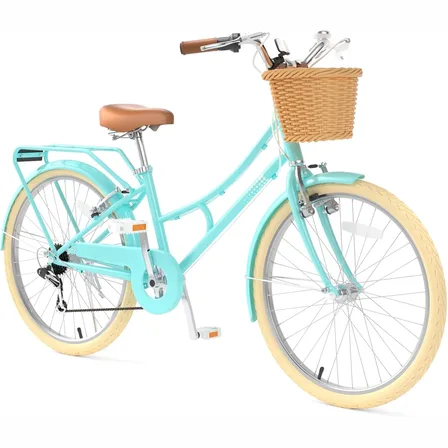
XJD 24-Inch Green Beach Cruiser Bike with U-Brake
This XJD 24-inch beach cruiser in green is made for riders about 4'8" to 5'4" ta…$159.99
$199.99 -
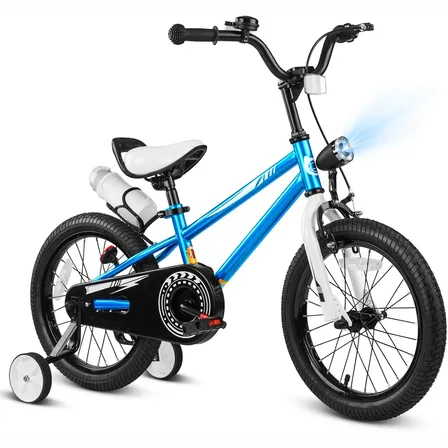
XJD Boys 12/14/16" Training Wheel Bike – Blue
The XJD Boys Bike in Blue is a training wheel bike for riders 71–122 cm tall—rou…$169
$199