

What size bike does a 6 year old ride
Most 6-year-olds should start by trying a 16-inch bike, but height and inseam decide the fit. Measure the child, then confirm stand-over clearance, reach, brake control and confidence on the actual bicycle.
Which wheel size should a 6-year-old try?
Using the XBikes starting points, a 16-inch bike covers ages 4–7 and rider heights of 40–48 inches (102–122 cm). That makes it the most direct starting point for many 6-year-olds—not an automatic answer for every child.
A shorter 6-year-old may still fit a 14-inch bike, whose starting range is ages 3–6 and 37–45 inches (94–114 cm). A taller child may need to compare an 18-inch bike, covering ages 5–9 and 43–52 inches (109–132 cm). These ranges overlap because body proportions, skill and bicycle geometry vary.
| Wheel size | XBikes age starting point | Rider-height starting point | Relevance at age 6 |
|---|---|---|---|
| 14 Inch | Ages 3–6 | 37–45 in / 94–114 cm | Compare for a shorter rider |
| 16 Inch | Ages 4–7 | 40–48 in / 102–122 cm | Usual first size to try |
| 18 Inch | Ages 5–9 | 43–52 in / 109–132 cm | Compare for a taller rider |
Do not move to a 20-inch bike merely because the child is nearly seven. The XBikes 20-inch starting point is ages 7–12 and 48–60 inches (122–152 cm), and the child must still pass an individual fit check.
Measure before choosing
- Measure standing height: Have the child stand without shoes, back straight against a wall. Mark the top of the head and measure from the floor.
- Measure inseam: With feet slightly apart, place a firm, thin book between the legs and raise it gently to simulate the saddle contact point. Measure from the floor to the book’s top edge.
- Compare height first: Use the table to identify the likely wheel sizes. Age only narrows the search; it does not prove fit.
- Try the actual bicycle: Frame shape, saddle adjustment and handlebar position can make two bicycles with the same wheel label fit differently.
Record both measurements in inches or centimetres before shopping. The inseam is especially useful during a physical fit check, even though the supplied XBikes standard does not assign numerical inseam ranges to wheel sizes.
What a successful fit check looks like
Ask the child to straddle the bicycle while standing over the frame. There should be usable clearance rather than contact with the frame. Then seat the child and check that the handlebars can be reached without an extreme stretch or a cramped posture.
The child should be able to steer smoothly, operate the brakes within comfortable reach and remain in control while starting, turning and stopping. Current confidence matters: a size that technically matches height can still be unsuitable if the bicycle feels difficult to balance or control.
Have the child try the bike whenever possible. Do not buy an oversized bicycle solely to provide growing room. If the child cannot stand over it comfortably, reach its controls or use its brakes reliably, choose another fit even when the age label appears suitable.
How the supplied XBikes options compare
The two catalog options are relevant because both offer 14-inch and 16-inch size labels—the principal comparison sizes for many 6-year-olds—and both are categorized as Training Wheel Bikes. One also offers a 20-inch label, but that larger option should be considered only when the child’s measurements and hands-on control support it.
 Light Pink XJD Girls' Bicycle with Basket & Training Wheels
Available in 12-, 14-, 16- and 20-inch labels. Its 14- and 16-inch options are relevant comparison points for a 6-year-old after measurement and an individual fit check.
 Blue XJD Girls Bike with Training Wheels – 12/14/16 Inch
Available in 12-, 14- and 16-inch labels and categorized as a Training Wheel Bike. The 14- and 16-inch options support a direct size comparison for this age.
Light Pink XJD Girls' Bicycle with Basket & Training Wheels is listed with 12-inch, 14-inch, 16-inch and 20-inch options. For this question, its 14-inch and 16-inch labels are the useful comparison points. Its 20-inch option is not equivalent to a 16-inch fit and should not be selected simply for future growth.
Blue XJD Girls Bike with Training Wheels – 12/14/16 Inch is listed in 12-inch, 14-inch and 16-inch options. Its 14-inch and 16-inch labels let a parent compare the two likely sizes when a 6-year-old falls within their overlapping height ranges.
Neither supplied product has an 18-inch option. If the child’s measured height points toward 18 inches, these products are smaller-size comparison points, not substitutes for an 18-inch bicycle. Training wheels are a catalog feature of both products, but their presence does not replace checking fit, reach, braking and the child’s present confidence.
Before the first ride
Use a bicycle helmet that fits properly, sits level and has its straps adjusted according to the helmet manufacturer’s instructions. Recheck bicycle fit after saddle adjustments and as the child grows.
For assembly, maintenance, load limits, compatibility and torque requirements, follow the exact product manual or ask a qualified bicycle mechanic; those details cannot be determined from wheel size alone.
For a 6-year-old, measure first and try a 16-inch bike first when height is 40–48 inches (102–122 cm). Compare 14 inches for a shorter rider or 18 inches for a taller rider, then choose only the bicycle the child can straddle, reach, brake and control confidently now.
Bikes for your next adventure
-

Light Purple XJD Toddler Bike Helmet, Adjustable, Size XS (46–51 cm)
This Light Purple XJD toddler bike helmet is made for the smallest riders — the …$20.39
-
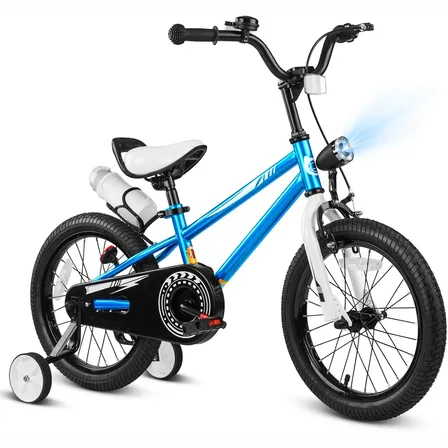
XJD Boys 12/14/16" Training Wheel Bike – Blue
The XJD Boys Bike in Blue is a training wheel bike for riders 71–122 cm tall—rou…$169
$199 -
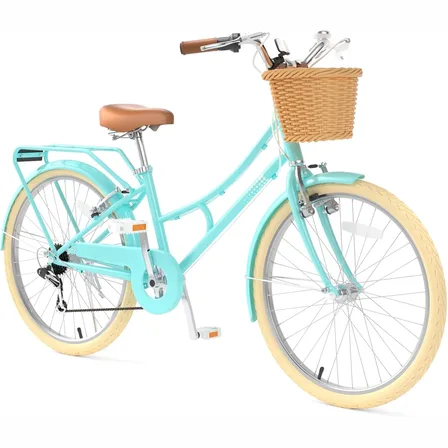
XJD 24-Inch Green Beach Cruiser Bike with U-Brake
This XJD 24-inch beach cruiser in green is made for riders about 4'8" to 5'4" ta…$159.99
$199.99