

What size bike does a 6 year old use
Most 6-year-olds should compare 16-inch and 18-inch bikes first, but measured height and an in-person fit—not age alone—should decide the size.
Which wheel size should you check?
Use the XBikes chart as a starting point. A 16-inch bike covers ages 4–7 and rider heights of 40–48 in (102–122 cm). An 18-inch bike covers ages 5–9 and heights of 43–52 in (109–132 cm). These overlapping ranges are why age cannot provide one automatic answer.
| Wheel size | XBikes starting age | Rider height | Relevance at age 6 |
|---|---|---|---|
| 14 Inch | 3–6 | 37–45 in / 94–114 cm | Check for a shorter rider whose measurements and control suit it. |
| 16 Inch | 4–7 | 40–48 in / 102–122 cm | A common comparison point for this age. |
| 18 Inch | 5–9 | 43–52 in / 109–132 cm | Compare when the child is tall enough and can control it confidently. |
| 20 Inch | 7–12 | 48–60 in / 122–152 cm | Consider only when height and an individual fit check support it. |
A 12-inch bike is an XBikes starting point for ages 3–4 and heights of 34–40 in (86–102 cm), so it is generally not the first comparison for a 6-year-old. Do not move up a size merely to allow room for growth.
Measure height and inseam before choosing
Measure the child without guessing from clothing size or age. For height, have the child stand straight against a wall without shoes and measure from the floor to the top of the head. Compare that result with the height ranges above.
For inseam, have the child stand upright with feet slightly apart. Measure from the floor to the crotch, using the footwear normally worn for riding if that matches how the bicycle will be tried. Inseam helps evaluate stand-over fit, but the supplied catalog details do not include bicycle geometry. Compare the measurement with the exact manufacturer information or try the bicycle directly.
Check the bike with the child on it
After narrowing the choice by height, have the child try each candidate size. The child should be able to stand over the frame without being pressed against it, get on and off without struggling, and sit in a position that does not require an uncomfortable stretch to the handlebar.
Ask the child to demonstrate steering and stopping in a controlled area. Check that the brake controls can be reached and operated reliably, and watch whether starts, turns and stops look controlled rather than hesitant. Current confidence matters: two children of equal height may be better served by different sizes because their reach and bike-handling ability differ.
If the larger bicycle compromises stand-over room, reach, braking or control, it is oversized even if its height range appears plausible. The American Academy of Pediatrics guidance supports trying the bicycle and avoiding an oversized purchase intended only for future growth.
How the supplied 12, 14 and 16-inch options help
The supplied catalog choices are useful when the fit check points toward 14 or 16 inches, or when a parent wants to compare those adjacent sizes. Blue XJD Girls Bike with Training Wheels – 12/14/16 Inch, XJD Boys 12/14/16" Training Wheel Bike – Blue, and XJD Kids' Training Wheel Bike for Boys & Girls, 12/14/16 Inch – White are all categorized as Training Wheel Bikes and list 12 Inch, 14 Inch and 16 Inch SKU labels.
These products can therefore provide same-model size comparisons within their listed range. They do not provide an 18-inch or 20-inch option, so they are not substitutes when the child’s measurements and trial indicate either of those wheel sizes.
 Blue XJD Girls Bike with Training Wheels – 12/14/16 Inch
Available in 12, 14 and 16 Inch labels. This Training Wheel Bike is relevant when the child’s measurements and individual fit check support 14 or 16 inches.
 XJD Boys 12/14/16" Training Wheel Bike – Blue
This blue Training Wheel Bike lists 12, 14 and 16 Inch options, allowing comparison of the smaller supplied sizes when measured height, reach and control support them.
 XJD Kids' Training Wheel Bike for Boys & Girls, 12/14/16 Inch – White
This white boys-and-girls Training Wheel Bike has 12, 14 and 16 Inch labels. Consider it only if the child’s height and hands-on fit check point to one of those sizes.
The exact titles distinguish blue, white, girls, boys, or boys-and-girls catalog presentations, but those words do not establish fit. Choose among the available SKU labels only after checking the child’s measured height, inseam, reach, brake control and confidence. Confirm assembly, adjustments, maintenance, load limits and any technical procedures in the exact product manual or with a qualified bicycle mechanic.
Make the final decision
- Measure the child’s height and inseam.
- Use the chart to shortlist 14, 16, 18 or, for a sufficiently tall rider, 20 inches.
- Have the child try the shortlisted sizes and reject any bike that impairs stand-over position, reach, braking or confident control.
- Choose the size that fits now rather than an oversized bicycle intended for later growth.
Before riding, add a properly fitting bicycle helmet. It should sit level and its straps should be adjusted according to the helmet manufacturer’s instructions. For a 6-year-old, begin with 16 and 18 inches unless the measured height points elsewhere, then let the hands-on fit check settle the choice.
Bikes for your next adventure
-

Light Purple XJD Toddler Bike Helmet, Adjustable, Size XS (46–51 cm)
This Light Purple XJD toddler bike helmet is made for the smallest riders — the …$20.39
-

XJD Boys 12/14/16" Training Wheel Bike – Blue
The XJD Boys Bike in Blue is a training wheel bike for riders 71–122 cm tall—rou…$169
$199 -
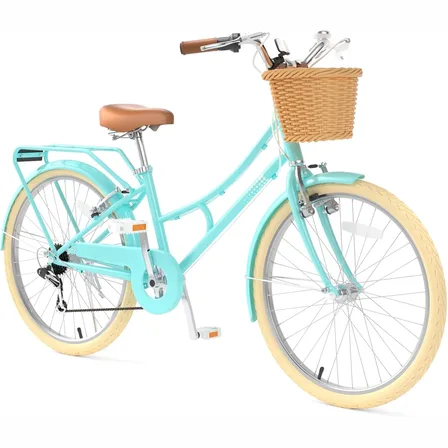
XJD 24-Inch Green Beach Cruiser Bike with U-Brake
This XJD 24-inch beach cruiser in green is made for riders about 4'8" to 5'4" ta…$159.99
$199.99