

What size bike does my 12 year old need
Most 12-year-olds should start by comparing a 20-inch or 24-inch bike, but height and fit decide: measure your child before choosing.
Start with height, not the birthday
Ask your child to stand straight without shoes against a wall, with feet flat and together. Mark the top of the head, then measure from the floor to the mark. Compare that result with the XBikes starting points below.
| Wheel size | Rider-height starting point | Age starting point |
|---|---|---|
| 20 Inch | 48–60 in / 122–152 cm | Ages 7–12 |
| 24 Inch | 54–64 in / 137–163 cm | Ages 10–14 |
| 26 Inch | Over 60 in / 153 cm | Youth and adults |
A 12-year-old measuring 54–60 inches falls within both the 20-inch and 24-inch starting ranges. That overlap does not make the sizes equivalent. Try both and choose according to stand-over clearance, reach, brake control and confidence. A rider over 60 inches can begin comparing 26-inch bikes, while a rider below 54 inches may still fit a 20-inch bike better.
Measure inseam for the fit check
Height narrows the search; inseam helps determine whether the child can stand over a particular frame. Have the rider stand without shoes, feet slightly apart, with a firm book raised between the legs to imitate a saddle. Measure vertically from the floor to the top edge of the book.
Do not convert that measurement into a wheel size with an invented formula. Frame shapes and proportions vary even when wheel labels match. Instead, take the height and inseam measurements to the exact bicycle and have the child try it.
What the child should be able to do
During the trial, check the whole riding position rather than accepting the wheel label alone:
- Stand over the frame: the child should be able to straddle it without being pressed against the top tube.
- Reach comfortably: hands should meet the controls without an extreme stretch or a cramped posture.
- Control the brakes: the rider should be able to reach and operate the brake controls reliably.
- Start, steer and stop: movements should look controlled at low speed, not like the child is fighting the bike.
- Feel confident: hesitation caused by excessive size is evidence that a smaller option deserves comparison.
Do not buy an oversized bicycle merely to leave growing room. A bike that is difficult to stand over, steer or stop is not a suitable present fit.
How the supplied XBikes option is relevant
The XJD Kids Bike for Girls – Pink, 12/14/16/20 Inch with Training Wheels is offered in 12-inch, 14-inch, 16-inch and 20-inch SKU labels. For this question, only its 20-inch option is a plausible comparison for a 12-year-old whose measured height remains within the 48–60 inch / 122–152 cm starting range. Its smaller options correspond to shorter-rider starting ranges and should not be selected just because they appear under the same product title.
These catalog options help show whether the child is still within the 20-inch range, but the product does not include a 24-inch or 26-inch SKU. It is therefore a comparison point—not a substitute—when measurements and an individual trial indicate that 24 or 26 inches should be considered.

The words “Kids Bike” in the title are a catalog label, not proof of fit for a particular 12-year-old. Confirm the chosen SKU and actual fit before ordering. For assembly, adjustments, compatibility, load limits, maintenance and torque requirements, follow the exact product manual or ask a qualified bicycle mechanic.
Finish the decision in three steps
- Record the child’s barefoot height and inseam in inches or centimetres.
- Use height to shortlist 20, 24 or 26 inches from the table, including both sizes when the ranges overlap.
- Have the child try each shortlisted bicycle and reject any option that compromises stand-over clearance, reach, brake operation or controlled riding.
Add a properly fitting bicycle helmet. It should sit level and be secured with its straps according to the helmet manufacturer’s instructions; an unsuitable bike cannot be corrected by helmet choice.
For your 12-year-old, measure first: compare 20 and 24 inches when height falls in their overlap, consider 26 inches above 60 inches, and choose only the bike the child can confidently stand over, reach, brake and control today.
Bikes for your next adventure
-
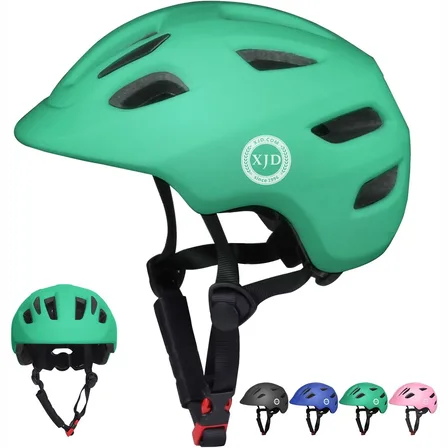
Green XJD Toddler Bike Helmet with Adjustable Fit, XS (46–51 cm)
The XJD toddler bike helmet in Green is built for the youngest riders — the size…$20.39
$23.99 -

Kids Bike Helmet by XJD for Boys & Girls – Black, Blue, Green, Pink, Purple
The XJD Kids Bike Helmet covers a wide 2-to-8-year age range thanks to two head-…$59.99
-

Kids Bike Helmet by XJD for Girls – Pink
The XJD Kids Bike Helmet in Pink is a lightweight multi-sport helmet for girls r…$59.99
$99