

What size bike for 11 year old
Most 11-year-olds should start by trying a 24-inch bike. Measure the child first: a 20-inch may fit at 48–60 in, while 26-inch options begin over 60 in.
Choose the starting wheel size from measured height
Age narrows the search, but it does not establish fit. In the XBikes starting points, a 24-inch bike covers ages 10–14 and rider heights of 54–64 in (137–163 cm), making it the usual first comparison for an 11-year-old.
A shorter 11-year-old may still need a 20-inch bike, whose starting range is ages 7–12 and 48–60 in (122–152 cm). Riders over 60 in (153 cm) may compare 26-inch bikes, but the overlap between ranges is not permission to select the larger wheel automatically. The child must be able to stand over, steer and stop the actual bicycle confidently.
| Measured rider height | Size to try | What it means |
|---|---|---|
| 48–54 in (122–137 cm) | 20 Inch | The 20-inch range applies; 24 inches has not yet reached its height starting point. |
| 54–60 in (137–152 cm) | 24 Inch | This falls within the 24-inch starting range. |
| Over 60 in (153 cm), up to 64 in (163 cm) | Compare 24 and 26 Inch | Use an individual fit check to resolve the overlap. |
Measure before comparing bikes
Measure height without shoes, with the child standing straight against a wall. Then measure inseam from the floor to the crotch while the child stands naturally. Wheel-size ranges use height here, while inseam helps you judge stand-over clearance on the particular frame.
Write down both measurements rather than relying on clothing size, a previous bicycle or a birthday. Frame shapes can differ even when wheel labels match, so the same child should try each candidate instead of treating “24 Inch” as a complete fit specification.
Check the actual fit and controls
Have the child try the assembled bicycle. The American Academy of Pediatrics advises against buying an oversized bicycle merely to allow room for growth. During the check, confirm that the rider can:
- stand over the frame without being forced onto tiptoes or against the frame;
- sit in a stable riding position and reach the handlebars without an excessive stretch;
- turn the bars while remaining balanced and in control;
- reach and operate the brakes reliably with their hands;
- start, stop and put a foot down without panic or a sudden loss of balance.
Current confidence matters alongside body measurements. If the larger option makes steering, mounting or braking uncertain, it is not the right choice today, even if the child is near the top of a smaller size range.
How the supplied XBikes options help
The catalog includes 20-, 24- and 26-inch comparison options relevant to the height ranges around age 11. They help you compare the likely size and its neighboring sizes, but each still requires an in-person stand-over, reach and brake-control check.
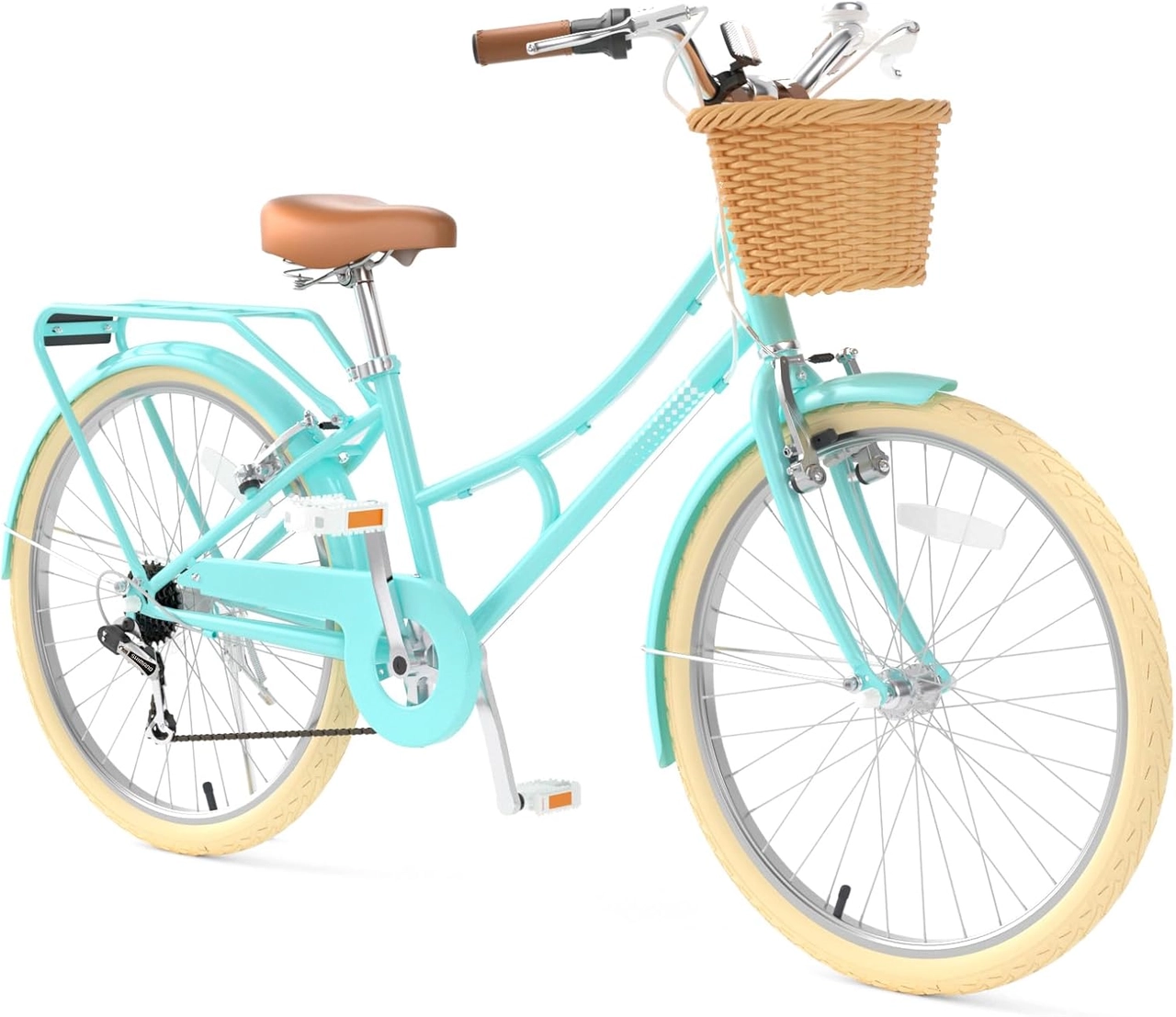 XJD 24-Inch Green Beach Cruiser Bike with U-Brake
A 24-inch catalog option matching the usual starting size for many 11-year-olds, with a Pink / 26 Inch SKU available for taller riders to compare after measuring and checking fit.
 Pink XJD Beach Cruiser Bike, 24"/26", U-Brake
Its 24 Inch and 26 Inch SKU labels make this a relevant comparison for riders over 60 inches, where the supplied height ranges overlap and an individual fit check must decide.
 Light Pink XJD Girls' Bicycle with Basket & Training Wheels
The 20 Inch SKU is relevant for a shorter 11-year-old within the supplied 48–60 inch height range; the listed 12-, 14- and 16-inch options are not the pertinent comparison here.
XJD 24-Inch Green Beach Cruiser Bike with U-Brake has Green / 24 Inch, Pink / 24 Inch and Pink / 26 Inch SKU labels. Its 24-inch choices match the usual starting point for many 11-year-olds; the Pink / 26 Inch option is relevant only for a rider over 60 in who can control that exact bike.
Pink XJD Beach Cruiser Bike, 24"/26", U-Brake is offered with 24 Inch and 26 Inch SKU labels. That makes it useful when a rider over 60 in falls into the overlap and needs to compare two distinct wheel sizes. Do not assume the 26-inch version provides the same fit as the 24-inch version.
Light Pink XJD Girls' Bicycle with Basket & Training Wheels has 12 Inch, 14 Inch, 16 Inch and 20 Inch SKU labels. For this question, only its 20 Inch option is a relevant comparison, and only when the 11-year-old measures within the 20-inch height range and passes the individual fit check. Its smaller listed sizes fall below the supplied height starting points relevant here.
Complete the decision safely
First choose the size bracket from measured height: normally 24 Inch at 54–64 in, 20 Inch for an 11-year-old within 48–60 in, or a 24-versus-26 comparison above 60 in. Next, reject any bicycle that compromises stand-over room, reach, braking or confident handling.
Use a properly fitting bicycle helmet that sits level, with straps adjusted according to its manufacturer’s instructions. Follow the exact bicycle manual for assembly, maintenance, compatibility, load limits and torque information not provided here, or ask a qualified bicycle mechanic.
The practical answer is therefore: measure the 11-year-old today, begin with 24 Inch if they are at least 54 in tall, and move to a neighboring size only when both the height range and the hands-on fit check support it.
Bikes for your next adventure
-

Light Purple XJD Toddler Bike Helmet, Adjustable, Size XS (46–51 cm)
This Light Purple XJD toddler bike helmet is made for the smallest riders — the …$20.39
-

Black XJD Toddler Bike Helmet, Adjustable – Kids' Protective Helmet
The XJD Toddler Bike Helmet in black is an adjustable protective helmet for kids…$20.39
-

XJD Girls Bike for Kids Ages 3-8, 12/14/16 Inch with Training Wheels – Purple
The XJD Girls Bike in Purple is a training-wheel bicycle for kids ages 3 to 8, f…$149
$169