

What size bike for 43 inch child
A 43-inch child should start by comparing 14-, 16-, and 18-inch bikes. Height fits all three XBikes ranges, so measure inseam and check control before choosing.
Why 43 inches does not give one automatic size
At 43 inches (about 109 cm), the child falls within three overlapping XBikes starting ranges: 14 Inch covers 37–45 inches, 16 Inch covers 40–48 inches, and 18 Inch covers 43–52 inches. That makes 16 Inch a sensible middle comparison, but it does not make it the correct size without an individual fit check.
Age is secondary. The XBikes age starting points are 3–6 for 14 Inch, 4–7 for 16 Inch, and 5–9 for 18 Inch, but children of the same age can differ substantially in leg length, reach, coordination, and confidence. Use measured height to narrow the choices, then let actual control decide.
Measure the child before shopping
Confirm height without shoes, standing straight against a wall. Then measure inseam: have the child stand with feet slightly apart and measure from the floor to the crotch. Keep both measurements available when checking the bicycle maker’s fit information.
Inseam matters because two children who are both 43 inches tall may have different stand-over clearance. The child should be able to straddle the bike without the frame pressing into the body. Follow the exact product manual for its fit and adjustment instructions; if those instructions are unclear, use a qualified bicycle mechanic.
Compare the overlapping wheel sizes
| Wheel size | XBikes starting range | What it means at 43 inches |
|---|---|---|
| 14 Inch | Ages 3–6; 37–45 in / 94–114 cm | Within the height range; compare if the child needs a smaller, easier-to-manage fit. |
| 16 Inch | Ages 4–7; 40–48 in / 102–122 cm | Within the height range and a useful middle comparison. |
| 18 Inch | Ages 5–9; 43–52 in / 109–132 cm | At the very bottom of the range; consider only if stand-over, reach, braking, and control all work now. |
A 12 Inch bike starts at 34–40 inches, so a 43-inch child is above that height range. A 20 Inch bike starts at 48 inches, so it is not the indicated starting point. Do not buy a larger bicycle merely to leave room for growth; an oversized bike can make starting, stopping, steering, and braking harder.
Perform a hands-on fit check
Have the child try each serious candidate rather than choosing from wheel size alone. Check these points with the seat and controls adjusted only as permitted by the product manual:
- Stand-over: The child can straddle the bicycle comfortably and get on and off without struggling.
- Reach: The child can hold the handlebars without stretching, locking the elbows, or leaning excessively.
- Brake control: If the bicycle has hand-operated controls, the child can reach and operate them reliably. Confirm the actual control setup on the specific bike.
- Starting and stopping: The child can begin, steer, slow, stop, and put a foot down with control.
- Confidence: The bike does not intimidate the rider or force awkward movements.
If the 18 Inch option technically allows stand-over but the child struggles to steer or stop, move down for comparison. If a 14 Inch option feels cramped or restricts comfortable movement, compare the 16 Inch. The correct choice is the one the child controls now.
How the supplied catalog option helps
The Blue XJD Girls Bike with Training Wheels – 12/14/16 Inch is listed in the Training Wheel Bikes category and has 12 Inch, 14 Inch, and 16 Inch SKU labels. For a 43-inch child, its 14- and 16-inch versions provide two relevant comparison points within the supplied height ranges; the 12-inch version is below the starting height range for this rider.

This catalog option does not include an 18 Inch SKU label, even though 18 Inch begins at 43 inches in the XBikes standard. Its 14- and 16-inch choices should therefore be compared on their own fit and control, not treated as equivalent to an 18-inch bicycle. Training wheels may also be relevant only if they match the child’s present riding needs; their presence does not replace a proper size check.
Make the final decision
Bring the child to the fit check wearing the shoes normally used for riding. Compare 14 and 16 Inch first, and add an 18 Inch comparison only if the child can comfortably straddle it, reach its controls, steer, brake, start, and stop without strain. Do not approve a size based solely on age, appearance, or expected growth.
Before riding, use a properly fitting bicycle helmet. It should sit level, and its straps should be used according to the helmet manufacturer’s instructions. Follow the bicycle’s exact manual for assembly, maintenance, adjustments, compatibility, load limits, and torque; use a qualified bicycle mechanic when necessary.
For a child measured at exactly 43 inches, choose the smallest of the suitable 14-, 16-, or 18-inch candidates that provides comfortable stand-over and complete, confident control today.
Bikes for your next adventure
-

Flower Pink XJD Girls Bike with Doll Seat & Basket
The XJD Flower Pink girls' bike is made for riders 71–122 cm tall (roughly ages …$69.99
-
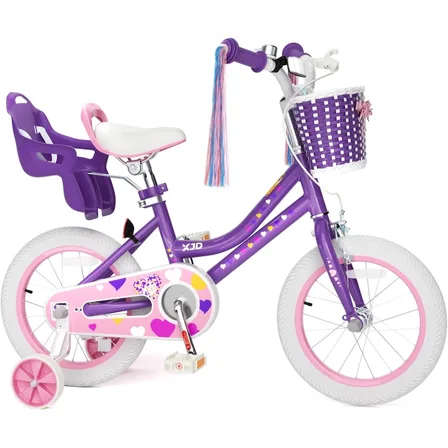
Purple XJD Girls' Bike with Doll Seat & Basket
For girls 71–122 cm tall (about ages 3–7), this XJD girls' bike in Purple pairs …$75.99
$99.99 -

Pink Girls' 12/14/16" Bike by XJD – Basket & Doll Seat
The XJD Pink Girls' Bike with Basket & Doll Seat is made for riders 71–122 cm ta…$75.99
$99.99