

What size bike for 34 child
If “34 child” means a 3–4-year-old, start by comparing a 12-inch and 14-inch bike. If it means a child who is 34 inches tall, XBikes’ starting point is a 12-inch bike. In either case, measure the child and confirm the fit in person before choosing.
Choose between 12 and 14 inches
Age gives you a place to begin, but height separates the likely choices. The XBikes starting ranges overlap intentionally: a 12-inch bike covers ages 3–4 and heights of 34–40 inches, while a 14-inch bike covers ages 3–6 and heights of 37–45 inches.
| Wheel size | XBikes age starting point | Rider-height starting point |
|---|---|---|
| 12 Inch | Ages 3–4 | 34–40 in / 86–102 cm |
| 14 Inch | Ages 3–6 | 37–45 in / 94–114 cm |
A child under 37 inches falls only within the supplied 12-inch height range. From 37 to 40 inches, compare both sizes through an individual fit check. From 41 to 45 inches, the supplied starting points favor 14 inches. These ranges narrow the search; they do not prove that a particular frame will fit.
Measure before comparing bikes
Measure the child’s height without shoes, standing straight against a wall. Then measure inseam from the floor to the crotch using the same posture. Height can be compared with the XBikes ranges above; inseam is needed to judge clearance on the actual bicycle.
Bring both measurements when shopping, but have the child try the bicycle whenever possible. Frame shapes vary even when wheel labels match. Do not select a larger bike simply to allow room for growth; a bike that is difficult to mount, stop or steer is not an appropriate current fit.
Run this fit check
- Stand-over: Have the child straddle the bicycle with feet on the ground. Check for comfortable clearance rather than contact with the frame.
- Starting and stopping: The child should be able to get on, start and put a foot down without struggling or tipping sharply.
- Reach: While seated, the child should reach the handlebar without stretching, locking the arms or losing a stable posture.
- Brake control: If the bicycle has hand brakes, confirm that the child can reach and operate them with control. A brake type named in a product title does not establish that its levers fit this child’s hands.
- Confidence: Watch for controlled turns and stops. Current ability matters alongside body measurements.
If the child cannot complete these checks comfortably, reject that fit even if age and height appear to match the chart.
How the supplied XBikes options relate
Two supplied models provide both 12-inch and 14-inch SKU labels, making them relevant comparison points for this question. The third starts at 20 inches, so it helps show where the likely choice should not jump based on age alone.
The catalog options below help compare the relevant 12- and 14-inch labels with a clearly larger starting option; the child’s measurements and trial fit must still decide the size.
 XJD Light Purple Girls Bike with Basket, Training Wheels, 12/14/16/20 Inch
Available in 12 Inch, 14 Inch and 16 Inch labels; its two smaller sizes are relevant comparison options for a measured child near the supplied 12- and 14-inch ranges.
 XJD Kids Beach Cruiser Bicycle, Rear Rack & V-Brakes, Mint Green
Its available 20 Inch, 24 Inch and 26 Inch labels are larger comparison points, not substitutes for a child whose measurements indicate a 12- or 14-inch bike.
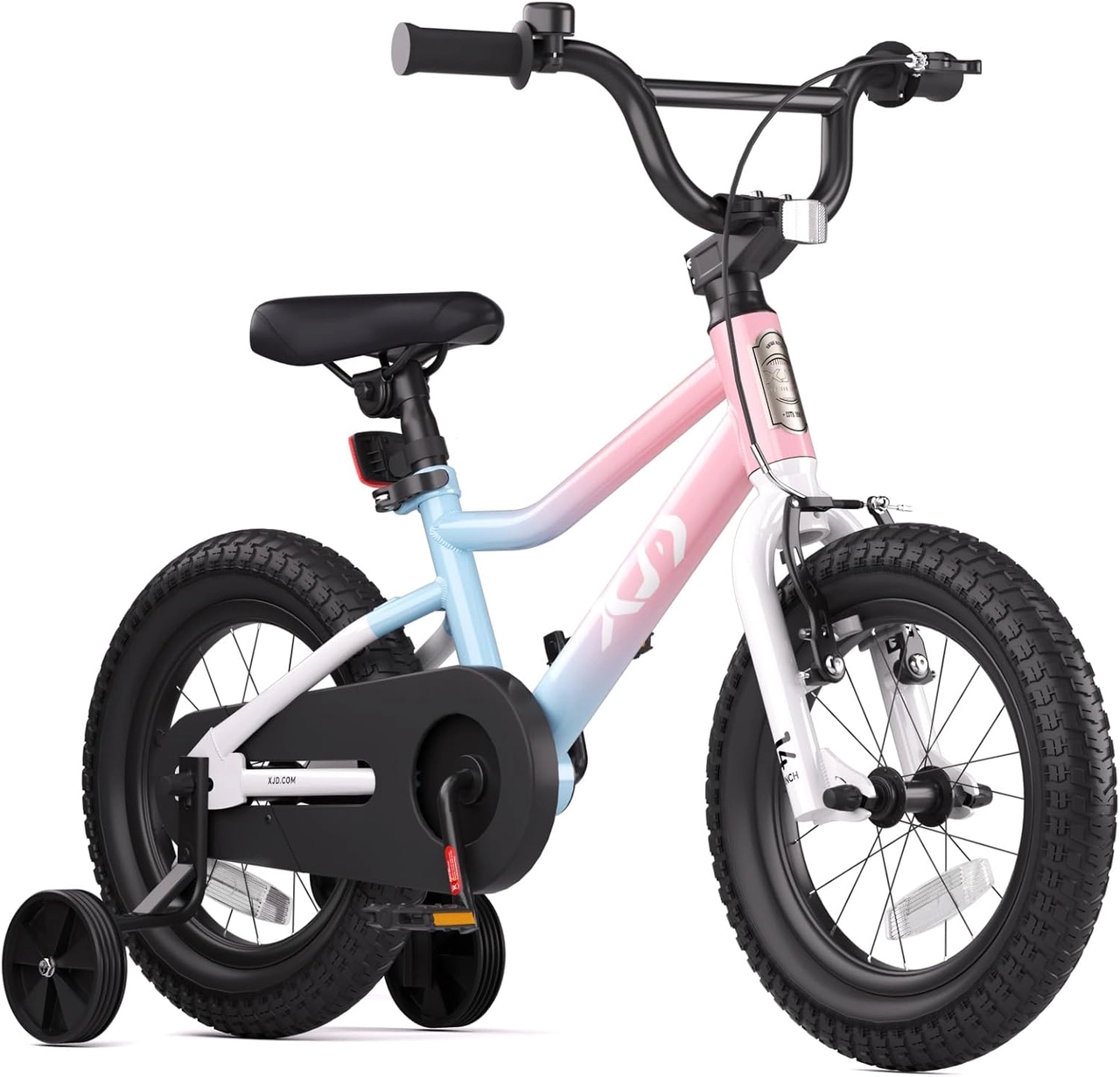 XJD Girls BMX Bike 12/14/16 Inch with Training Wheels – Pink Blue
Available with 12 Inch, 14 Inch and 16 Inch labels, allowing parents to compare the two likely wheel-size starting points while still checking individual fit and control.
Relevant 12- and 14-inch choices
XJD Light Purple Girls Bike with Basket, Training Wheels, 12/14/16/20 Inch is supplied here with available SKU labels of 12 Inch, 14 Inch and 16 Inch. Its 12- and 14-inch versions are the relevant ones to compare for a 3–4-year-old or a rider near 34 inches tall.
XJD Girls BMX Bike 12/14/16 Inch with Training Wheels – Pink Blue likewise has supplied 12 Inch, 14 Inch and 16 Inch SKU labels. Compare only the 12- and 14-inch versions for the measurements discussed here; the shared wheel label does not guarantee the same stand-over or reach as another model.
A larger option that is usually not relevant
XJD Kids Beach Cruiser Bicycle, Rear Rack & V-Brakes, Mint Green is supplied in 20 Inch, 24 Inch and 26 Inch labels. Under the XBikes starting points, 20 inches begins at ages 7–12 and 48–60 inches in height. It is therefore not a substitute for a 12- or 14-inch bike for the stated child unless new measurements place the rider in that larger range and a fit check confirms control.
Make the final decision
For a child exactly 34 inches tall, try a 12-inch bike first. For a 3–4-year-old who is 37–40 inches tall, compare 12 and 14 inches side by side and choose only after checking clearance, reach, braking and confidence. Follow the exact product manual or ask a qualified bicycle mechanic about assembly, adjustment, compatibility, maintenance or torque.
Finish by fitting a bicycle helmet: it should fit properly, sit level and have its straps used according to the helmet manufacturer’s instructions. Choose the bike the child can control now—not the larger one you hope they will grow into.
Bikes for your next adventure
-

Light Pink XJD Girls' Bicycle with Basket & Training Wheels
The Light Pink XJD Girls' Bicycle with Basket & Training Wheels is a retro-style…$109.99
$129.99 -

XJD Kids Bike for Girls – Pink, 12/14/16/20 Inch with Training Wheels
The XJD Kids Bike for Girls in Pink is a training-wheel bike built to carry your…$139
$159 -

XJD Girls Bike for Kids Ages 3-8, 12/14/16 Inch with Training Wheels – Purple
The XJD Girls Bike in Purple is a training-wheel bicycle for kids ages 3 to 8, f…$149
$169