

What size bike for 6 yr old
For most 6-year-olds, start by comparing a 14-, 16- and 18-inch bike, with 16 inches often matching the age range. Measure first: height, inseam, reach and control decide the fit—not age alone.
Which wheel size should you check?
XBikes uses wheel-size ranges as starting points, not guarantees. A 6-year-old may overlap several sizes because children of the same age can differ greatly in height, proportions and riding confidence.
| Wheel size | XBikes age starting point | Rider-height starting point |
|---|---|---|
| 14 Inch | Ages 3–6 | 37–45 in / 94–114 cm |
| 16 Inch | Ages 4–7 | 40–48 in / 102–122 cm |
| 18 Inch | Ages 5–9 | 43–52 in / 109–132 cm |
| 20 Inch | Ages 7–12 | 48–60 in / 122–152 cm |
Begin with the row containing the child's measured height. If the measurement falls in an overlap, compare both sizes in person. A 20-inch bike is not automatically suitable simply because the child is nearly seven; its XBikes starting range begins at age seven and 48 inches / 122 cm.
Measure the child before shopping
- Height: Have the child stand straight without shoes against a wall. Measure from the floor to the top of the head, then compare that result with the table.
- Inseam: With feet slightly apart, measure from the floor to the crotch. Use this measurement during an actual stand-over check rather than trying to convert it into a wheel size with an unsupported formula.
- Reach and hands: Note whether the child can sit naturally, steer without stretching and comfortably operate the fitted brakes.
- Confidence: Consider whether the rider starts, stops, turns and balances independently or still needs extra support.
Record the measurements instead of relying on clothing size, another child's bike or age printed in a listing.
Do a real fit check
The American Academy of Pediatrics' HealthyChildren guidance supports having the child try the bicycle and avoiding an oversized bike bought mainly for growth. With the bicycle upright, check that the child can stand over it appropriately, get on and off without struggling, and remain in control.
On the seat, the rider should reach the handlebars without an awkward forward stretch. Have the child demonstrate steering, starting and stopping in a controlled setting. Confirm that the fitted brake controls are within comfortable reach and can be operated reliably. If the child looks tense, cannot manage the controls or needs to lean excessively, try a different size or setup.
Do not assume that lowering a seat makes an oversized frame suitable. Wheel size is only one part of fit, and frame dimensions can vary. Follow the exact product manual for permitted adjustments and assembly, or ask a qualified bicycle mechanic when the setup is unclear.
How the supplied XBikes options compare
The catalog choices provide practical 14-, 16- and 20-inch comparison points around this age. They help you compare overlapping sizes after measuring, although neither supplied product offers an 18-inch option; the available sizes are not substitutes for an 18-inch bike when that is the size that fits.
 XJD Boys & Girls BMX Bike with Training Wheels, 12/14/16" – Blue
Offers 12 Inch, 14 Inch and 16 Inch SKU labels. Its 14- and 16-inch options are useful fit-check comparisons for a 6-year-old after measuring height, inseam, reach and control.
 Girls' Training Wheel Bike by XJD with Basket – Purple
Offers 14 Inch, 16 Inch and 20 Inch SKU labels. The smaller two are common comparison points at age six; consider 20 Inch only when the supplied height starting point and individual fit checks support it.
XJD Boys & Girls BMX Bike with Training Wheels, 12/14/16" – Blue is listed in Kids' BMX Bikes with 12 Inch, 14 Inch and 16 Inch SKU labels. For a typical size comparison at age six, its 14- and 16-inch versions are the relevant options to fit-check. The 12-inch starting range is ages 3–4 and 34–40 in / 86–102 cm, so it will generally be relevant only if the child's measured height falls within that range and the complete fit check works.
Girls' Training Wheel Bike by XJD with Basket – Purple is listed in Training Wheel Bikes with 14 Inch, 16 Inch and 20 Inch SKU labels. Its 14- and 16-inch versions cover common comparison points for a six-year-old. Consider its 20-inch version only when the rider's measured height reaches the XBikes starting range of 48–60 in / 122–152 cm and the child can comfortably manage stand-over, reach, braking and control.
The product names and category labels do not prove an individual fit. Confirm the exact selected SKU label before comparing it with the child's measurements.
Finish the decision safely
Once a size passes the stationary checks, let the child try it in a controlled area with close adult supervision. Recheck mounting, turning, braking and stopping rather than judging fit from appearance alone.
A bicycle helmet is essential, but its fit is separate from bicycle sizing. U.S. Consumer Product Safety Commission guidance says the helmet should fit properly, sit level and have its straps used according to the manufacturer's instructions.
For this 6-year-old, measure height and inseam now, shortlist the matching 14-, 16- or 18-inch starting range, and choose only after the child proves comfortable reach, brake operation and control. If 18 inches fits, look for that exact size rather than treating one of the supplied 16- or 20-inch options as equivalent.
Bikes for your next adventure
-

XJD Girls Bike for Kids Ages 3-8, 12/14/16 Inch with Training Wheels – Purple
The XJD Girls Bike in Purple is a training-wheel bicycle for kids ages 3 to 8, f…$149
$169 -

Pink Girls' 12/14/16" Bike by XJD – Basket & Doll Seat
The XJD Pink Girls' Bike with Basket & Doll Seat is made for riders 71–122 cm ta…$75.99
$99.99 -
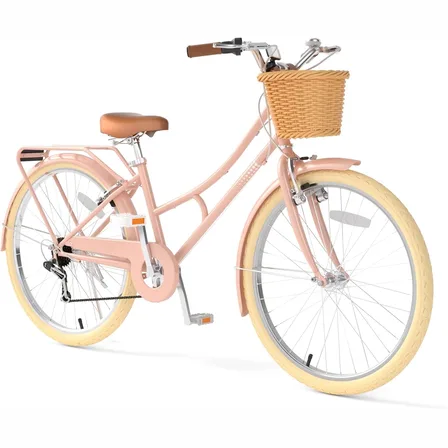
Pink XJD Beach Cruiser Bike, 24"/26", U-Brake
The XJD Pink Beach Cruiser Bike is a single-speed cruiser built for older kids a…$159.99