

What size bike for 6-year old
For most 6-year-olds, start by comparing 16 Inch and 18 Inch bikes. Measure the child’s height first, then confirm inseam clearance, reach, brake control and confidence on the actual bike. Choose the smaller size when control is uncertain; do not buy an oversized bike for future growth.
Choose the starting size by measured height
Age narrows the search, but height is the more useful first comparison. Under the XBikes starting points, a 16 Inch bike covers ages 4–7 and heights of 40–48 in (102–122 cm). An 18 Inch bike covers ages 5–9 and heights of 43–52 in (109–132 cm). Their ranges overlap, so height alone cannot settle every case.
| Wheel size | XBikes age starting point | Rider-height starting point | Relevance at age 6 |
|---|---|---|---|
| 14 Inch | 3–6 | 37–45 in / 94–114 cm | Worth checking for a shorter rider |
| 16 Inch | 4–7 | 40–48 in / 102–122 cm | A common starting comparison |
| 18 Inch | 5–9 | 43–52 in / 109–132 cm | Compare when height and control support it |
| 20 Inch | 7–12 | 48–60 in / 122–152 cm | Consider by measured fit, not simply to allow growth |
A child around 43–48 in (109–122 cm) falls within both the 16 Inch and 18 Inch height ranges. That overlap is a prompt for a real fit check, not evidence that the two sizes are interchangeable.
Measure before comparing bikes
Measure height without shoes, with the child standing straight against a wall. For inseam, have the child stand with feet slightly apart and measure from the floor to the crotch. Record both measurements in inches or centimetres so they can be compared consistently.
Wheel-size charts do not provide a complete stand-over measurement because frame shapes differ. Use the inseam figure when the child tries the bike: they need practical clearance when straddling it and must be able to mount and stop without struggling. Do not invent clearance from wheel size alone; check the exact bike and its manual.
Use the fit check to decide between sizes
Have the child try each plausible size in a controlled area. The American Academy of Pediatrics advises trying the bicycle rather than buying an oversized model for growth. Check these points before choosing:
- Stand-over: the child can straddle the bicycle without being forced onto tiptoes or trapped by the frame.
- Reach: hands reach the controls while the child remains balanced, without an exaggerated stretch.
- Brake control: the child can reach and operate the fitted brakes reliably. Follow the exact product manual for adjustment.
- Starting and stopping: the rider can set off, steer, slow down and put a foot down with control.
- Confidence: the bike does not make the child tense, hesitant or dependent on an adult to hold it upright.
If both 16 Inch and 18 Inch appear possible, choose according to control rather than the larger number. A bike that technically matches the height range is still unsuitable if the child cannot reach, brake or stop confidently.
How the supplied bike helps with the comparison
The Flower Pink XJD Girls Bike with Doll Seat & Basket is listed as a Training Wheel Bike with 12 Inch, 14 Inch and 16 Inch options. Its 14 Inch and 16 Inch versions provide relevant catalog choices for comparing a shorter 6-year-old or a rider whose measurements place them in the 16 Inch range. No 18 Inch version is supplied here, so this product cannot substitute for an 18 Inch bike when that is the better individual fit.
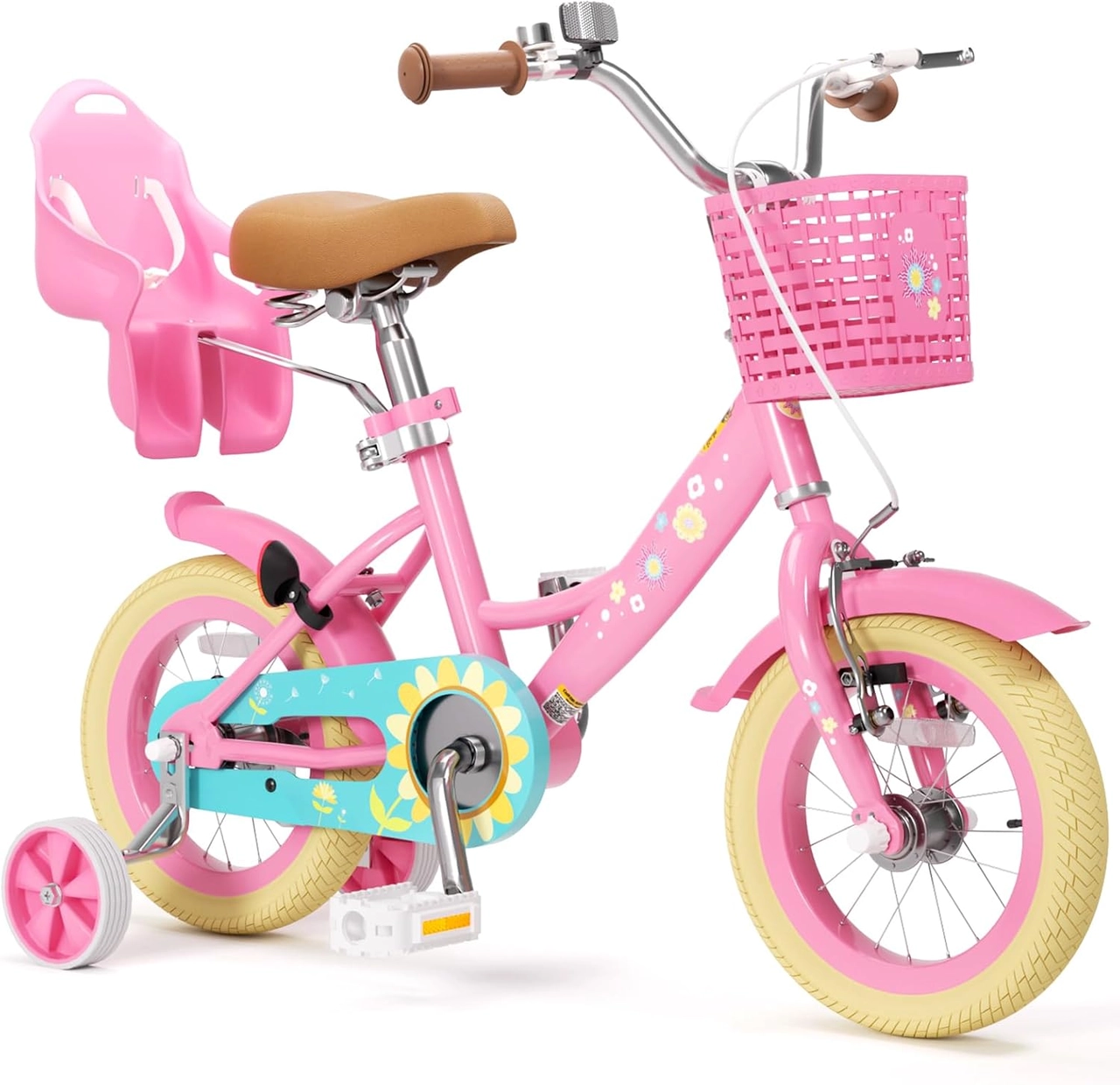
The 12 Inch option starts at ages 3–4 and heights of 34–40 in (86–102 cm), so it will generally fall below the starting range expected for a 6-year-old. Still, the child’s measured dimensions and actual control—not the birthday—make the final decision. The product title and category also do not prove fit, brake type, construction, availability or suitability for a particular rider.
Complete the setup without guessing
Once a size passes the fit check, follow the exact product manual for assembly, adjustments, maintenance, compatibility, load limits and torque. If any instruction is absent or the setup is uncertain, use a qualified bicycle mechanic rather than improvising.
Add a properly fitting bicycle helmet. U.S. Consumer Product Safety Commission guidance says the helmet should sit level and its straps should be used according to the manufacturer’s instructions. Recheck bicycle fit as the child grows or if starting, stopping, steering or braking becomes awkward.
The decision for your 6-year-old
Measure height and inseam today, shortlist 16 Inch and 18 Inch from the applicable ranges, and include 14 Inch only for a shorter rider whose measurements support it. Then let the child try the candidates. Buy only the size on which stand-over clearance, reach, braking, starts and stops are all controlled—even if that means choosing the smaller of two overlapping options.
Bikes for your next adventure
-

XJD Girls Bike for Kids Ages 3-8, 12/14/16 Inch with Training Wheels – Purple
The XJD Girls Bike in Purple is a training-wheel bicycle for kids ages 3 to 8, f…$149
$169 -

Pink Girls' 12/14/16" Bike by XJD – Basket & Doll Seat
The XJD Pink Girls' Bike with Basket & Doll Seat is made for riders 71–122 cm ta…$75.99
$99.99 -

Light Purple XJD Toddler Bike Helmet, Adjustable, Size XS (46–51 cm)
This Light Purple XJD toddler bike helmet is made for the smallest riders — the …$20.39