

What size bike for a 13 year old
For a 13-year-old, start with a 24-inch bike at 54–64 in (137–163 cm) tall, or compare a 26-inch bike once the rider is over 60 in (153 cm). Measure the child and check the actual fit before choosing.
Choose by height, not age alone
Thirteen sits near the transition between youth wheel sizes, so age cannot settle the decision. Under the XBikes starting points, a 24-inch bicycle covers ages 10–14 and heights of 54–64 in (137–163 cm). A 26-inch bicycle is a starting point for youth and adults over 60 in (153 cm).
A smaller 13-year-old may still fall within the 20-inch starting range of 48–60 in (122–152 cm), which is listed for ages 7–12. That age range is only a guide: measured height, inseam, reach, brake control and confidence take priority. If the rider falls within an overlap, try both relevant sizes rather than automatically choosing the larger one.
What to measure before shopping
- Standing height: Measure without shoes, with the child standing upright against a wall. Compare the result with the XBikes height ranges.
- Inseam: Measure from the floor to the crotch while the rider stands naturally. Use it to assess clearance over the actual bicycle rather than estimating from trouser size.
- Reach and control: On the bike, check whether the rider can steer without stretching, turn the bars comfortably and operate the brakes securely.
- Current confidence: A less-confident rider may struggle with a bicycle that feels tall, long or difficult to control, even when height falls within a published range.
Relevant wheel-size starting points
| Wheel size | XBikes age starting point | Rider height | Relevance at age 13 |
|---|---|---|---|
| 20 Inch | Ages 7–12 | 48–60 in / 122–152 cm | Consider only when the measured rider remains in this height range and the individual fit works. |
| 24 Inch | Ages 10–14 | 54–64 in / 137–163 cm | The usual first comparison for a 13-year-old within this height range. |
| 26 Inch | Youth and adults | Over 60 in / 153 cm | Compare when the rider exceeds the height threshold and can control the bicycle comfortably. |
Wheel diameter does not reveal every frame dimension. Two bicycles with the same wheel size can feel different, so these ranges narrow the search but do not replace trying the exact model.
How to perform the fit check
Have the child try the bicycle. First check stand-over clearance: the rider should be able to straddle the frame without the bicycle pressing uncomfortably against the body. Then check the riding position. The child should not have to overreach for the handlebar or feel crowded while steering.
Ask the rider to operate each brake while maintaining a secure grip. Brake levers must be reachable and controllable with the child’s hands. Also observe starting, stopping, turning and placing a foot down. A size is not suitable merely because the rider can sit on its saddle.
Do not buy an oversized bicycle solely to leave room for growth. If the 26-inch option compromises stand-over clearance, reach or brake operation, remain with a correctly fitting 24-inch option and reassess as the child grows.
How the supplied bikes help with comparison
The catalog choices provide 24-inch and 26-inch beach-cruiser comparison points for the two most likely size paths. They are relevant only after the rider’s measurements identify which wheel sizes deserve a real fit check.
 24-Inch Purple XJD Beach Cruiser Bike with U-Brake
A 24-inch beach-cruiser comparison for riders measuring 54–64 in (137–163 cm), subject to individual stand-over, reach and brake-control checks.
 26-Inch XJD Beach Cruiser Bike for Girls – Purple, V-Brake
Offers catalog SKU labels spanning 20, 24 and 26 inches. Confirm the exact selected label; a 26-inch version is relevant only above 60 in (153 cm) and after a hands-on fit check.
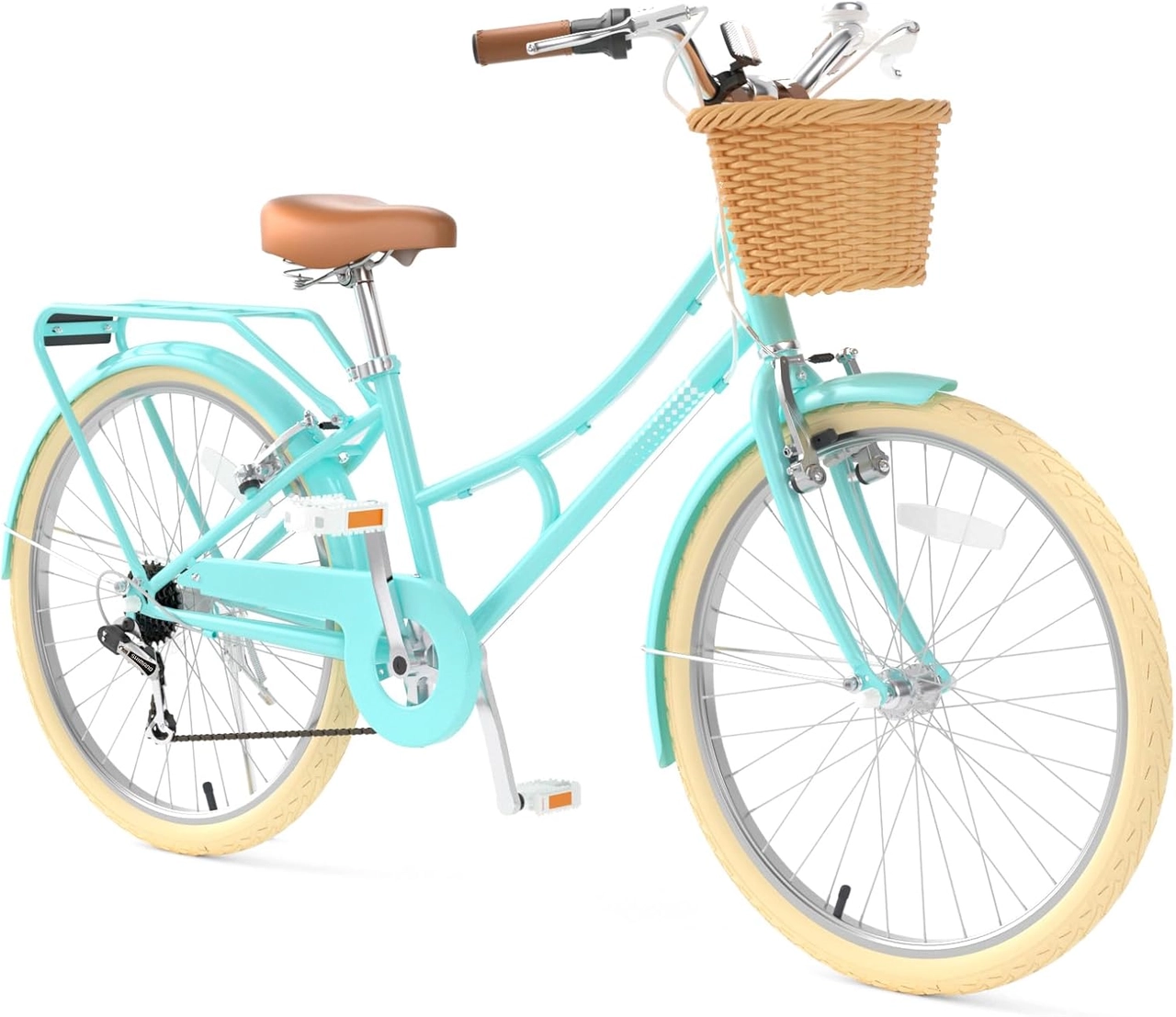 XJD 24-Inch Green Beach Cruiser Bike with U-Brake
A beach-cruiser listing with 24- and 26-inch SKU labels. Its 24-inch options suit comparison within the 54–64 in (137–163 cm) starting range, but the exact bicycle still requires a fit check.
The 24-Inch Purple XJD Beach Cruiser Bike with U-Brake and XJD 24-Inch Green Beach Cruiser Bike with U-Brake are 24-inch beach-cruiser options to examine when the rider measures 54–64 in (137–163 cm). The green model has Green / 24 Inch, Pink / 24 Inch and Pink / 26 Inch SKU labels, so verify the selected label rather than relying on the listing name alone.
The 26-Inch XJD Beach Cruiser Bike for Girls – Purple, V-Brake provides 20-, 24- and 26-inch SKU labels in its catalog options, including Purple / 26 Inch. Select by the exact SKU label and measured fit. Its 26-inch version is relevant only for a rider over 60 in (153 cm) who passes the stand-over, reach, control and brake-reach checks; its 20- and 24-inch variants are not equivalent substitutes.
Make the final decision
After identifying the likely size, compare the child on the exact bicycle and SKU. Follow the exact product manual or use a qualified bicycle mechanic for assembly, adjustment, maintenance, compatibility, load limits and torque information not provided here.
Before riding, fit a bicycle helmet properly: it should sit level, with its straps used according to the helmet manufacturer’s instructions. For this 13-year-old, choose 24 inches when the measured height and controls fit that range; move to 26 inches only above 60 in (153 cm) when the larger bicycle also passes every hands-on fit check.
Bikes for your next adventure
-

XJD Girls Bike for Kids Ages 3-8, 12/14/16 Inch with Training Wheels – Purple
The XJD Girls Bike in Purple is a training-wheel bicycle for kids ages 3 to 8, f…$149
$169 -

Light Purple XJD Toddler Bike Helmet, Adjustable, Size XS (46–51 cm)
This Light Purple XJD toddler bike helmet is made for the smallest riders — the …$20.39
-

Pink Girls' 12/14/16" Bike by XJD – Basket & Doll Seat
The XJD Pink Girls' Bike with Basket & Doll Seat is made for riders 71–122 cm ta…$75.99
$99.99