

What size bike for a 5.8 young man
A 5.8-foot young man should start with a 26-inch bike, then confirm fit by checking his measured height, inseam, reach, stand-over and brake control.
First, clarify what “5.8” means
If 5.8 means 5.8 feet, the rider is 69.6 inches tall. If it means 5 feet 8 inches, he is 68 inches tall. Either interpretation places him above 60 inches, so the XBikes starting point is a 26-inch bicycle.
That wheel size is only a starting point. It does not identify a complete fit by itself, because bicycles with the same wheel size can feel different. Age is also less useful than the rider’s actual measurements and ability to control the bicycle.
Measure the rider before choosing
Measure height without shoes, with the rider standing upright against a wall. Then measure inseam from the floor to the crotch while he stands naturally. Record both measurements rather than relying on a remembered height or clothing size.
Use the height measurement to find the XBikes wheel-size starting point:
| Wheel size | XBikes rider-height starting point | How it applies here |
|---|---|---|
| 24 Inch | 54–64 in / 137–163 cm | Below either interpretation of 5.8 |
| 26 Inch | Over 60 in / 153 cm | The appropriate starting point to try |
The inseam should then be compared with the bicycle’s stand-over space and adjustment range. Because no universal frame measurement is supplied here, check the exact bicycle’s sizing information and manual rather than assuming every 26-inch model fits identically.
Perform an individual fit check
Have the young man try the bicycle in person whenever possible. The American Academy of Pediatrics guidance emphasizes trying the bike, checking stand-over and control, and avoiding an oversized bicycle bought merely for future growth.
During the fit check, confirm that he can:
- Stand over the bicycle comfortably and get on and off without struggling.
- Reach the handlebars without excessive stretching, locked elbows or an awkwardly cramped posture.
- Turn the handlebars while remaining balanced and in control.
- Reach and operate the brakes confidently with his hands in a normal riding position.
- Start, stop and place a foot down without the bicycle becoming difficult to manage.
A failed check is a reason to try a different frame or bicycle, even if its wheel-size label appears correct. Current confidence matters too: a technically possible fit is not a suitable choice if the rider cannot control it comfortably.
How the supplied 24-inch bike is relevant
The supplied catalog contains the 24-Inch Purple XJD Beach Cruiser Bike with U-Brake, categorized as a Beach Cruiser Bike. Its 24-inch size provides a useful nearby comparison: it can help show how a smaller wheel-size starting point differs, but it is not equivalent to or a substitute for the indicated 26-inch starting point.
This particular catalog option helps answer the title by making the size boundary concrete. The XBikes standard places 24-inch bicycles at 54–64 inches in rider height, while both 68 inches and 69.6 inches exceed that range. No 26-inch product is supplied here, so the displayed item should be treated only as a nearest-size comparison point.
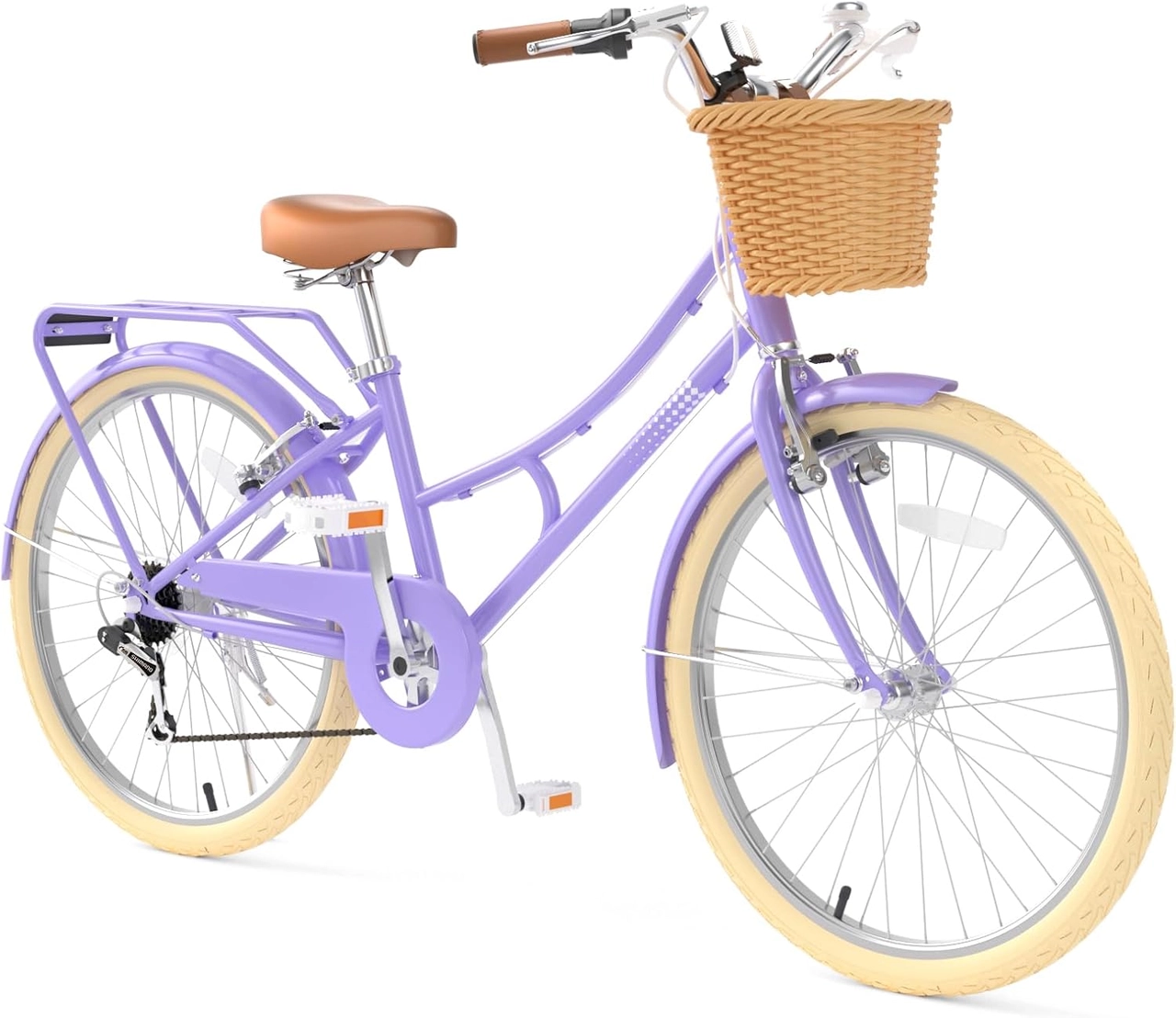
Do not infer frame dimensions, adjustment limits, weight capacity or other compatibility details from the product name. If considering this bicycle despite the height comparison, consult its exact product manual and complete an individual fit check; use a qualified bicycle mechanic when fit, assembly or compatibility remains uncertain.
Check control before completing the choice
Once a 26-inch candidate is found, compare the recorded height and inseam with that exact model’s guidance. Adjust it only as permitted by its manual. Then repeat the stand-over, reach and brake checks with the rider wearing normal riding shoes.
Reject a candidate that forces a stretched posture, prevents comfortable brake operation, or feels hard to start and stop. Do not move up to a larger bicycle merely to allow room for growth. Conversely, do not select the supplied 24-inch bicycle simply because a smaller bicycle may appear easier to handle; its stated rider-height range does not include a 5-foot-8-inch or 5.8-foot rider.
Make the final decision
Use a properly fitting bicycle helmet on every ride. U.S. Consumer Product Safety Commission guidance says the helmet should fit properly, sit level and have its straps used according to the manufacturer’s instructions.
For this rider, the next action is clear: verify whether “5.8” means 68 or 69.6 inches, record his inseam, and try a 26-inch bicycle. Choose it only if he passes the stand-over, reach, brake-control, starting and stopping checks; otherwise compare another 26-inch frame rather than substituting the supplied 24-inch model.
Bikes for your next adventure
-

Pink Girls' 12/14/16" Bike by XJD – Basket & Doll Seat
The XJD Pink Girls' Bike with Basket & Doll Seat is made for riders 71–122 cm ta…$75.99
$99.99 -

Light Purple XJD Toddler Bike Helmet, Adjustable, Size XS (46–51 cm)
This Light Purple XJD toddler bike helmet is made for the smallest riders — the …$20.39
-

Flower Pink XJD Girls Bike with Doll Seat & Basket
The XJD Flower Pink girls' bike is made for riders 71–122 cm tall (roughly ages …$69.99