

What size bike for kids
Choose a kids’ bike by measured height first, then confirm inseam clearance, comfortable reach, brake control and confidence on the actual bicycle.
Start with the child’s measurements
Measure the child without shoes, standing straight against a wall. Record total height from floor to the top of the head. For inseam, have the child stand with feet slightly apart and measure from the floor to the crotch. These measurements are more useful than age alone.
Next, compare measured height with the XBikes starting points below. Wheel size is only a starting category: frame shapes and control positions can differ, so the child still needs an individual fit check.
| Wheel size | Starting age | Rider height |
|---|---|---|
| 12 Inch | 3–4 | 34–40 in / 86–102 cm |
| 14 Inch | 3–6 | 37–45 in / 94–114 cm |
| 16 Inch | 4–7 | 40–48 in / 102–122 cm |
| 18 Inch | 5–9 | 43–52 in / 109–132 cm |
| 20 Inch | 7–12 | 48–60 in / 122–152 cm |
| 24 Inch | 10–14 | 54–64 in / 137–163 cm |
| 26 Inch | Youth and adults | Over 60 in / 153 cm |
How to choose when ranges overlap
Several sizes may match the same height. Do not automatically choose the larger one. Begin with every size whose height range contains the child’s measurement, then let real fit and control decide. Current confidence matters: a hesitant beginner may handle a smaller suitable option more comfortably than a larger bike that is difficult to manage.
Do not buy an oversized bicycle simply to allow room for growth. American Academy of Pediatrics guidance emphasizes having the child try the bicycle and checking stand-over clearance, control and brake reach. A bike that will fit later is not necessarily controllable now.
Perform the fit check
- Check stand-over: With the child straddling the bicycle, confirm there is comfortable clearance rather than contact with the frame.
- Check the riding position: Seated with hands on the controls, the child should not have to stretch, twist or lock the arms to reach the handlebar.
- Check the brakes: The child must be able to reach and operate the brake controls securely. Do not assume a control can be adjusted unless the exact manual says so.
- Check basic control: In a clear, supervised area, confirm the rider can start, steer, stop and place a foot down without losing control.
- Check confidence: If the child appears frightened or cannot manage the bicycle predictably, reconsider the size even when height falls within the starting range.
Where the supplied XBikes options fit
The two catalog options are relevant when the child’s measurements point toward 12-, 14- or 16-inch wheels and training-wheel bikes are being considered. They let you compare three overlapping size starting points, but their catalog labels do not replace an in-person fit check.
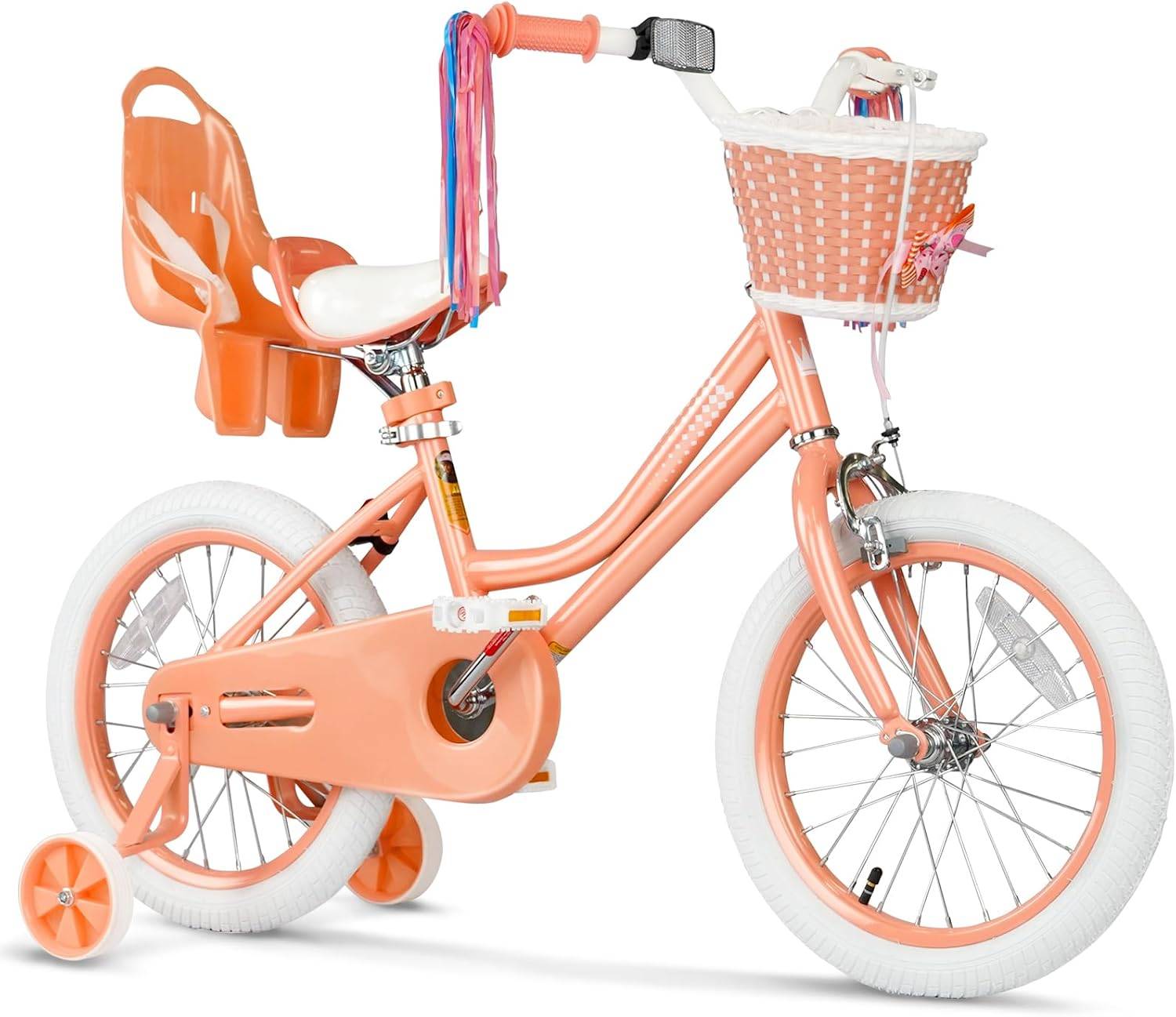 Girls 12/14/16 Inch Kids Bike by XJD with Training Wheels – Peach
A Training Wheel Bike offered in supplied 12 Inch, 14 Inch and 16 Inch SKU labels; relevant when measured height points to one of those ranges and an individual fit check confirms control.
 XJD Light Purple Girls Bike with Basket, Training Wheels, 12/14/16/20 Inch
A Training Wheel Bike with supplied available SKU labels of 12 Inch, 14 Inch and 16 Inch. Its exact title mentions 20 Inch, but the provided catalog facts do not list a 20 Inch available SKU.
Girls 12/14/16 Inch Kids Bike by XJD with Training Wheels – Peach is categorized as a Training Wheel Bike and is supplied in 12 Inch, 14 Inch and 16 Inch SKU labels. Compare only the size that matches the child’s measured-height range, then verify stand-over, reach and control.
XJD Light Purple Girls Bike with Basket, Training Wheels, 12/14/16/20 Inch is also categorized as a Training Wheel Bike. Although “20 Inch” appears in its exact catalog title, the supplied available SKU labels are only 12 Inch, 14 Inch and 16 Inch. Do not treat the title wording as proof that a 20-inch option is available.
If measurements indicate 18, 20, 24 or 26 inches, neither supplied product is an exact-size option based on the available SKU labels. They are smaller comparison points, not substitutes for the indicated size.
Before making the final decision
Repeat the fit check after any permitted setup adjustment, following the exact product manual. For assembly, maintenance, load limits, compatibility and torque information not stated here, use that manual or ask a qualified bicycle mechanic rather than guessing.
Add a properly fitting bicycle helmet. U.S. Consumer Product Safety Commission guidance says the helmet should sit level and its straps should be used according to the manufacturer’s instructions. A helmet does not correct a poorly fitting bicycle.
Your next step is simple: measure height and inseam, shortlist only the matching wheel-size ranges, and have the child demonstrate comfortable stand-over, reach, braking and control before choosing the bike.
Bikes for your next adventure
-

XJD Girls Bike for Kids Ages 3-8, 12/14/16 Inch with Training Wheels – Purple
The XJD Girls Bike in Purple is a training-wheel bicycle for kids ages 3 to 8, f…$149
$169 -
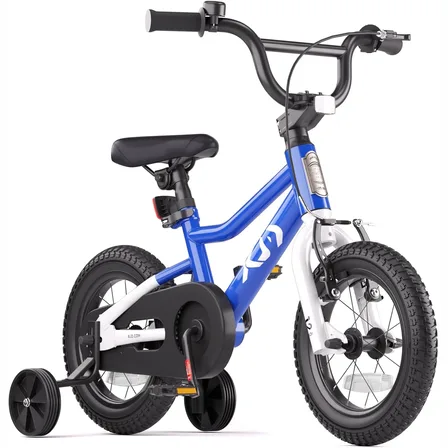
XJD Boys & Girls BMX Bike with Training Wheels, 12/14/16" – Blue
The XJD Boys & Girls BMX Bike in Blue is a first pedal bike for kids roughly age…$99.99
$119.99 -

XJD Girls BMX Bike 12/14/16 Inch with Training Wheels – Pink Blue
The XJD Girls BMX Bike in Pink/Blue is built as a first pedal bike for kids roug…$99.99
$119.99