

What size bike for my 11 year old daughter
For most 11-year-old daughters, start by comparing a 24-inch bike, but use her measured height and an in-person fit check—not age alone.
Start with height, then check the likely wheel size
Measure your daughter barefoot, standing straight against a wall. The XBikes starting range for a 24-inch bike is 54–64 inches (137–163 cm), covering ages 10–14. If she is 48–60 inches (122–152 cm), also compare a 20-inch bike; that size is the starting point for ages 7–12. Riders over 60 inches (153 cm) may need to compare 26-inch bikes.
The ranges overlap deliberately. An 11-year-old who is 55 inches tall could potentially fit either a 20-inch or 24-inch model depending on inseam, frame shape, reach, brake control and confidence. Age identifies candidates; it does not determine the final size.
Measure inseam before shopping
Have her stand barefoot with her back against a wall and her feet slightly apart. Place a firm book between her legs, raise it gently to simulate a saddle, and measure from the floor to the top edge of the book. Record both height and inseam in inches or centimetres.
Compare those measurements with the sizing information for the exact bicycle being considered. Wheel diameter alone cannot establish stand-over clearance because frame shapes vary. If the manufacturer’s instructions do not provide enough fit information, ask a qualified bicycle mechanic to assess the bike.
What she must be able to do on the bike
A promising size still needs a practical fit check. The American Academy of Pediatrics recommends having the child try the bicycle and avoiding an oversized bike bought merely for future growth. During the trial, check that she can:
- stand over the frame with appropriate clearance rather than being pressed against it;
- mount, start, steer and stop without the bicycle overwhelming her;
- reach the handlebars without locking her elbows or stretching excessively;
- operate every brake control comfortably and with enough hand control;
- remain balanced and confident during low-speed turns and stops.
If she cannot perform those actions calmly, do not assume she will simply grow into the bike. Compare a smaller frame or wheel-size option. If she looks cramped, cannot achieve a workable riding position, or is already beyond the stated range, compare the next size up.
How the supplied 20-inch options relate
The supplied catalog products are training-wheel bikes, so they are relevant mainly when your daughter’s measurements point toward a 20-inch comparison and she needs that type of setup. They do not include a 24-inch available SKU, so they are nearest-size comparison points—not substitutes for a 24-inch bike when that is the size her fit check supports.
These particular options help answer the title by showing which catalog choices reach the smaller overlapping 20-inch range and which stop below it.
 XJD Girls' Bike with Training Wheels, 12/14/16/20 Inch – Purple
A training-wheel bike with available 12-, 14-, 16- and 20-inch labels. Its 20-inch option is relevant only when the rider’s measurements and individual fit check support that size.
 XJD Kids Bike for Girls – Pink, 12/14/16/20 Inch with Training Wheels
This pink training-wheel bike has available 12-, 14-, 16- and 20-inch labels. The 20-inch version can be compared when height, inseam, reach, brake control and confidence indicate a suitable fit.
 XJD Light Purple Girls Bike with Basket, Training Wheels, 12/14/16/20 Inch
The supplied available labels are 12, 14 and 16 inches, despite the exact title mentioning 20 inches. It does not provide a listed 20- or 24-inch comparison for a typical 11-year-old fit assessment.
- XJD Girls' Bike with Training Wheels, 12/14/16/20 Inch – Purple is listed in the Training Wheel Bikes category with available 12-, 14-, 16- and 20-inch labels.
- XJD Kids Bike for Girls – Pink, 12/14/16/20 Inch with Training Wheels is also a Training Wheel Bikes option with available 12-, 14-, 16- and 20-inch labels.
- XJD Light Purple Girls Bike with Basket, Training Wheels, 12/14/16/20 Inch has supplied available SKU labels of 12, 14 and 16 inches. Despite the sizes embedded in its catalog title, the supplied availability does not list a 20-inch SKU, so it is not a current 20-inch comparison.
The 12-, 14- and 16-inch versions are below the XBikes starting ranges normally associated with an 11-year-old. Consider one only if her actual measurements and an individual trial support it; never treat a smaller catalog option as equivalent to a correctly fitting 20- or 24-inch bike.
Make the final decision
- Measure her standing height and inseam.
- Use 20 inches as a comparison at 48–60 inches (122–152 cm), 24 inches at 54–64 inches (137–163 cm), and 26 inches above 60 inches (153 cm).
- Within an overlap, try both candidate sizes rather than choosing by age.
- Confirm stand-over clearance, comfortable reach, reliable brake operation and confident control.
- Follow the exact product manual for assembly, adjustments, compatibility, maintenance, load limits and torque, or use a qualified bicycle mechanic.
Complete the setup with a properly fitting bicycle helmet. The U.S. Consumer Product Safety Commission advises that it should sit level and that its straps be used according to the helmet manufacturer’s instructions.
For your 11-year-old daughter, choose the smallest candidate that gives her a comfortable riding position and full control without crowding her—not a larger bicycle intended only for future growth.
Bikes for your next adventure
-

XJD Kids Bike for Girls – Pink, 12/14/16/20 Inch with Training Wheels
The XJD Kids Bike for Girls in Pink is a training-wheel bike built to carry your…$139
$159 -

Blue XJD Girls Bike with Training Wheels – 12/14/16 Inch
If you're shopping for a first pedal bike for a daughter roughly 3 to 8 years ol…$149
$169 -
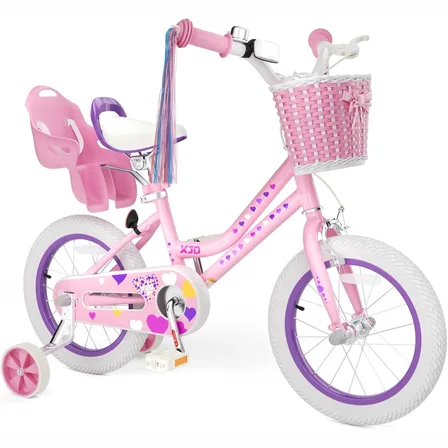
Light Pink XJD Girls' Bicycle with Basket & Training Wheels
The Light Pink XJD Girls' Bicycle with Basket & Training Wheels is a retro-style…$109.99
$129.99