

What size bike for my 12 year old son
For a 12-year-old son, start by measuring his height: a 24-inch bike is the usual XBikes starting point at 54–64 in (137–163 cm), but fit—not age—decides.
Choose the starting wheel size from measured height
Measure your child without shoes, standing straight against a wall. Compare that measurement with the XBikes starting points below. Age ranges can help narrow the search, but a 12-year-old may fall into more than one range.
| Wheel size | XBikes age starting point | Rider height |
|---|---|---|
| 20 Inch | Ages 7–12 | 48–60 in / 122–152 cm |
| 24 Inch | Ages 10–14 | 54–64 in / 137–163 cm |
| 26 Inch | Youth and adults | Over 60 in / 153 cm |
If he is 54–60 inches tall, both the 20-inch and 24-inch starting ranges overlap. Do not decide from the chart alone: compare both bikes in person and choose the one he can control comfortably. If he is over 60 inches, include 26-inch bikes in the fit check. If he is under 54 inches, begin with the 20-inch range.
Measure inseam as well as total height
Height identifies likely wheel sizes; inseam helps reveal whether a particular frame is manageable. With your child wearing the shoes he will normally ride in, have him stand with his feet slightly apart. Place a rigid book between his legs, raise it gently to simulate the bike saddle, and measure from the floor to the top edge.
Compare that measurement with the actual stand-over clearance and saddle adjustment information for the exact bicycle. Frame shapes differ even when wheel labels match, so an inseam cannot be converted reliably into a wheel size without checking the individual bike.
Do a five-part fit check before buying
Have your son try the bicycle rather than buying a larger model solely to leave growing room. An oversized bike can make starting, stopping and steering harder. Check these points:
- Stand-over: He should be able to straddle the frame without the bicycle pressing uncomfortably into him.
- Starting and stopping: He should mount, set off and stop without struggling to hold the bike upright.
- Reach: He should reach the handlebar without locking his elbows, stretching his torso or losing a balanced posture.
- Brake control: He must reach and operate the fitted brake controls confidently. Do not assume they fit because the wheel size looks right.
- Steering confidence: He should turn, look around and make ordinary low-speed corrections while remaining in control.
If either overlapping size passes these checks, consider his current confidence and control rather than automatically choosing the larger wheel. Follow the exact product manual for assembly, adjustment, maintenance and limits, or ask a qualified bicycle mechanic when the instructions or fit are uncertain.
How the supplied 20-inch products relate
The supplied catalog products offer 12-, 14-, 16- and 20-inch SKU labels and belong to the Training Wheel Bikes category. Their 20-inch versions can therefore serve as comparison options only when your son's measured height and individual fit point toward a 20-inch bicycle. They do not offer the 24-inch size that is often the starting point for a 12-year-old in the 54–64-inch height range, so they are not substitutes for a correctly fitting 24-inch bike.
The Pink 12/14/16/20" XJD Girls Bike with Training Wheels & Basket and Light Pink XJD Girls' Bicycle with Basket & Training Wheels both list the same four wheel-size labels. The Girls' Training Wheel Bike by XJD, 12–20 Inch Wheels – Blue also lists 12, 14, 16 and 20 inches. Their exact titles describe catalog styling and included features, while the available sizes—not the gender wording—are what matter to this fit comparison. None supplies catalog evidence about frame measurements, brake reach or suitability for your individual child.
These particular options help answer the question by showing what is available at the smaller 20-inch boundary and by making clear when a parent needs to continue looking for a 24- or 26-inch comparison instead.
 Pink 12/14/16/20" XJD Girls Bike with Training Wheels & Basket
Available in 12-, 14-, 16- and 20-inch labels. Its 20-inch version is relevant only if the rider’s measured height and individual fit support that size; it is not a substitute for a 24-inch bike.
 Light Pink XJD Girls' Bicycle with Basket & Training Wheels
This Training Wheel Bikes product offers 12-, 14-, 16- and 20-inch labels. Consider the 20-inch option only after checking the child’s height, inseam, reach, brake control and confidence.
 Girls' Training Wheel Bike by XJD, 12–20 Inch Wheels – Blue
The blue XJD training-wheel model lists sizes from 12 to 20 inches. It can provide a 20-inch comparison point, but the catalog facts do not establish individual fit or provide a 24-inch option.
Finish the decision safely
Once a bike passes the stand-over, reach, brake and control checks, fit a bicycle helmet. It should sit level, fit properly and have its straps used according to the helmet manufacturer's instructions.
Your next step is simple: measure your son's height and inseam, shortlist 20, 24 or 26 inches from the supplied height ranges, and have him try the candidates. Choose the size he can control now; do not size up merely for future growth.
Bikes for your next adventure
-

Black XJD Kids Bike for Boys – 12, 14 & 16 Inch Sizes
For a son between roughly 3 and 8 years old, the XJD Kids Bike in Black covers t…$169
$199 -
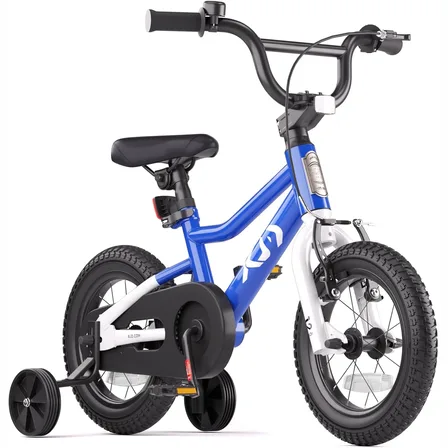
XJD Boys & Girls BMX Bike with Training Wheels, 12/14/16" – Blue
The XJD Boys & Girls BMX Bike in Blue is a first pedal bike for kids roughly age…$99.99
$119.99 -

Kids Bike Helmet by XJD for Boys & Girls – Black, Blue, Green, Pink, Purple
The XJD Kids Bike Helmet covers a wide 2-to-8-year age range thanks to two head-…$59.99