

What size bike for my 5 year old daughter
For most 5-year-old girls, start by comparing a 14 Inch and 16 Inch bike. Measure her height and inseam, then confirm stand-over clearance, reach, braking and control on the actual bicycle.
Choose the starting wheel size from her height
Age narrows the search, but it does not determine fit. Under the XBikes starting points, both 14 Inch and 16 Inch bicycles cover age five. Her measured height gives the more useful first comparison.
| Wheel size | XBikes age starting point | Rider height | Relevance at age five |
|---|---|---|---|
| 12 Inch | Ages 3–4 | 34–40 in / 86–102 cm | Consider only if her measurements and an individual fit check support it. |
| 14 Inch | Ages 3–6 | 37–45 in / 94–114 cm | A primary size to compare. |
| 16 Inch | Ages 4–7 | 40–48 in / 102–122 cm | A primary size to compare. |
| 18 Inch | Ages 5–9 | 43–52 in / 109–132 cm | Compare if she is tall enough and can control it confidently. |
If she is 40–45 inches tall, the height bands for 14 Inch and 16 Inch overlap. That does not make the sizes interchangeable: try both and choose according to her body proportions and control. If she is 43–48 inches tall, 16 Inch and 18 Inch overlap, so the same hands-on comparison matters.
Measure her before comparing bikes
Measure height without shoes, with her standing straight against a wall. For inseam, have her stand with feet slightly apart and measure from the floor to the top of the inside leg. Record both measurements in inches or centimetres.
Height selects the likely wheel-size range. Inseam helps you evaluate whether she can stand over the bicycle and reach the ground appropriately when trying it. Wheel size alone cannot reveal saddle height, frame shape or reach, so do not infer a complete fit from the label.
Check the actual fit, not just the number
Have your daughter try the bicycle. The American Academy of Pediatrics advises against buying an oversized bike merely so a child can grow into it. During the fit check, look for these specific signs:
- She can stand over the bicycle without the frame pressing into her.
- She reaches the handlebars without stretching, locking her elbows or leaning excessively.
- She can steer through turns while remaining balanced and looking ahead.
- Her hands can reach and operate the available brake controls reliably.
- She can start, stop and get off without panic or adult lifting.
A larger bike is not the right choice if she becomes hesitant, cannot control a turn or cannot brake consistently. A smaller candidate is not automatically correct either; cramped posture or restricted steering means you should compare another size.
How confidence changes the decision
Current riding confidence can decide between two sizes that both match her height. A new or cautious rider may control the smaller fitting option more comfortably. A confident rider may fit the larger candidate, but only if stand-over, reach, braking and manoeuvring remain easy. Do not use confidence to excuse an oversized frame.
Training wheels may support a particular learning approach, but they do not repair poor fit. The child still needs suitable reach, stand-over clearance and brake control. Follow the exact bicycle manual for assembly, adjustments, compatibility, maintenance and load limits; use a qualified bicycle mechanic when the instructions or fit are uncertain.
Where the supplied XBikes options fit
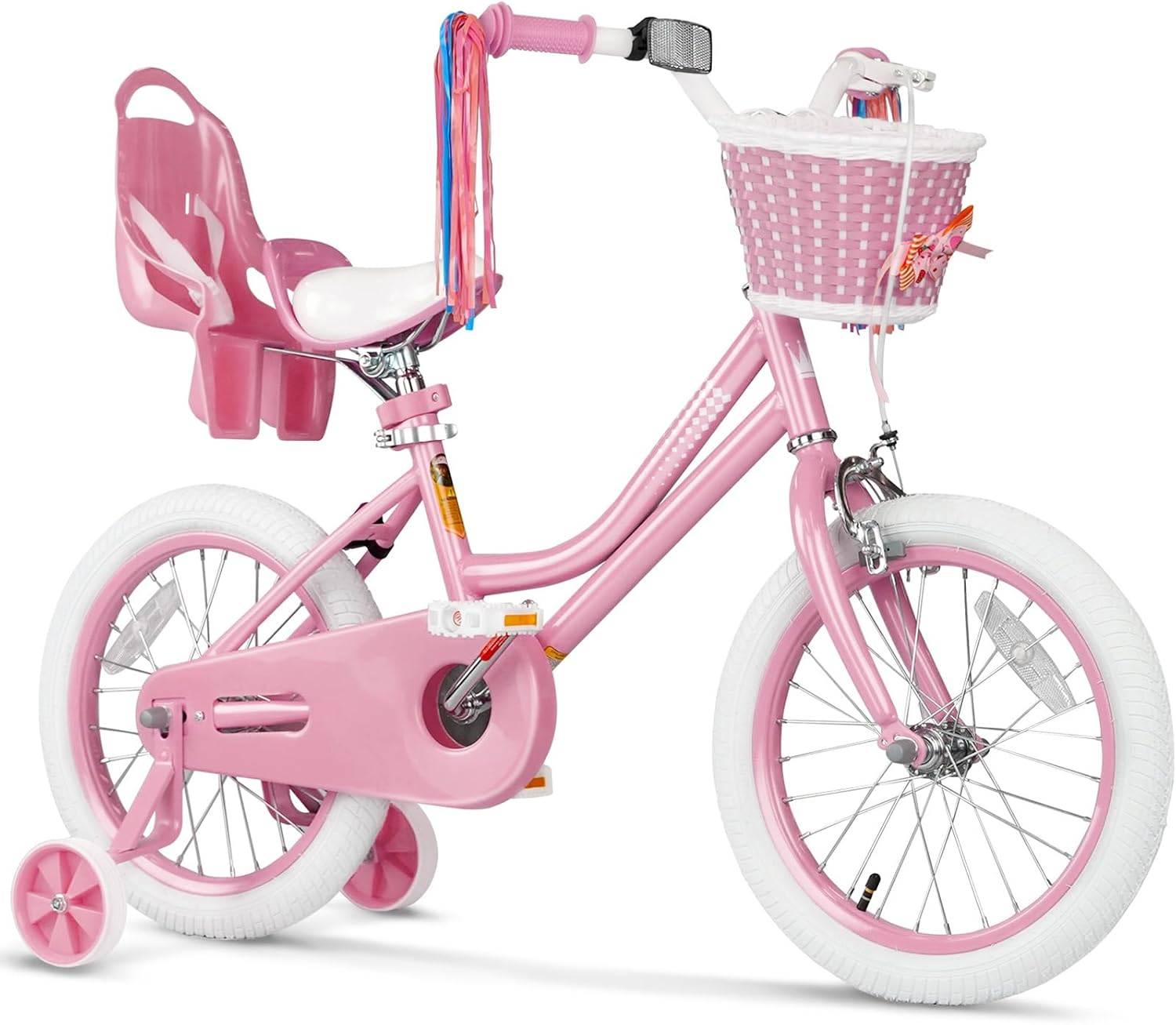
The XJD Pink Girls' Bike – Kids 12/14/16 Inch Training Wheel Bicycle is relevant because its available SKU labels let you compare 12 Inch, 14 Inch and 16 Inch versions within one catalog listing. For many five-year-olds, its 14 Inch and 16 Inch labels align with the starting ranges above; the 12 Inch version falls below the age-five starting range and should be considered only when her measurements and an actual try-out support it.
These particular catalog options help answer the sizing question by providing the two main starting sizes for age five in one training-wheel bicycle listing, plus a smaller comparison for a shorter rider. They do not include an 18 Inch option, so if her height and fit check point to 18 Inch, the displayed products are comparison points rather than substitutes.
Make the final decision
- Measure her height and inseam without shoes.
- Use height to shortlist 14 Inch, 16 Inch or, where appropriate, 18 Inch.
- Try each shortlisted size and check stand-over, reach, turning, braking and dismounting.
- Choose the size she controls now, rather than one bought mainly for future growth.
Before riding, add a properly fitting bicycle helmet. It should sit level and its straps should be adjusted according to the helmet manufacturer's instructions. For your five-year-old daughter, the practical answer is therefore usually a 14 Inch versus 16 Inch comparison, with 18 Inch considered only when her height and hands-on control support it.
Bikes for your next adventure
-

XJD Kids Bike for Girls – Pink, 12/14/16/20 Inch with Training Wheels
The XJD Kids Bike for Girls in Pink is a training-wheel bike built to carry your…$139
$159 -

Blue XJD Girls Bike with Training Wheels – 12/14/16 Inch
If you're shopping for a first pedal bike for a daughter roughly 3 to 8 years ol…$149
$169 -

Light Pink XJD Girls' Bicycle with Basket & Training Wheels
The Light Pink XJD Girls' Bicycle with Basket & Training Wheels is a retro-style…$109.99
$129.99