

What size bike for my 6 year old
For a 6-year-old, start by comparing a measured height with 14-, 16-, and 18-inch bikes. Most fall in the 16-inch range, but fit decides.
Which wheel size should you check?
Measure your child without shoes, then use these XBikes starting points. Age ranges overlap, so age six does not identify one correct wheel size.
| Wheel size | XBikes age starting point | Rider height |
|---|---|---|
| 14 Inch | Ages 3–6 | 37–45 in / 94–114 cm |
| 16 Inch | Ages 4–7 | 40–48 in / 102–122 cm |
| 18 Inch | Ages 5–9 | 43–52 in / 109–132 cm |
| 20 Inch | Ages 7–12 | 48–60 in / 122–152 cm |
A six-year-old measuring 40–45 inches overlaps the 14- and 16-inch ranges. At 43–48 inches, the 16- and 18-inch ranges overlap. That overlap is a prompt to try both sizes, not permission to choose the larger one automatically. A child at or above 48 inches may also enter the 20-inch starting range, but control still matters more than the chart.
Measure height and inseam first
For height, have the child stand straight against a wall without shoes. Keep heels on the floor and mark the top of the head, then measure from floor to mark.
For inseam, place a book firmly between the legs to represent the saddle contact point. Measure from the floor to the top edge of the book. Do not turn that number directly into a wheel size: compare it with the actual bicycle’s stand-over clearance and lowest usable saddle position.
Bring both measurements when shopping. Geometry can differ between bicycles carrying the same wheel-size label, so “16 Inch” alone cannot confirm that the frame, saddle, and controls suit your child.
Perform the fit check
Have your child try the bicycle rather than estimating from the box or buying extra room for growth. Check these points:
- Stand-over: the child can straddle the bicycle comfortably and stabilize it without being forced onto tiptoes.
- Starting and stopping: the child can get on, push off, stop, and put a foot down without panic or excessive leaning.
- Reach: hands reach the handlebar while elbows remain relaxed and steering feels controlled.
- Brake control: the child can reach and operate the fitted braking controls reliably. Verify the exact setup on the bicycle and follow its product manual.
- Confidence: turns and low-speed balance look controlled. A technically reachable larger bike is still unsuitable if it overwhelms the rider.
If two wheel sizes match the height chart, choose according to the better stand-over, reach, braking control, and present confidence. Do not buy an oversized bicycle solely so the child can grow into it.
How the available XBikes options help
The supplied catalog options provide 12-, 14-, and 16-inch comparison points, including training-wheel configurations. They are relevant when your measured six-year-old fits the 14- or 16-inch starting range and can pass the hands-on checks. Neither supplied product currently lists an 18-inch SKU, so these products are comparison points—not substitutes—when an 18-inch fit is indicated.
 XJD Light Purple Girls Bike with Basket, Training Wheels, 12/14/16/20 Inch
Available in supplied 12-, 14-, and 16-inch SKU labels, this Training Wheel Bike offers two relevant comparison sizes for many measured six-year-olds. The title mentions 20 Inch, but no 20-inch SKU is included in the supplied availability facts.
 XJD Girls BMX Bike 12/14/16 Inch with Training Wheels – Pink Blue
This Kids’ BMX Bike has supplied 12-, 14-, and 16-inch SKU labels and training wheels, making its 14- and 16-inch versions useful fit-check candidates when the child’s measured height overlaps those ranges.
XJD Light Purple Girls Bike with Basket, Training Wheels, 12/14/16/20 Inch is categorized as a Training Wheel Bike. Its supplied available SKU labels are 12 Inch, 14 Inch, and 16 Inch. Although “20 Inch” appears in the exact catalog title, a 20-inch SKU is not included in the supplied availability facts.
XJD Girls BMX Bike 12/14/16 Inch with Training Wheels – Pink Blue is categorized as a Kids’ BMX Bike and likewise has supplied 12-, 14-, and 16-inch SKU labels. The BMX wording is a catalog description, not evidence that its geometry will fit a particular child.
A 12-inch option is generally outside the usual six-year-old starting point because XBikes associates it with ages 3–4 and heights of 34–40 inches / 86–102 cm. Still, measured fit—not the child’s birthday—settles the decision.
Before the first ride
Use a properly fitting bicycle helmet. It should sit level, with straps adjusted according to the helmet manufacturer’s instructions. Recheck fit whenever the helmet is adjusted or replaced.
For assembly, fastener torque, maintenance, load limits, or component compatibility, follow the exact bicycle’s manual. If the instructions are missing or the bicycle’s controls cannot be set up confidently, use a qualified bicycle mechanic.
Your next step is simple: record height and inseam, shortlist every overlapping wheel size, then let your six-year-old try them. Choose only the bike on which stand-over, reach, braking, starting, and stopping all work today.
Bikes for your next adventure
-
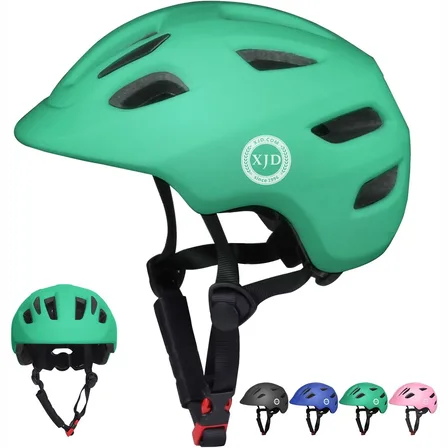
Green XJD Toddler Bike Helmet with Adjustable Fit, XS (46–51 cm)
The XJD toddler bike helmet in Green is built for the youngest riders — the size…$20.39
$23.99 -

Kids Bike Helmet by XJD for Boys & Girls – Black, Blue, Green, Pink, Purple
The XJD Kids Bike Helmet covers a wide 2-to-8-year age range thanks to two head-…$59.99
-

Kids Bike Helmet by XJD for Girls – Pink
The XJD Kids Bike Helmet in Pink is a lightweight multi-sport helmet for girls r…$59.99
$99