

What size bike for average 6 year old
For an average 6-year-old, start by comparing a 16-inch bike with an 18-inch bike. Measure the child first: height narrows the choice, while inseam, stand-over clearance, reach, brake control and confidence determine the actual fit.
Which wheel size should you check?
Under the XBikes starting points, a 16-inch bike covers rider heights of 40–48 inches (102–122 cm) and ages 4–7. An 18-inch bike covers 43–52 inches (109–132 cm) and ages 5–9. Because a 6-year-old can fall within either range, age does not settle the decision.
| Wheel size | Starting age range | Starting height range | Relevance at age 6 |
|---|---|---|---|
| 14 Inch | 3–6 | 37–45 in / 94–114 cm | Consider only for a shorter rider whose measurements and test ride support it. |
| 16 Inch | 4–7 | 40–48 in / 102–122 cm | A common comparison size, especially within this height range. |
| 18 Inch | 5–9 | 43–52 in / 109–132 cm | Compare when the child is at least 43 inches tall and can control it comfortably. |
| 20 Inch | 7–12 | 48–60 in / 122–152 cm | Usually a later starting point unless the measured height and individual fit support it. |
These ranges overlap deliberately: wheel size is only a starting point. Do not move up merely because the child has reached the upper end of an age label.
Measure before comparing bikes
- Height: Have the child stand straight without shoes against a wall. Measure from the floor to the top of the head.
- Inseam: With feet slightly apart, measure from the floor to the crotch. This helps assess whether the child can stand over the bicycle comfortably.
- Reach and controls: On the actual bike, check whether the child can hold the handlebars naturally, steer without stretching and operate the brakes confidently.
Do not convert the inseam into a wheel size using an invented formula. Frame shapes and adjustment ranges differ, so compare the measurement with the actual bicycle and its manual.
What a proper test fit should show
Have the child try the bicycle rather than choosing from age alone. While standing over it, the child should have usable clearance and should not be forced awkwardly onto tiptoes. Seated, the rider should reach the handlebars without locking the elbows, leaning excessively or losing steering control.
Ask the child to start, stop, turn and operate the brakes in a controlled area with close adult supervision. A bike that technically matches the height chart may still be too demanding if the rider cannot stop reliably, feels intimidated or struggles to balance its size. Do not buy an oversized bicycle solely to allow room for growth.
How the supplied XBikes options relate
The supplied catalog options help because each currently lists 12-inch, 14-inch and 16-inch SKU labels, letting families compare the smaller sizes around the likely 16-inch starting point. They do not supply a verified 18-inch option, so they are relevant only when the child’s measurements and hands-on fit point to 16 inches or less; they are not substitutes for an 18-inch bike.
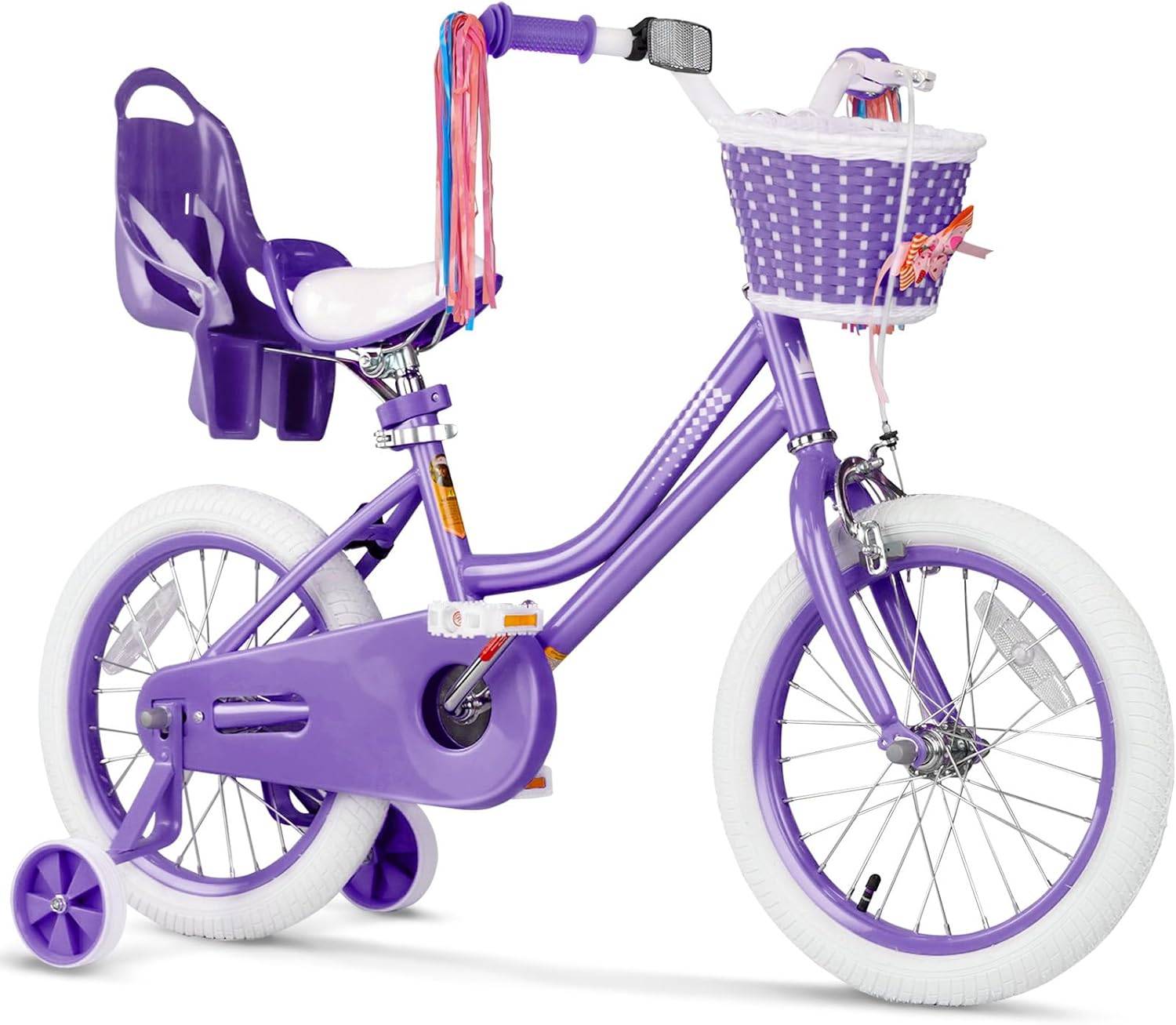 XJD Girls Bike for Kids Ages 3-8, 12/14/16 Inch with Training Wheels – Purple
A Training Wheel Bikes option with supplied 12-, 14- and 16-inch SKU labels. Its 16-inch version is relevant only when the rider’s measurements and individual fit support that size.
 Girls 12/14/16 Inch Kids Bike by XJD with Training Wheels – Peach
This Training Wheel Bikes product has supplied 12-, 14- and 16-inch choices. Compare the 14- or 16-inch version according to measured height, stand-over, reach, brake control and confidence.
 XJD Light Purple Girls Bike with Basket, Training Wheels, 12/14/16/20 Inch
The supplied SKU labels are 12, 14 and 16 Inch, despite 20 Inch appearing in the exact title. It can inform a smaller-size comparison but provides no verified 18-inch choice.
XJD Girls Bike for Kids Ages 3-8, 12/14/16 Inch with Training Wheels – Purple is listed in Training Wheel Bikes with 12-, 14- and 16-inch choices. The age wording in its title is a catalog label, not proof that every 6-year-old fits it.
Girls 12/14/16 Inch Kids Bike by XJD with Training Wheels – Peach offers the same supplied wheel-size labels in the Training Wheel Bikes category. Compare its 14- or 16-inch choice only after measuring the rider and checking control.
XJD Light Purple Girls Bike with Basket, Training Wheels, 12/14/16/20 Inch includes “20 Inch” in its exact catalog title, but the supplied available SKU labels are only 12 Inch, 14 Inch and 16 Inch. Do not assume a 20-inch option is available from this information.
Choose between 16 and 18 inches
If the child measures 40–42 inches (102–108 cm), the XBikes ranges point first toward 16 inches. From 43–48 inches (109–122 cm), both 16 and 18 inches fall within the height ranges, so the better choice is the one the child can stand over, reach, steer and brake confidently. From 49–52 inches (123–132 cm), 18 inches is the matching starting range; the supplied 16-inch products should then be treated as smaller comparison points, not equivalent replacements.
If neither candidate permits comfortable stand-over, natural reach and reliable braking, choose neither until a suitable fit can be tried. Follow the exact product manual for assembly, adjustment, maintenance, compatibility and limits, or use a qualified bicycle mechanic.
Before the first ride
Use a properly fitting bicycle helmet. It should sit level and its straps should be adjusted according to the helmet manufacturer’s instructions. Recheck the bicycle fit after adjustments, because changing the seat position does not make an oversized frame appropriate.
For this 6-year-old, measure height and inseam today, test 16- and 18-inch bikes when the height ranges allow, and select only the size the child can stand over, steer and stop confidently.
Bikes for your next adventure
-

Kids Bike Helmet by XJD for Boys & Girls – Black, Blue, Green, Pink, Purple
The XJD Kids Bike Helmet covers a wide 2-to-8-year age range thanks to two head-…$59.99
-

Kids Bike Helmet by XJD for Girls – Pink
The XJD Kids Bike Helmet in Pink is a lightweight multi-sport helmet for girls r…$59.99
$99 -

XJD Kids Bike for Girls – Pink, 12/14/16/20 Inch with Training Wheels
The XJD Kids Bike for Girls in Pink is a training-wheel bike built to carry your…$139
$159