

What size bike for my 7 year old son
For most 7-year-olds, start by comparing 18-inch and 20-inch bikes, then choose by measured height, inseam, reach, brake control and confidence.
Which wheel size should you check first?
Age seven sits at the overlap between several XBikes starting points. A 16-inch bike covers ages 4–7 and heights of 40–48 in (102–122 cm). An 18-inch bike covers ages 5–9 and heights of 43–52 in (109–132 cm). A 20-inch bike covers ages 7–12 and heights of 48–60 in (122–152 cm).
That means an average age label cannot decide the size. If your son is under 48 in (122 cm), compare 16-inch and 18-inch bikes according to his actual fit. At exactly 48 in (122 cm), all three starting ranges meet, so control and confidence become especially important. Above 48 in, begin with 18-inch and 20-inch options; above 52 in (132 cm), the XBikes starting points favor a 20-inch bike.
Measure him before comparing bikes
Measure his height without shoes, standing upright against a wall. Then measure his inseam from the floor to the crotch while he stands naturally. Record both measurements rather than relying on clothing size or a previous bicycle.
Wheel-size charts are only a shortlist. Frame shapes and riding positions can differ, so inseam and reach must be checked on the actual bicycle or against the exact maker’s fit information. Do not estimate extra room for future growth by moving up a size.
Perform the individual fit check
Have your son try the bicycle whenever possible. A suitable candidate should let him manage the bicycle deliberately rather than merely remain on it. Check these points:
- Stand-over: He should be able to straddle the bicycle securely. Follow the exact product manual for its stated stand-over and adjustment guidance.
- Starting and stopping: He should be able to get moving, stop and put a foot down without panic or a hard lean.
- Reach: He should reach the handlebar without stretching, locking his arms or losing a comfortable upright position.
- Brake control: He should be able to reach and operate the fitted brake controls confidently. Do not assume a control can be adjusted beyond the manufacturer’s instructions.
- Turning: He should steer through ordinary turns while remaining balanced and in control.
If the larger candidate makes any of these tasks noticeably harder, it is too large now, even if its age range includes seven. The American Academy of Pediatrics advises trying the bicycle and avoiding an oversized bike bought only for growth.
How the supplied 12-, 14- and 16-inch bikes relate
The supplied catalog choices help because both provide 12-inch, 14-inch and 16-inch size labels, allowing you to compare the upper end of the smaller-bike range. They do not include an 18-inch or 20-inch option, so they are not substitutes when your son’s measurements and fit check point to either larger wheel size.
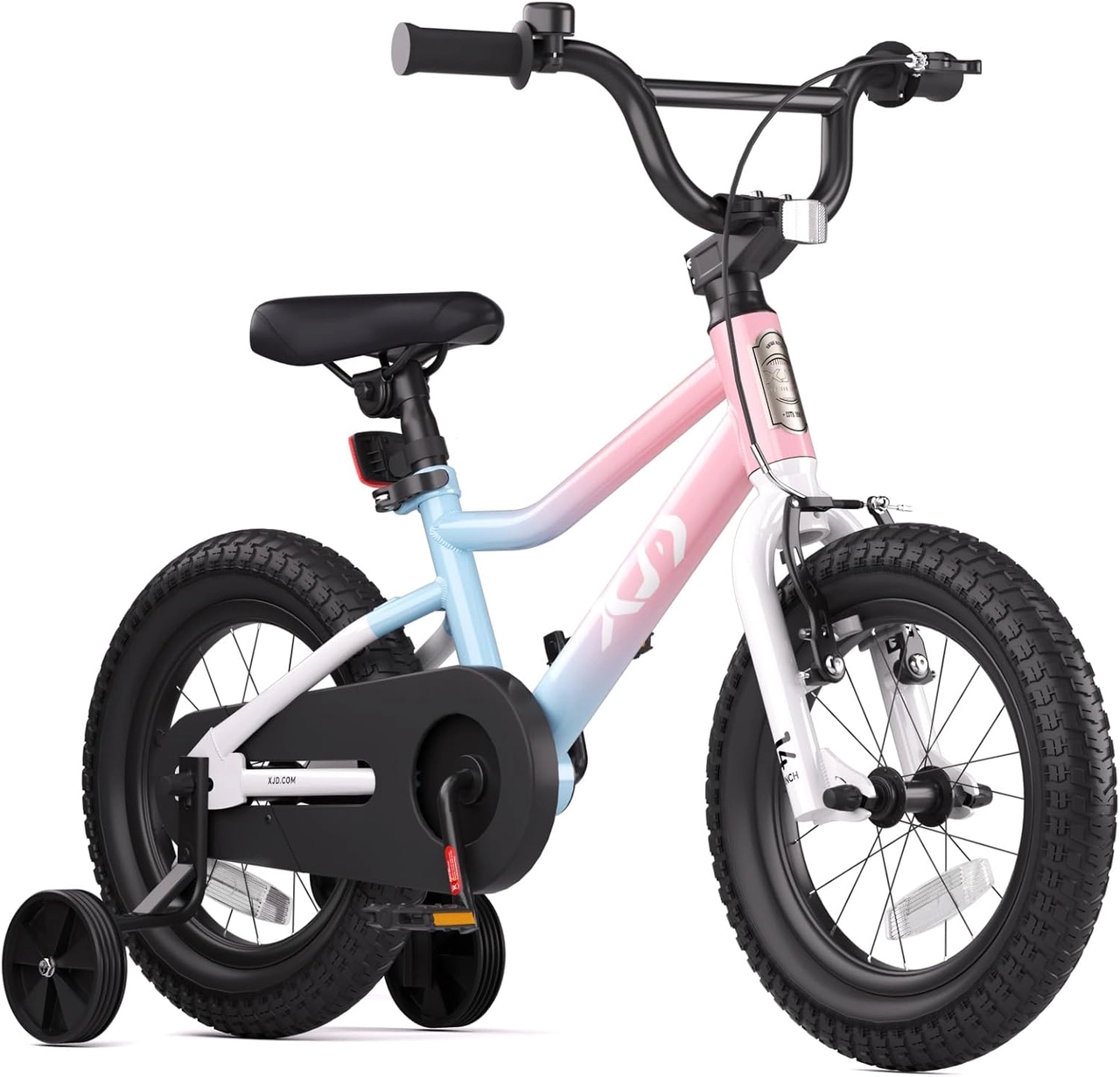 XJD Girls BMX Bike 12/14/16 Inch with Training Wheels – Pink Blue
Available in 12 Inch, 14 Inch and 16 Inch labels. Its 16-inch option is relevant only if the child fits the 40–48 in (102–122 cm) starting range and passes an individual control check.
 XJD Boys & Girls BMX Bike with Training Wheels, 12/14/16" – Blue
This Kids’ BMX Bike offers 12 Inch, 14 Inch and 16 Inch labels with training wheels. For a seven-year-old, the 16-inch option is the relevant comparison point, subject to measured height and hands-on fit.
XJD Girls BMX Bike 12/14/16 Inch with Training Wheels – Pink Blue is listed as a Kids’ BMX Bike with 12 Inch, 14 Inch and 16 Inch options. For a seven-year-old, only its 16-inch version overlaps the supplied age starting point, and it remains relevant only when his measured height and hands-on control support that size.
XJD Boys & Girls BMX Bike with Training Wheels, 12/14/16" – Blue is also a Kids’ BMX Bike offered in 12 Inch, 14 Inch and 16 Inch labels. Its 16-inch option is a comparison candidate for a rider within 40–48 in (102–122 cm), subject to the full fit check. The 12-inch and 14-inch labels should not be treated as suitable merely because they appear alongside it.
Training wheels are stated in both product titles, but the supplied facts do not specify setup, removal, compatibility or adjustment procedures. Follow the exact product manual or ask a qualified bicycle mechanic rather than improvising.
Include confidence in the decision
A confident rider may handle a correctly fitting larger candidate within his height range, while a cautious or new rider may control the smaller overlapping size more successfully. Confidence never overrides physical fit: he must still stand over, reach, steer and brake comfortably.
Do not choose a smaller or larger wheel solely because training wheels are present. Wheel size and riding support answer different questions, and both must suit the child’s current ability.
What to do next
- Measure his height and inseam without shoes.
- Use his height to shortlist 16, 18 or 20 inches from the XBikes ranges.
- Have him try each realistic candidate and compare stand-over, starts, stops, reach, turning and brake operation.
- Reject any size he cannot control comfortably today, even if it offers growing room.
- Before riding, use a properly fitting bicycle helmet that sits level, with straps secured according to its manufacturer’s instructions.
For your seven-year-old son, choose the smallest candidate among the relevant 16-, 18- or 20-inch range that passes every current fit and control check—not the size you hope he will grow into.
Bikes for your next adventure
-

Black XJD Kids Bike for Boys – 12, 14 & 16 Inch Sizes
For a son between roughly 3 and 8 years old, the XJD Kids Bike in Black covers t…$169
$199 -
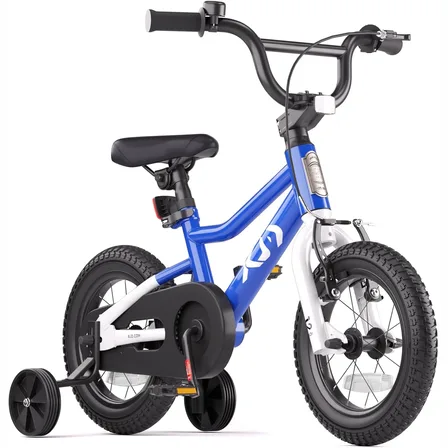
XJD Boys & Girls BMX Bike with Training Wheels, 12/14/16" – Blue
The XJD Boys & Girls BMX Bike in Blue is a first pedal bike for kids roughly age…$99.99
$119.99 -

Kids Bike Helmet by XJD for Boys & Girls – Black, Blue, Green, Pink, Purple
The XJD Kids Bike Helmet covers a wide 2-to-8-year age range thanks to two head-…$59.99