

What size bike for my 8 year old son
For most 8-year-old boys, start by comparing an 18 Inch or 20 Inch bike: use 18 Inch at 43–52 in (109–132 cm) and 20 Inch at 48–60 in (122–152 cm). Measure your son first, then confirm stand-over space, reach, brake control and confidence on the actual bicycle. Do not buy an oversized bike for future growth.
Choose the starting size from his measured height
Age places an 8-year-old within two overlapping XBikes starting ranges. Height is the more useful first comparison because children of the same age can differ considerably in proportions and riding ability.
| Wheel size | XBikes age starting point | Rider height | Relevance at age 8 |
|---|---|---|---|
| 18 Inch | Ages 5–9 | 43–52 in / 109–132 cm | Compare if his measured height falls in this range. |
| 20 Inch | Ages 7–12 | 48–60 in / 122–152 cm | Compare if his measured height falls in this range. |
| 24 Inch | Ages 10–14 | 54–64 in / 137–163 cm | Consider only if his height and an individual fit check support it; age alone does not. |
If his height is in the 48–52 in (122–132 cm) overlap, neither 18 Inch nor 20 Inch wins automatically. His inseam, body proportions, reach, control and current confidence should decide which frame fits.
Measure height and inseam before shopping
- Height: Have him stand upright without shoes against a wall, looking straight ahead. Mark the top of his head and measure from the floor to that mark.
- Inseam: With shoes off, have him stand naturally. Place a firm, level book between his legs to represent the saddle area, then measure from the floor to the top edge of the book.
- Record both measurements: Use height to select the wheel-size starting point. Keep the inseam measurement for comparing stand-over space and saddle adjustment on a specific bicycle.
Wheel diameter is only a category label; frames with the same wheel size can have different shapes and reach. That is why the final decision must be made on the actual model rather than from the wheel label alone.
Check the bicycle with your son on it
Have him try the bike in the footwear he will normally use. While standing over the frame, he should have clear space rather than being pressed against it. Seated in a normal riding position, he should reach the handlebars without an uncomfortable stretch or cramped posture.
Ask him to hold the grips and operate the brakes. He needs to reach and use the controls deliberately without shifting his hands into an unstable position. He should also be able to start, steer, stop and get off without the bicycle feeling intimidating or difficult to manage.
A smaller, controllable bicycle is preferable to an oversized one purchased for growth. If the fit is uncertain, compare both candidate sizes in person or ask a qualified bicycle mechanic to assess his position and control.
How the supplied catalog option helps
The supplied Girls' Training Wheel Bike by XJD with Basket – Purple is available with 14 Inch, 16 Inch and 20 Inch SKU labels. Its 20 Inch option is directly relevant when your son's measured height falls within the 20 Inch starting range; the 14 Inch and 16 Inch options are smaller comparison points, not equivalent fits. The product title is a catalog name, not evidence that it fits or does not fit a particular child.

This catalog selection does not include an 18 Inch SKU. If your son's measurements and test ride indicate 18 Inch, the displayed product is not a substitute; use its listed sizes only to understand the available comparison, then look for an actual 18 Inch bicycle to fit-check.
Know when training wheels are relevant
Because the supplied product is categorized as a training wheel bike, it may be relevant if your son currently needs that type of support and the 20 Inch version passes his individual fit check. Size and riding support are separate decisions: a correctly sized wheel label does not prove that the bicycle suits his balance, confidence or control needs.
If he already rides independently, do not assume a training wheel model is the appropriate next step merely because 20 Inch matches his height range. Compare the product category with his present ability and intended riding. Follow the exact product manual for assembly, adjustment, maintenance, compatibility and load limits, or use a qualified bicycle mechanic where the manual does not resolve a question.
Make the final size decision
- Choose an 18 Inch starting point when he measures 43–52 in (109–132 cm), subject to the complete fit check.
- Choose a 20 Inch starting point when he measures 48–60 in (122–152 cm), again subject to the complete fit check.
- Within the overlap, select the bicycle he can stand over, reach, brake, steer, start and stop with better control and confidence.
- Reject a bike that is oversized now, even if he may grow into it.
Before the first ride, provide a bicycle helmet that fits properly, sits level and has its straps used according to the helmet manufacturer's instructions. For your 8-year-old son, the next action is simple: measure his height and inseam, compare 18 Inch with 20 Inch where applicable, and buy only after he demonstrates comfortable control on the exact bicycle.
Bikes for your next adventure
-

Black XJD Kids Bike for Boys – 12, 14 & 16 Inch Sizes
For a son between roughly 3 and 8 years old, the XJD Kids Bike in Black covers t…$169
$199 -
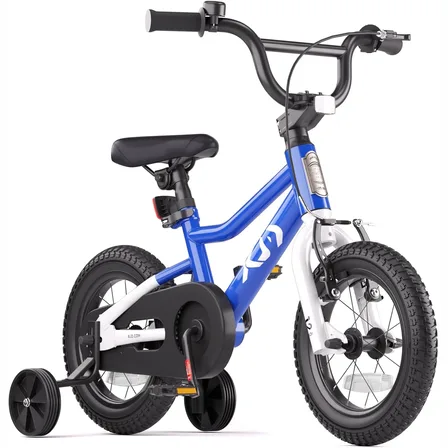
XJD Boys & Girls BMX Bike with Training Wheels, 12/14/16" – Blue
The XJD Boys & Girls BMX Bike in Blue is a first pedal bike for kids roughly age…$99.99
$119.99 -

Kids Bike Helmet by XJD for Boys & Girls – Black, Blue, Green, Pink, Purple
The XJD Kids Bike Helmet covers a wide 2-to-8-year age range thanks to two head-…$59.99