

What size bike frame for 10 year old
Most 10-year-olds should start by comparing 20-inch and 24-inch bikes, then choose by measured height and an in-person fit check—not age alone.
The practical size answer
Measure the child’s current standing height without shoes. Under the XBikes starting points, a 20-inch bike corresponds to riders 48–60 inches (122–152 cm) tall, while a 24-inch bike corresponds to 54–64 inches (137–163 cm). Both ranges include age 10, so children between 54 and 60 inches need to compare both sizes for stand-over clearance, reach, brake control and confidence.
A rider taller than 60 inches (153 cm) may also compare a 26-inch bike, which XBikes lists for youth and adults over that height. A child outside these starting ranges should not be moved into a listed size merely because it is commonly associated with their age.
| Wheel size | XBikes starting age | Rider height | Use at age 10 |
|---|---|---|---|
| 20 Inch | 7–12 | 48–60 in / 122–152 cm | Compare when height is within this range |
| 24 Inch | 10–14 | 54–64 in / 137–163 cm | Compare when height is within this range |
| 26 Inch | Youth and adults | Over 60 in / 153 cm | Consider only above the stated height and after a fit check |
Measure before choosing
Record standing height first, then measure inseam so you can assess how the child stands over the actual bicycle. Use the bicycle or product manual’s measuring directions where provided; frame shapes differ, so inseam should not be converted into a wheel size using an invented formula.
Have the child straddle the bicycle while wearing the shoes normally used for riding. Check that the frame does not prevent comfortable stand-over clearance. Then place the child in the riding position and observe whether the handlebar can be reached without an awkward stretch or cramped posture.
These checks matter more than a birthday. Two 10-year-olds of the same height can differ in leg length, arm reach and riding confidence.
Compare control, not just clearance
A promising size should let the child start, stop, steer and dismount with control. Confirm that the child can comfortably reach and operate the brakes while maintaining a secure grip. The controls should not require strained fingers, an excessive reach or a major shift of the hands.
Ask the child to try the bicycle in a suitable controlled area. Watch for hesitant starts, difficulty turning, unstable stops or fear caused by the bicycle feeling too large. Current confidence is part of fit: a size that matches a height chart can still be unsuitable if the rider cannot control it comfortably.
Do not choose an oversized bicycle solely to leave room for growth. The verified pediatric guidance emphasizes trying the bicycle and checking stand-over, general control and brake reach before purchase.
How the supplied XBikes options help
The two catalog options provide relevant size comparison points because both include a 20 Inch SKU, while one also includes 24 Inch and 26 Inch choices. Their listed sizes help narrow what to try, but the SKU label alone cannot confirm frame fit.
 XJD Pink Beach Cruiser for Girls – Rear Rack & V-Brake
Available in 20 Inch, 24 Inch and 26 Inch labels, this beach cruiser provides three useful size comparison points for a 10-year-old, subject to measured height and an individual fit check.
 Girls' Training Wheel Bike by XJD with Basket – Purple
Its 20 Inch label may be relevant for a rider 48–60 inches tall; the supplied 14 Inch and 16 Inch choices do not replace a required 20- or 24-inch fit.
XJD Pink Beach Cruiser for Girls – Rear Rack & V-Brake
This model is offered in 20 Inch, 24 Inch and 26 Inch SKU labels. That makes it useful for comparing all three relevant starting points: 20 and 24 inches for many 10-year-olds, plus 26 inches only for a rider over 60 inches (153 cm). The exact product title identifies it as a beach cruiser and mentions a rear rack and V-brake; confirm actual stand-over, reach and brake operation on the chosen size.
Girls' Training Wheel Bike by XJD with Basket – Purple
This model is offered in 14 Inch, 16 Inch and 20 Inch SKU labels. For the title question, only its 20 Inch option overlaps the usual age-10 comparison, and only when the child is within the 48–60 inch (122–152 cm) height range and passes the individual fit check. Its smaller SKUs are not equivalent substitutes for a 20- or 24-inch need.
Because this model has no supplied 24 Inch or 26 Inch SKU, it is not the relevant catalog option when the fit check points to either of those wheel sizes. Treat “Training Wheel” in its exact catalog title as a product descriptor, not evidence that it matches a particular child’s ability.
Final check before deciding
- Measure standing height and inseam.
- Use height to shortlist 20 Inch, 24 Inch or, above 60 inches, 26 Inch.
- Have the child try each shortlisted bicycle and check stand-over, reach, steering, starts and stops.
- Confirm comfortable brake reach and operation.
- Choose the size the child controls now, rather than sizing up for future growth.
Fit a bicycle helmet so it sits level and use its straps according to the helmet manufacturer’s instructions. Follow the exact bicycle manual or consult a qualified bicycle mechanic for assembly, adjustments, compatibility, maintenance, load limits or torque details not supplied here.
For a 10-year-old, decide between 20 and 24 inches from measured height, then let the real-world control check settle any overlap; consider 26 inches only when the rider is over 60 inches tall and fits it confidently.
Bikes for your next adventure
-

XJD Girls Bike for Kids Ages 3-8, 12/14/16 Inch with Training Wheels – Purple
The XJD Girls Bike in Purple is a training-wheel bicycle for kids ages 3 to 8, f…$149
$169 -

Pink Girls' 12/14/16" Bike by XJD – Basket & Doll Seat
The XJD Pink Girls' Bike with Basket & Doll Seat is made for riders 71–122 cm ta…$75.99
$99.99 -
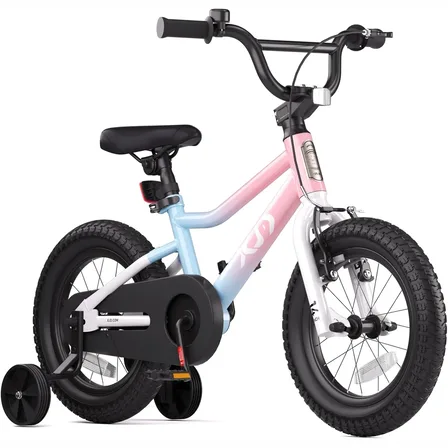
XJD Girls BMX Bike 12/14/16 Inch with Training Wheels – Pink Blue
The XJD Girls BMX Bike in Pink/Blue is built as a first pedal bike for kids roug…$99.99
$119.99