

What size bike is best for 10 year old
For most 10-year-olds, start by comparing 20-inch and 24-inch bikes. Choose by measured height and individual fit: 20 Inch covers 48–60 in (122–152 cm), while 24 Inch covers 54–64 in (137–163 cm).
Which size should you try first?
Age ten falls within both XBikes starting ranges: 20 Inch is listed for ages 7–12, and 24 Inch for ages 10–14. The overlap means age cannot settle the choice. Measure the child, then use height to decide which wheel size to test first.
- Below 54 in (137 cm): begin with a 20-inch bike.
- From 54 to 60 in (137–152 cm): compare both 20-inch and 24-inch bikes in person. Fit, reach and confidence should decide.
- From 60 to 64 in (153–163 cm): begin with a 24-inch bike. A 26-inch model may also be a comparison once the rider is over 60 in (153 cm), but it still must pass the full fit check.
These ranges are starting points, not guarantees. Frame shapes and control positions can differ even when two bicycles have the same wheel size.
Measure height and inseam before shopping
Measure standing height without shoes, with the child upright against a wall. For inseam, have the child stand with feet slightly apart and measure from the floor to the crotch. Record both measurements in inches or centimetres rather than estimating from clothing size.
Height identifies a sensible wheel-size range. Inseam helps you judge stand-over clearance when the actual bicycle is available. The supplied standard does not give a numerical inseam requirement, so do not invent one or rely on wheel diameter alone.
Perform the fit check on the actual bike
Have the child try the bicycle. The American Academy of Pediatrics guidance supports checking stand-over, control and brake reach, and warns against buying an oversized bicycle merely for future growth.
- Stand-over: ask the child to straddle the bicycle with both feet planted. They should be able to stand securely rather than being forced onto tiptoes or against the frame.
- Reach: while seated, check that the child can hold the handlebar without stretching, locking the elbows or leaning excessively.
- Brake control: confirm that the child can comfortably reach and operate the brake controls while maintaining a stable grip.
- Confidence: in a suitable controlled area, look for easy starts, steady steering and controlled stops. A technically plausible size is still wrong if the rider cannot control it confidently.
Do not assume a larger wheel is an upgrade. If a 24-inch bicycle compromises stand-over, reach or braking, select a properly fitting 20-inch bicycle instead.
How the supplied XBikes options compare
The catalog options below provide relevant 20-inch and 24-inch comparison points, plus 26-inch choices for a taller rider. Their available size labels help narrow what to try, but they do not replace measurements or an individual fit check.
 Pink 12/14/16/20" XJD Girls Bike with Training Wheels & Basket
The 20 Inch option is the relevant age-ten starting point; the same product also has 12 Inch, 14 Inch and 16 Inch labels, which fall below the usual starting ranges for this question.
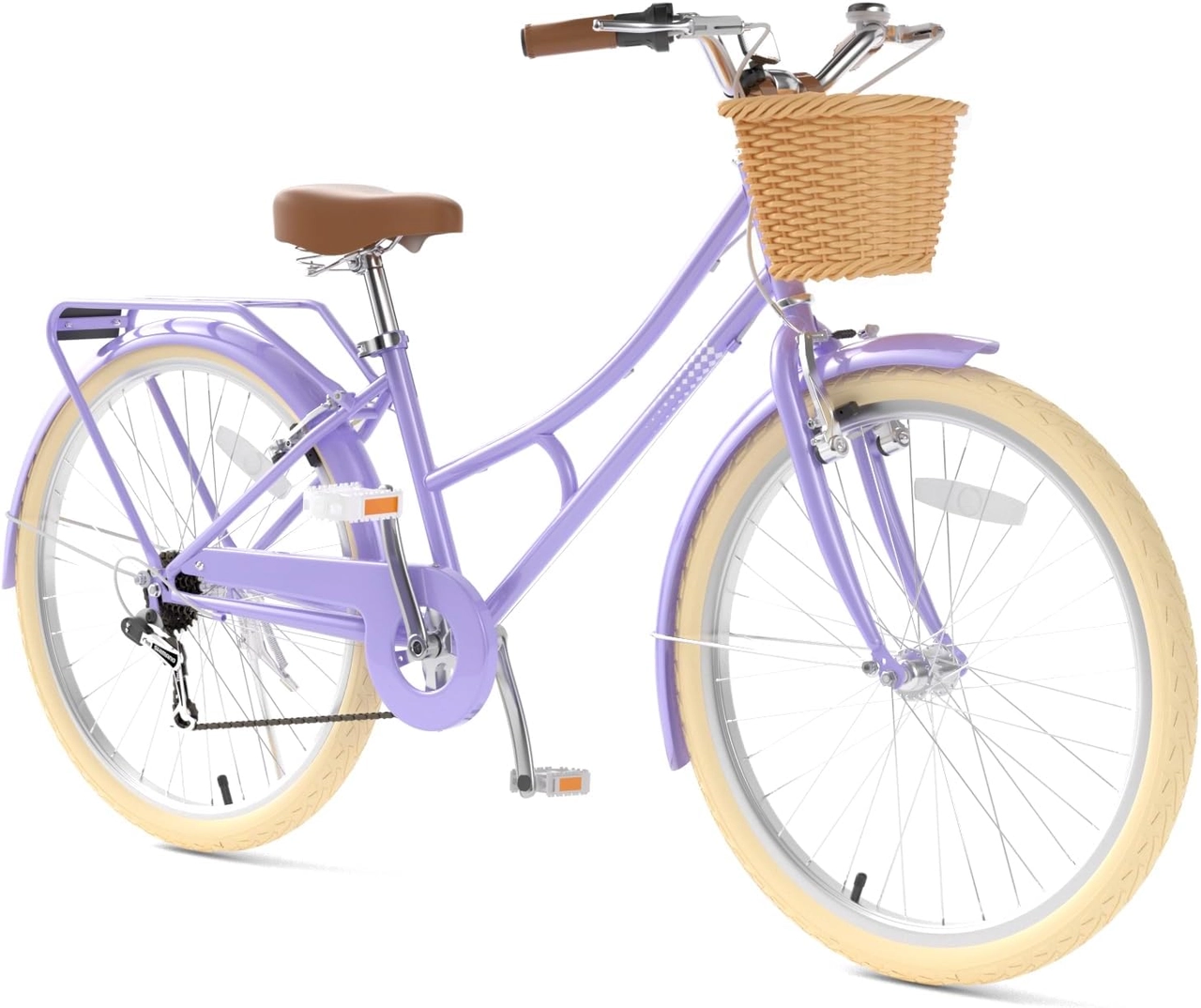 26-Inch XJD Beach Cruiser Bike for Girls – Purple, V-Brake
Available 20 Inch and 24 Inch labels support direct comparison for many 10-year-olds. Its 26 Inch labels are relevant only for riders over 60 in (153 cm) who pass an individual fit check.
 XJD 24-Inch Green Beach Cruiser Bike with U-Brake
Its 24 Inch labels match the 54–64 in (137–163 cm) starting range. The listed 26 Inch option is a comparison only for a rider over 60 in (153 cm), subject to fit.
The Pink 12/14/16/20" XJD Girls Bike with Training Wheels & Basket is available in 12 Inch, 14 Inch, 16 Inch and 20 Inch. For this question, its 20 Inch option is the relevant starting point. The smaller labels fall below the usual age-ten starting ranges, although actual fit still governs.
The 26-Inch XJD Beach Cruiser Bike for Girls – Purple, V-Brake has available labels spanning 20 Inch, 24 Inch and 26 Inch in the listed colours. That makes it useful for comparing the overlapping 20-inch and 24-inch ranges, while its 26-inch options are relevant only once the rider is over 60 in (153 cm) and fits confidently.
The XJD 24-Inch Green Beach Cruiser Bike with U-Brake is available with Green / 24 Inch, Pink / 24 Inch and Pink / 26 Inch labels. Its 24-inch choices align with the 54–64 in (137–163 cm) starting range; the 26-inch label should be considered only above 60 in (153 cm), subject to the same checks.
Check setup and helmet fit
Once a size passes the fit test, follow the exact product manual for assembly, adjustments, compatibility, maintenance, load limits and torque instructions. If the manual is unavailable or the setup is uncertain, use a qualified bicycle mechanic rather than guessing.
A bicycle helmet must fit properly, sit level and have its straps used according to the helmet manufacturer’s instructions, consistent with U.S. Consumer Product Safety Commission guidance. Helmet fit does not compensate for a bicycle that is too large or difficult to control.
Make the decision
Measure first: try 20 Inch below 54 in (137 cm), compare 20 Inch and 24 Inch throughout their 54–60 in overlap, and begin with 24 Inch from 60 to 64 in (153–163 cm). Buy only after the child demonstrates secure stand-over, comfortable reach, reliable brake operation and confident control on that exact bike.
Bikes for your next adventure
-

XJD Girls Bike for Kids Ages 3-8, 12/14/16 Inch with Training Wheels – Purple
The XJD Girls Bike in Purple is a training-wheel bicycle for kids ages 3 to 8, f…$149
$169 -

Pink Girls' 12/14/16" Bike by XJD – Basket & Doll Seat
The XJD Pink Girls' Bike with Basket & Doll Seat is made for riders 71–122 cm ta…$75.99
$99.99 -

Light Purple XJD Toddler Bike Helmet, Adjustable, Size XS (46–51 cm)
This Light Purple XJD toddler bike helmet is made for the smallest riders — the …$20.39