

What size bike is for a 10 year old
For a 10-year-old, start with a 20-inch or 24-inch bike. Use the child’s measured height—not age alone—to choose: 20-inch suits 48–60 in (122–152 cm), while 24-inch starts at 54 in (137 cm).
Choose between 20-inch and 24-inch
At age 10, a rider may fall within both XBikes starting ranges. The overlap is intentional: wheel size is only a starting point, and two children of the same age can need different bikes because their height, inseam, reach, coordination and confidence differ.
| Wheel size | XBikes age starting point | Rider height starting point |
|---|---|---|
| 20 Inch | Ages 7–12 | 48–60 in / 122–152 cm |
| 24 Inch | Ages 10–14 | 54–64 in / 137–163 cm |
| 26 Inch | Youth and adults | Over 60 in / 153 cm |
If the child is under 54 in (137 cm), begin with a 20-inch model. From 54 to 60 in (137–152 cm), compare both 20-inch and 24-inch bikes in person. From 60 to 64 in (153–163 cm), a 24-inch bike remains within its stated range; a 26-inch option can also be assessed because its range begins above 60 in (153 cm). Do not move up automatically—the better size is the one the child can control confidently.
Measure the rider before comparing bikes
Measure height without shoes, with the child standing straight against a wall. Then measure inseam from the floor to the crotch while the child stands naturally. Record both measurements rather than relying on clothing size or a previous bicycle.
Height narrows the wheel-size choice. Inseam helps assess whether the child can stand over the actual frame comfortably. Because frame shapes vary, an inseam measurement should be compared with the manufacturer’s fit information for the exact bicycle rather than converted into a universal wheel size.
Check the actual fit and controls
Have the child try the bicycle whenever possible. They should be able to stand over the frame without the bike trapping or unbalancing them. Seated, they need a comfortable reach to the handlebar, with no excessive stretching or cramped posture.
Ask the rider to hold the handlebar and operate each brake control. They must be able to reach and use the controls reliably while keeping the bicycle steady. Also observe starting, stopping, turning and placing a foot down. A size that matches the height table can still be unsuitable if reach, stand-over clearance or control is poor.
Current confidence matters. A less-experienced rider may handle a smaller, familiar-feeling bicycle more successfully than a larger one within the same height overlap. Do not buy an oversized bike merely to allow room for growth; immediate control takes priority.
How the supplied 24-inch and 26-inch bikes help
The catalog options supplied here are useful comparison points for a 10-year-old who is tall enough to assess a 24-inch bike, or for a rider over 60 in (153 cm) who may also compare a 26-inch option. They do not establish fit by themselves: the child still needs the measurement and control checks above.
XJD 24-Inch Green Beach Cruiser Bike with U-Brake is available in Green / 24 Inch, Pink / 24 Inch and Pink / 26 Inch labels. Pink XJD Beach Cruiser Bike, 24"/26", U-Brake is available with 24 Inch and 26 Inch labels. These choices allow a family to compare the two relevant larger wheel-size starting points while keeping the individual fit decision separate.
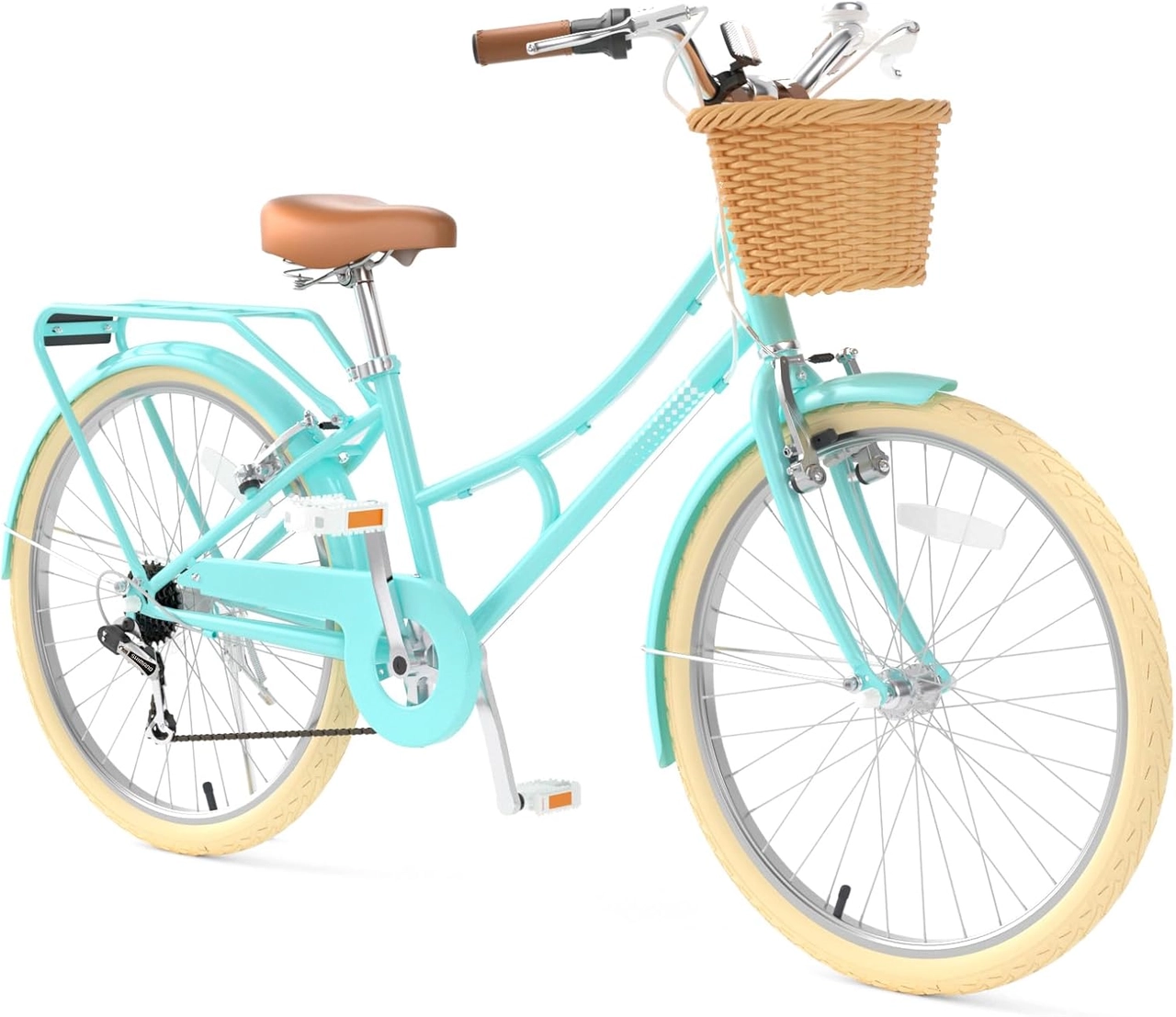 XJD 24-Inch Green Beach Cruiser Bike with U-Brake
A 24-inch comparison option for riders measuring at least 54 in (137 cm); its supplied labels also include a 26-inch choice for assessment above 60 in (153 cm). Individual fit remains essential.
 Pink XJD Beach Cruiser Bike, 24"/26", U-Brake
Available with 24-inch and 26-inch labels, making it relevant when comparing larger starting sizes for a 10-year-old who meets the supplied height ranges and can operate the bike confidently.
For a child below 54 in (137 cm), neither product’s supplied 24-inch or 26-inch option should replace a proper comparison with a 20-inch bike. Likewise, a 26-inch label is not equivalent to a 24-inch fit: assess it only when the rider is over 60 in (153 cm), and still reject it if stand-over, reach or control is unsuitable.
Do these checks before riding
- Confirm the chosen wheel size against the child’s current measured height.
- Check stand-over position, seated reach and access to every brake control on the exact bike.
- Have the child demonstrate a controlled start, turn, stop and foot-down movement in a suitable supervised area.
- Follow the exact product manual for assembly, adjustment, maintenance, compatibility, load limits and torque. If anything is unclear, use a qualified bicycle mechanic.
- Use a properly fitting bicycle helmet. It should sit level, with its straps adjusted according to the helmet manufacturer’s instructions.
The decision for your 10-year-old
Choose 20-inch below 54 in (137 cm); compare 20-inch and 24-inch from 54 to 60 in (137–152 cm); and begin with 24-inch above that, considering 26-inch only over 60 in (153 cm). Measure today, try the exact frame, and buy only when the child can stand over, reach, brake and steer with confidence.
Bikes for your next adventure
-

Light Purple XJD Toddler Bike Helmet, Adjustable, Size XS (46–51 cm)
This Light Purple XJD toddler bike helmet is made for the smallest riders — the …$20.39
-

Pink Girls' 12/14/16" Bike by XJD – Basket & Doll Seat
The XJD Pink Girls' Bike with Basket & Doll Seat is made for riders 71–122 cm ta…$75.99
$99.99 -

XJD Girls Bike for Kids Ages 3-8, 12/14/16 Inch with Training Wheels – Purple
The XJD Girls Bike in Purple is a training-wheel bicycle for kids ages 3 to 8, f…$149
$169