

What size bike is ideal for a 5 year old
For a 5-year-old, compare a 14-, 16- or 18-inch bike according to measured height: 14 inch for 37–45 in, 16 inch for 40–48 in, and 18 inch for 43–52 in. Most importantly, confirm stand-over clearance, reach, braking control and confidence on the actual bike.
Choose by height, not the fifth birthday
Five-year-olds can fall within several wheel-size ranges. Age identifies sensible starting points, but it cannot show whether a child can mount, stop or steer a particular bicycle comfortably. Measure the rider before choosing, then arrange an individual fit check.
| Wheel size | XBikes age starting point | Rider height |
|---|---|---|
| 14 Inch | Ages 3–6 | 37–45 in / 94–114 cm |
| 16 Inch | Ages 4–7 | 40–48 in / 102–122 cm |
| 18 Inch | Ages 5–9 | 43–52 in / 109–132 cm |
Use every overlapping row as a comparison, not an automatic answer. For example, a child measuring 44 inches falls within all three height ranges. Trying the bikes is then essential: the larger wheel is not automatically preferable, and an oversized bicycle should not be bought merely to allow room for growth.
Measure height and inseam
Measure height with the child standing straight against a wall without shoes. Keep the feet flat and level, mark the top of the head, and measure from the floor to the mark. Compare that result with the table first.
Next, measure inseam. With shoes off and feet slightly apart, place a firm, thin book upright between the legs to represent the saddle area. Measure from the floor to the top edge of the book. The supplied wheel-size standard does not assign numerical inseam limits, so use this measurement when checking the exact bicycle’s stand-over space and saddle adjustment rather than converting it into a wheel size.
Perform the fit check on the actual bike
Have the child try each candidate with an adult steadying the bicycle. A suitable fit lets the rider get on and off without struggling and stand over the bicycle without being pressed against the frame. Follow the exact product manual for saddle adjustment, assembly and any limits; ask a qualified bicycle mechanic when the instructions or fit are unclear.
While seated, the child should reach the handlebar without stretching, locking the elbows or losing a balanced posture. Ask the rider to turn the handlebar both ways and confirm that steering remains controlled. Their hands must also reach and operate the brakes confidently. Do not assume a brake control is usable simply because the height range matches.
Finally, watch a short, supervised start, straight ride, turn and stop in a traffic-free area. A child who freezes, wobbles excessively or cannot stop on command may need a smaller or more manageable fit, even if a larger size also appears in the height table. Current confidence is part of the decision.
How the supplied bikes help with comparison
The catalog options below provide 12-, 14-, 16- and 20-inch SKU labels across three training-wheel bike listings. For the title question, their 14- and 16-inch versions are relevant comparison candidates when the child’s measured height fits those XBikes ranges. None offers an 18-inch SKU, so these products are not substitutes when an individual fit check points to an 18-inch bicycle.
 Girls' Training Wheel Bike by XJD with Basket – Purple
Offers 14 Inch and 16 Inch comparison choices within the main age-five starting ranges, plus a 20 Inch SKU whose XBikes starting range begins at age seven and 48 inches.
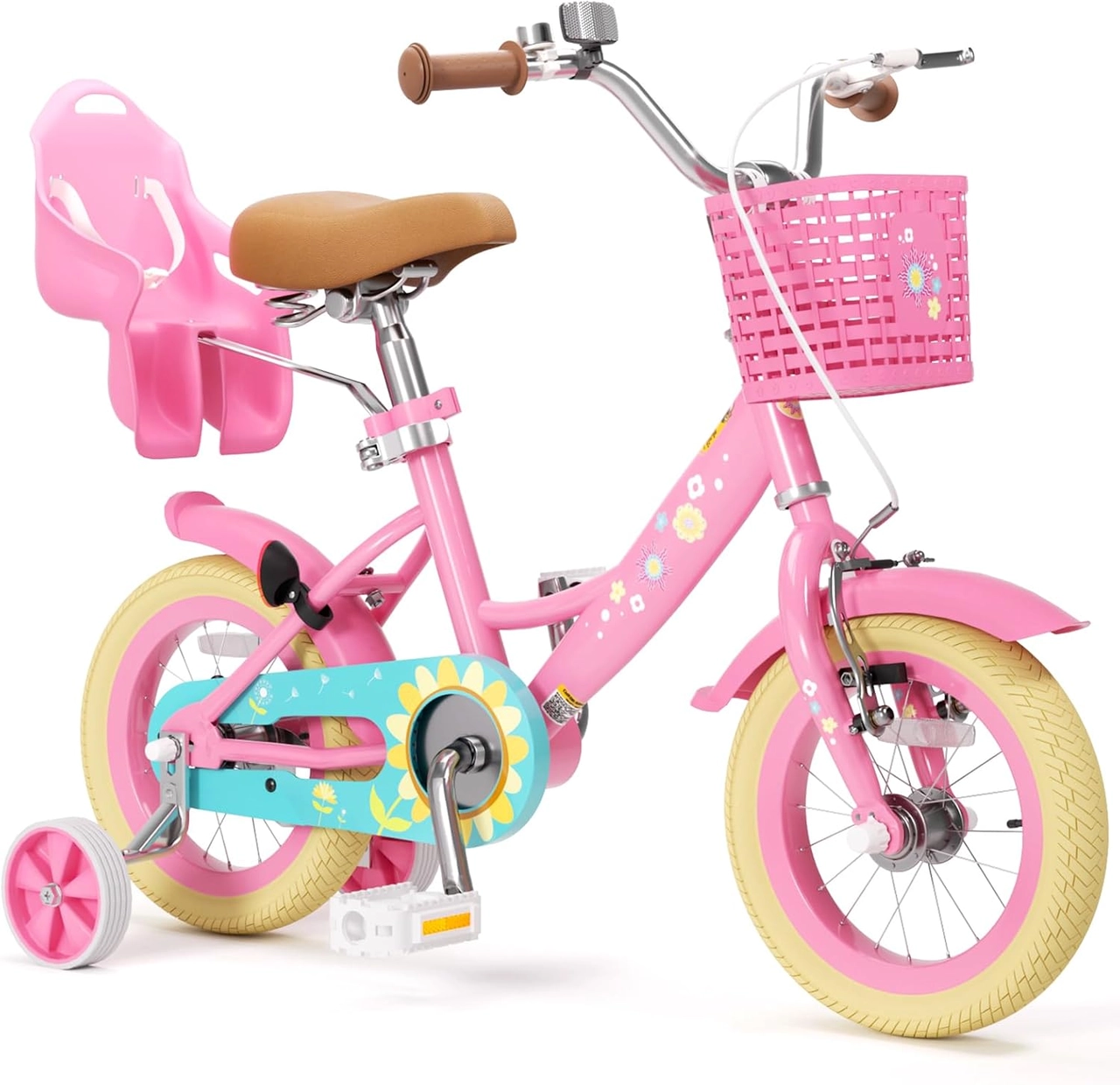 Flower Pink XJD Girls Bike with Doll Seat & Basket
Its 14 Inch and 16 Inch SKU labels make it relevant for measured age-five riders within those height ranges. The 12 Inch option requires an individual fit check and is not selected by age alone.
 Purple XJD Girls' Bike with Doll Seat & Basket
Provides 12 Inch, 14 Inch and 16 Inch SKU labels. For a 5-year-old, the 14- and 16-inch versions are the directly relevant starting comparisons when measured height and hands-on fit agree.
Girls' Training Wheel Bike by XJD with Basket – Purple has 14 Inch, 16 Inch and 20 Inch SKU labels. Compare its 14- and 16-inch versions for an appropriately measured 5-year-old. The 20-inch starting range is ages 7–12 and 48–60 in / 122–152 cm, so age five alone does not support choosing it.
Flower Pink XJD Girls Bike with Doll Seat & Basket and Purple XJD Girls' Bike with Doll Seat & Basket each have 12 Inch, 14 Inch and 16 Inch SKU labels. Their 14- and 16-inch choices overlap the relevant age-five starting points. Although a child’s height can overlap another range, the 12-inch standard is ages 3–4 and 34–40 in / 86–102 cm; judge any candidate through the complete fit check, not its label alone.
Make the final decision
Choose the smallest candidate among the appropriate height ranges that still provides a comfortable individual fit and allows confident steering and braking; do not size up solely for future growth. Before riding, add a properly fitting bicycle helmet that sits level and has its straps adjusted according to the helmet manufacturer’s instructions.
For your 5-year-old, measure height and inseam now, shortlist the matching 14-, 16- or 18-inch range, and have the child demonstrate mounting, reach, steering and stopping before you select the size.
Bikes for your next adventure
-

Black XJD Toddler Bike Helmet, Adjustable – Kids' Protective Helmet
The XJD Toddler Bike Helmet in black is an adjustable protective helmet for kids…$20.39
-
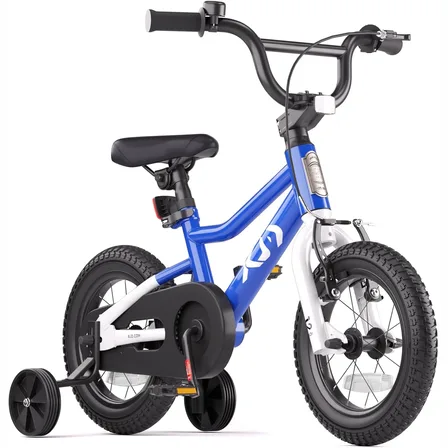
XJD Boys & Girls BMX Bike with Training Wheels, 12/14/16" – Blue
The XJD Boys & Girls BMX Bike in Blue is a first pedal bike for kids roughly age…$99.99
$119.99 -
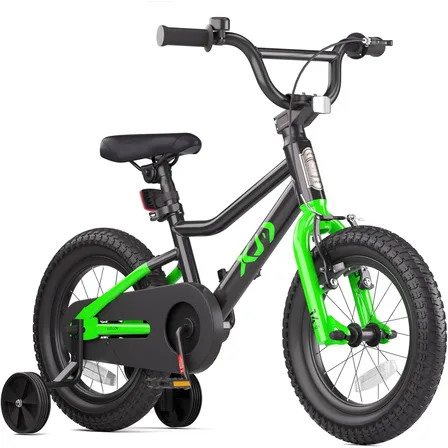
Black XJD Kids' BMX Bicycle with Training Wheels
The XJD Kids' BMX Bicycle with Training Wheels is built for children roughly 3 t…$99.99
$119.99