

What size bike is next after 12 in
The next bike wheel size after 12 inches is 14 inches. Measure your child and check the actual fit before moving up; do not choose a larger bike merely to leave growing room.
Is 14 inches always the right next bike?
Fourteen inches is the next size in the XBikes sequence, but it is a comparison point rather than an automatic prescription. The XBikes starting range for a 14-inch bike is ages 3–6 and a rider height of 37–45 inches (94–114 cm). Height is more useful than age, and neither replaces an individual fit check.
A child near the upper end of a 12-inch bike’s range may be ready to try 14 inches. A child who is already tall enough for the next range might also compare a 16-inch model, but only if they can stand over, reach, steer and brake confidently. Skipping directly to 16 inches is not worthwhile when the larger bike compromises control.
Measure before comparing sizes
Measure the child without shoes, standing straight against a wall. Record total height from the floor to the top of the head. Then measure inseam from the floor to the crotch, using a firm book held level to approximate where the saddle meets the body.
Use height to select which bikes to try. Use inseam to evaluate clearance and whether the child can get on, stop and stabilize comfortably. Bicycle geometry varies, so wheel diameter alone cannot establish stand-over clearance or saddle fit.
| Wheel size | XBikes age starting point | XBikes rider-height starting point |
|---|---|---|
| 12 Inch | Ages 3–4 | 34–40 in / 86–102 cm |
| 14 Inch | Ages 3–6 | 37–45 in / 94–114 cm |
| 16 Inch | Ages 4–7 | 40–48 in / 102–122 cm |
The ranges overlap intentionally: a 40-inch rider, for example, falls within all three starting ranges. That overlap is a reason to compare real fit and control, not a reason to choose the largest wheel.
What to check during the test ride
Have the child try each candidate bike in a clear, controlled area with close adult supervision. A suitable next size should let the rider manage the bike rather than merely reach the pedals.
- Stand-over: Check that the child can straddle the bicycle with usable clearance and remain balanced. Do not rely on wheel size to predict this.
- Starting and stopping: The rider should be able to start without wrestling the bike and stop in control.
- Reach: Hands should reach the handlebar naturally without an excessive stretch or a cramped posture.
- Steering: The child should turn and correct direction without the bike feeling too large or cumbersome.
- Brake control: Confirm that the child can reach and operate the bike’s braking controls reliably. Follow the exact product manual for operation and adjustment.
- Confidence: Watch for hesitation caused by size. Previous skill on a 12-inch bike does not guarantee immediate control of a larger one.
How the supplied catalog option helps
The Girls' Training Wheel Bike by XJD, 12–20 Inch Wheels – Blue is relevant because its supplied catalog labels include 12 Inch, 14 Inch, 16 Inch and 20 Inch. That makes its 12-, 14- and 16-inch choices useful comparison points for the step described here. The 20-inch label is a later size in the sequence, not an equal substitute for 14 inches; its XBikes starting range is ages 7–12 and 48–60 inches (122–152 cm).
These catalog choices help you compare the current 12-inch size with the immediate 14-inch step and the following 16-inch step while keeping the decision tied to measured height and an actual fit check.

The product title identifies it as a training-wheel bike, but the supplied facts do not establish whether its training wheels, adjustments or other components match another bicycle. For assembly, compatibility, maintenance, load limits and torque requirements, follow the exact product manual or ask a qualified bicycle mechanic.
Do not size up only for growth
An oversized bicycle can make mounting, balancing, steering and braking harder. If the child fits the 12-inch range and cannot confidently control a 14-inch trial bike, remain with the better-fitting size and reassess after growth or skill changes. Conversely, do not keep a child on 12 inches solely because of age when measured height and a hands-on comparison indicate that 14 inches fits properly.
Age ranges are only starting points. Prioritize measured height, inseam, stand-over clearance, reach, brake control and the child’s present confidence every time.
Make the next-size decision
- Measure height and inseam.
- If height is within 37–45 inches (94–114 cm), begin by trying a 14-inch bike.
- Compare stand-over, reach, starting, steering and braking with the current 12-inch bike.
- Choose 14 inches only when the child controls it comfortably; otherwise keep the correctly fitting 12-inch bike and check again later.
Before riding, use a properly fitting bicycle helmet. It should sit level, with its straps used according to the helmet manufacturer’s instructions. The practical answer is therefore 14 inches next—but the bike to take home is the 14-inch option only after the child passes the fit and control checks.
Bikes for your next adventure
-
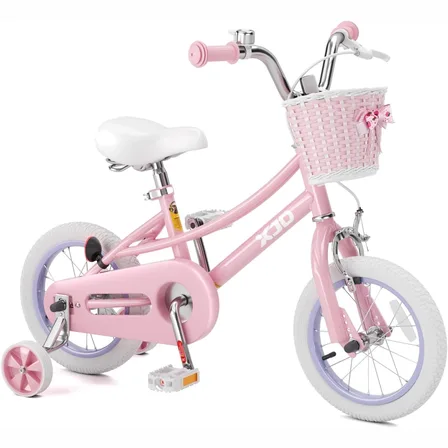
Pink 12/14/16/20" XJD Girls Bike with Training Wheels & Basket
The Pink XJD Girls Bike with Training Wheels & Basket is a first-bike pick f…$65.99
$75.99 -

Black XJD Toddler Bike Helmet, Adjustable – Kids' Protective Helmet
The XJD Toddler Bike Helmet in black is an adjustable protective helmet for kids…$20.39
-

Kids Bike Helmet by XJD for Boys & Girls – Black, Blue, Green, Pink, Purple
The XJD Kids Bike Helmet covers a wide 2-to-8-year age range thanks to two head-…$59.99