

What size bike should a 5 year old ride
Most 5-year-olds should start by trying a 14- or 16-inch bike; consider 18 inches only when measured height and an individual fit check support it.
Choose the trial size from height, not age alone
Measure the child’s height without shoes, standing straight against a wall. Then compare that measurement with the XBikes starting points below. Age narrows the search, but height, inseam, reach, brake control and confidence decide whether a particular bicycle actually fits.
| Wheel size | XBikes age starting point | Rider height starting point | Meaning for a 5-year-old |
|---|---|---|---|
| 12 Inch | Ages 3–4 | 34–40 in / 86–102 cm | Not the usual age match, but height and a successful fit check matter more than age. |
| 14 Inch | Ages 3–6 | 37–45 in / 94–114 cm | A likely trial size within both the age and height guidance. |
| 16 Inch | Ages 4–7 | 40–48 in / 102–122 cm | Another likely trial size, especially for a taller or more confident rider. |
| 18 Inch | Ages 5–9 | 43–52 in / 109–132 cm | Worth trying when the child is tall enough and remains fully in control. |
| 20 Inch | Ages 7–12 | 48–60 in / 122–152 cm | Outside the usual age starting point; consider only for sufficient height and a convincing fit. |
If the measurement falls in an overlap—such as 43 inches, which appears in the 14-, 16- and 18-inch ranges—do not choose from the chart alone. Arrange a hands-on comparison, beginning with the smaller plausible sizes.
Measure inseam before the child tries the bike
Height identifies candidates; inseam helps reveal whether the frame gives workable clearance. With the child wearing normal riding shoes, place a book firmly between the legs as though it were a bicycle saddle. Keep it level, then measure from the floor to the top edge.
Compare that measurement with the actual stand-over dimensions provided for the exact bicycle or check the fit in person. No stand-over measurements are supplied for the catalog products here, so the wheel label cannot confirm clearance by itself.
Run a simple fit check
Have the child try the assembled bicycle rather than buying a larger model for future growth. A suitable candidate should pass all of these checks:
- Stand-over: the child can straddle the bicycle with practical clearance and without leaning it sharply.
- Starting and stopping: the child can get on, begin moving and stop without struggling against the bicycle’s size.
- Reach: the handlebars are reachable without locking the elbows, stretching the torso or losing a stable seated position.
- Brake control: the child can reach and operate the fitted braking controls reliably. Wheel size does not prove this.
- Confidence: steering, turning and putting a foot down look controlled rather than hesitant or forced.
If a larger option fails any check, move down a size even when it appears to offer more growing room. If the smaller option feels cramped or prevents normal control, compare the next size up.
How the supplied XBikes options relate
The supplied catalog options are relevant because all three are listed as Training Wheel Bikes and offer 14- and 16-inch size labels—the two most likely starting trials for many 5-year-olds. They also provide adjacent sizes for children whose measurements point elsewhere, but each still requires the same individual fit check.
 Black XJD Kids Bike for Boys – 12, 14 & 16 Inch Sizes
Available in 12-, 14- and 16-inch labels, this Training Wheel Bikes option covers both common starting trials for a 5-year-old, subject to height and hands-on fit checks.
 Light Pink XJD Girls' Bicycle with Basket & Training Wheels
This Training Wheel Bikes option has 12-, 14-, 16- and 20-inch labels. The 14- and 16-inch choices are most directly relevant; 20 inches needs sufficient measured height and a successful fit check.
 Blue XJD Girls Bike with Training Wheels – 12/14/16 Inch
Offered with 12-, 14- and 16-inch labels in the Training Wheel Bikes category, this model includes the two likely starting comparisons but still requires checks for clearance, reach and control.
Black XJD Kids Bike for Boys – 12, 14 & 16 Inch Sizes is offered in 12 Inch, 14 Inch and 16 Inch labels. It supports comparison across the smaller likely candidates, but it does not provide an 18-inch option.
Light Pink XJD Girls' Bicycle with Basket & Training Wheels is offered in 12 Inch, 14 Inch, 16 Inch and 20 Inch labels. Its 14- and 16-inch choices are directly relevant; the 20-inch label should be considered for a 5-year-old only when measured height and hands-on control support it. It has no supplied 18-inch option.
Blue XJD Girls Bike with Training Wheels – 12/14/16 Inch is offered in 12 Inch, 14 Inch and 16 Inch labels. Like the black option, it covers two likely starting trials but not the 18-inch starting point.
These titles and size labels do not establish stand-over clearance, reach, braking fit or confidence. Consult the exact product information and manual for missing dimensions, assembly, maintenance, compatibility, load limits and torque guidance, or ask a qualified bicycle mechanic.
Make the final decision
For a 5-year-old, measure height and inseam first, then try 14 and 16 inches when the height ranges support them. Add an 18-inch trial at 43–52 inches / 109–132 cm, but do not size up unless stand-over, reach, braking and control remain comfortable. After choosing the bicycle, fit a bicycle helmet so it sits level and secure its straps according to the helmet manufacturer’s instructions.
Bikes for your next adventure
-

Pink Girls' 12/14/16" Bike by XJD – Basket & Doll Seat
The XJD Pink Girls' Bike with Basket & Doll Seat is made for riders 71–122 cm ta…$75.99
$99.99 -

XJD Girls Bike for Kids Ages 3-8, 12/14/16 Inch with Training Wheels – Purple
The XJD Girls Bike in Purple is a training-wheel bicycle for kids ages 3 to 8, f…$149
$169 -
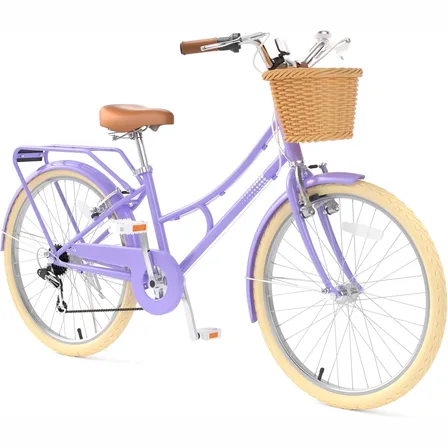
24-Inch Purple XJD Beach Cruiser Bike with U-Brake
The XJD 24-Inch Purple Beach Cruiser is built for girls and young women roughly …$159.99