

What size bike should a 6 year old need
Most 6-year-olds should start by trying a 16-inch or 18-inch bike, but measured height and an individual fit check—not age alone—decide the right size.
Start with height, then narrow the wheel size
Measure your child without shoes, standing straight against a wall. Compare that height with the XBikes starting points below. A 16-inch bike covers 40–48 in (102–122 cm), while an 18-inch bike covers 43–52 in (109–132 cm). The ranges overlap, so height may leave two reasonable sizes to try.
| Wheel size | Starting age | Rider height |
|---|---|---|
| 14 Inch | 3–6 | 37–45 in / 94–114 cm |
| 16 Inch | 4–7 | 40–48 in / 102–122 cm |
| 18 Inch | 5–9 | 43–52 in / 109–132 cm |
| 20 Inch | 7–12 | 48–60 in / 122–152 cm |
A smaller 6-year-old may still fit a 14-inch bike. A tall child near or above 48 in (122 cm) may need to compare an 18-inch bike with a 20-inch bike. These figures identify what to test; they do not confirm fit on their own.
Measure inseam before the test ride
Height is the first filter, but inseam helps you judge whether the child can stand over and mount the actual bicycle comfortably. Have the child stand against a wall with feet slightly apart. Place a rigid book upright between the legs to mimic a saddle, then measure from the floor to the top edge of the book.
Do not convert that measurement into a wheel size using an unrelated chart. Bicycle frame shapes differ, so compare the measured inseam with the stand-over space and adjustment guidance for the exact model. Follow its product manual, or ask a qualified bicycle mechanic if the fit or assembly is unclear.
Check the child on the actual bike
The American Academy of Pediatrics recommends having the child try the bicycle and avoiding an oversized bike bought merely for future growth. During the fit check, look for control rather than the largest frame the child can tolerate.
- Stand-over: The child should be able to straddle the bicycle comfortably rather than being pressed against the frame.
- Starting and stopping: They should mount, begin riding and stop without struggling to manage the bicycle.
- Reach: They should hold the handlebars without stretching, locking their arms or losing a stable riding position.
- Brake control: They must be able to reach and operate the fitted brakes confidently. Confirm operation according to the exact product manual.
- Confidence: If the bike feels intimidating, difficult to turn or awkward at low speed, try the smaller suitable option.
How the supplied 12, 14 and 16-inch bikes help
The supplied catalog options are useful when a 6-year-old’s measurements point toward the smaller end of the range. Both models offer 12-, 14- and 16-inch SKU labels, letting you compare those listed sizes; neither offers an 18- or 20-inch SKU in the supplied facts.
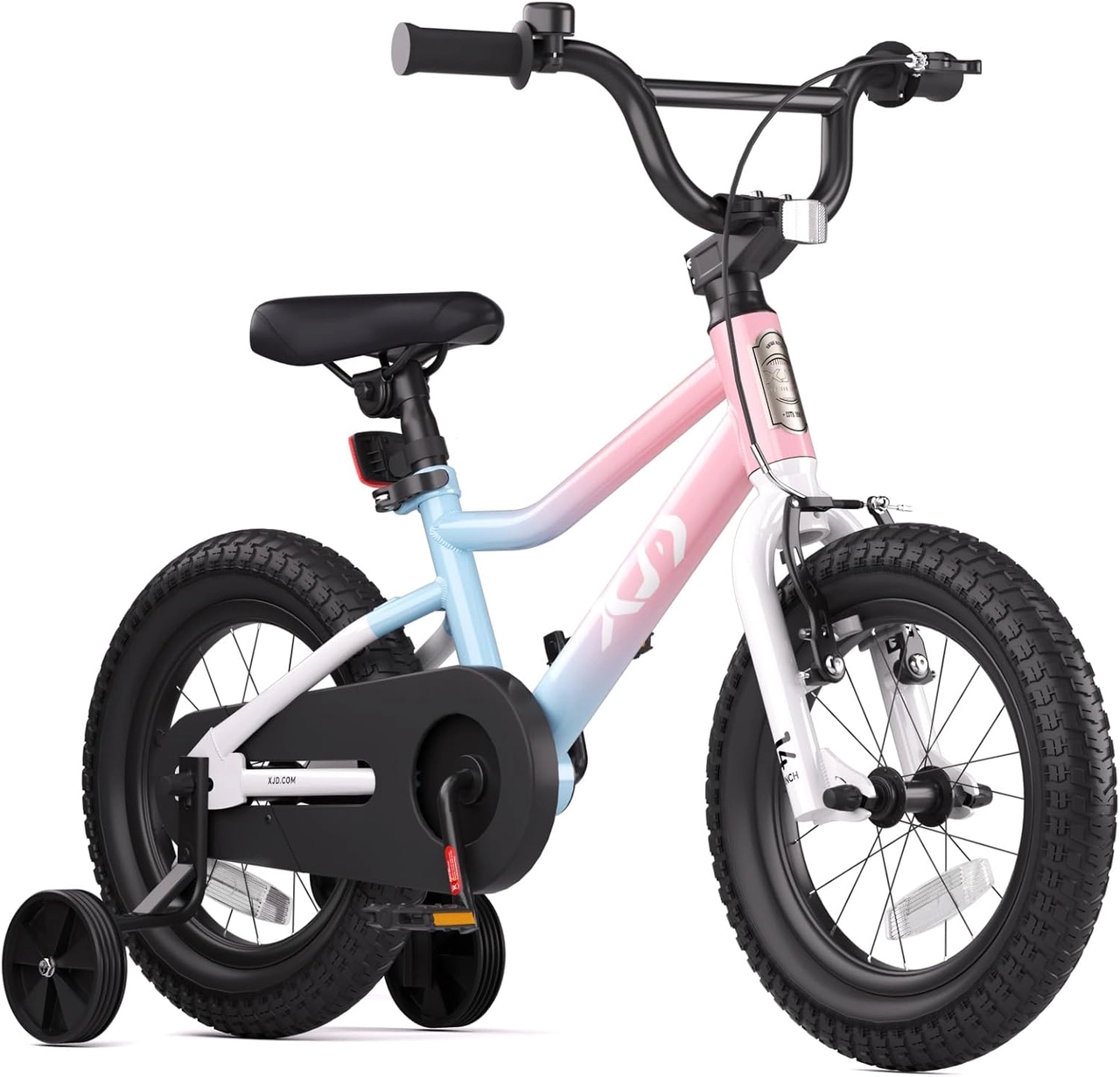 XJD Girls BMX Bike 12/14/16 Inch with Training Wheels – Pink Blue
Available in 12, 14 and 16 Inch options. Its 14- or 16-inch version may be relevant for a smaller 6-year-old, subject to measured height and an individual fit check.
 XJD Boys & Girls BMX Bike with Training Wheels, 12/14/16" – Blue
This Kids' BMX Bikes model has 12, 14 and 16 Inch options. Compare the suitable listed size only when the child’s height supports it, then verify stand-over, reach, brake control and confidence.
XJD Girls BMX Bike 12/14/16 Inch with Training Wheels – Pink Blue is a Kids' BMX Bikes model with 12 Inch, 14 Inch and 16 Inch options. For a typical size comparison at age six, its 14- and 16-inch versions are the relevant starting points, depending on measured height and actual control.
XJD Boys & Girls BMX Bike with Training Wheels, 12/14/16" – Blue is also a Kids' BMX Bikes model available in 12 Inch, 14 Inch and 16 Inch options. Its sizing relevance is therefore the same: compare the appropriate listed wheel size through an individual fit check, not through the title or appearance.
If measurement suggests an 18-inch or 20-inch bike, these products are smaller-size comparison points only. A 16-inch option is not a substitute for an 18-inch bike, and the supplied catalog facts do not establish that either model will fit your child.
Make the final size decision
- Measure standing height and inseam.
- Use height to shortlist 14, 16, 18 or 20 inches from the table.
- Have the child try each plausible size and compare stand-over, reach, braking, turning and confidence.
- Choose the size the child can control now rather than sizing up solely for growth.
Complete the setup with a properly fitted bicycle helmet. U.S. Consumer Product Safety Commission guidance says it should sit level and its straps should be adjusted according to the helmet manufacturer’s instructions. For bicycle assembly, maintenance, compatibility, load limits or torque settings, use the exact product manual or a qualified bicycle mechanic.
For your 6-year-old, measure first: try 16 and 18 inches when height falls in their overlap, then select the bike that gives comfortable stand-over, easy reach, dependable brake control and confident handling today.
Bikes for your next adventure
-

XJD Girls Bike for Kids Ages 3-8, 12/14/16 Inch with Training Wheels – Purple
The XJD Girls Bike in Purple is a training-wheel bicycle for kids ages 3 to 8, f…$149
$169 -

Pink Girls' 12/14/16" Bike by XJD – Basket & Doll Seat
The XJD Pink Girls' Bike with Basket & Doll Seat is made for riders 71–122 cm ta…$75.99
$99.99 -

Light Purple XJD Toddler Bike Helmet, Adjustable, Size XS (46–51 cm)
This Light Purple XJD toddler bike helmet is made for the smallest riders — the …$20.39