

What size bike should a 6 year old get
Most 6-year-olds should start by trying a 16-inch bike, especially at 40–48 in (102–122 cm) tall. Taller riders may fit an 18-inch bike, but measure and test the fit before choosing.
Choose by height, not the birthday alone
Age gives you a starting point, not a final answer. In the XBikes size standard, a 16-inch bike covers ages 4–7 and rider heights of 40–48 in (102–122 cm). That makes it the usual first comparison for a 6-year-old.
An 18-inch bike covers ages 5–9 and heights of 43–52 in (109–132 cm). A taller 6-year-old may therefore need to compare both 16-inch and 18-inch bikes. A smaller child could fall within the 14-inch range of ages 3–6 and heights of 37–45 in (94–114 cm). These ranges overlap because children with the same height can differ in leg length, reach and confidence.
Measure your child before shopping
Measure the child without shoes, standing upright against a wall. Record total height from the floor to the top of the head. Then measure inseam from the floor to the crotch, using a firm book held level between the legs to represent the saddle area.
Compare height with these relevant XBikes starting points:
| Wheel size | Age starting point | Rider height |
|---|---|---|
| 14 Inch | 3–6 | 37–45 in / 94–114 cm |
| 16 Inch | 4–7 | 40–48 in / 102–122 cm |
| 18 Inch | 5–9 | 43–52 in / 109–132 cm |
| 20 Inch | 7–12 | 48–60 in / 122–152 cm |
Inseam does not select a wheel size by itself because frame geometry and saddle adjustment vary. Use it during the physical fit check to judge stand-over clearance and whether the child can start and stop confidently.
Perform the fit check
Have the child try the exact bicycle rather than assuming every bike with the same wheel size fits identically. The American Academy of Pediatrics advises against buying an oversized bicycle merely for future growth. During the trial, check that the child can:
- Stand over the frame with comfortable clearance rather than being pressed against it.
- Reach the handlebars without stretching, locking the elbows or losing an upright, controlled posture.
- Turn the handlebars while remaining balanced and in control.
- Reach and operate the brakes effectively with their hands in a normal riding position.
- Mount, start, pedal, stop and put a foot down without panic or assistance.
Current confidence matters. If two sizes appear possible, choose the one the child can control now. A wheel-size chart cannot override poor reach, inadequate clearance or difficulty braking.
How the supplied bike helps with comparison
The XJD Light Purple Girls Bike with Basket, Training Wheels, 12/14/16/20 Inch is categorized as a training-wheel bike and has supplied SKU labels for 12 Inch, 14 Inch and 16 Inch. For a typical 6-year-old, its 16-inch option is the directly relevant starting point; its 14-inch option may be relevant for a shorter rider. Although “20 Inch” appears in the catalog title, 20 Inch is not among the supplied available SKU labels, so do not assume that version is selectable. This product also does not provide an 18-inch comparison.
These particular catalog options help answer the sizing question because the available 14-inch and 16-inch labels let a parent compare two overlapping sizes for a smaller or average-height 6-year-old. The product is relevant only if the child passes the individual height, stand-over, reach, brake-control and confidence checks.

When to consider 18 or 20 inches
Consider trying an 18-inch bike when the child measures within 43–52 in (109–132 cm), particularly if a 16-inch bicycle feels cramped. The supplied product is only a nearby 16-inch comparison point in that situation, not an 18-inch substitute.
A 20-inch bike begins at ages 7–12 and heights of 48–60 in (122–152 cm) in the XBikes standard. A tall 6-year-old near or above 48 in may try one, but age six alone is not evidence that it fits. Reject it if stand-over clearance, reach, braking or handling is compromised. Do not size up solely to extend the years of use.
Complete the decision safely
Once a bicycle fits, add a properly fitting bicycle helmet. U.S. Consumer Product Safety Commission guidance says the helmet should sit level and its straps should be adjusted according to the manufacturer’s instructions.
Follow the exact bicycle manual for assembly, adjustment, maintenance, compatibility, load limits and torque information that is not supplied here. If the fit or setup remains uncertain, use a qualified bicycle mechanic.
For a 6-year-old, measure height and inseam today, begin with a 16-inch trial, compare 14 or 18 inches only when the measurements support it, and buy only the size the child can stand over, reach, brake and control confidently now.
Bikes for your next adventure
-

Pink Girls' 12/14/16" Bike by XJD – Basket & Doll Seat
The XJD Pink Girls' Bike with Basket & Doll Seat is made for riders 71–122 cm ta…$75.99
$99.99 -

XJD Girls Bike for Kids Ages 3-8, 12/14/16 Inch with Training Wheels – Purple
The XJD Girls Bike in Purple is a training-wheel bicycle for kids ages 3 to 8, f…$149
$169 -
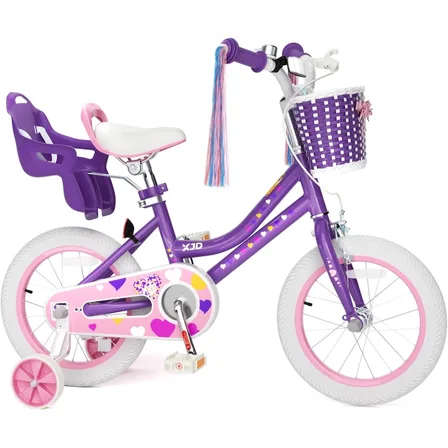
Purple XJD Girls' Bike with Doll Seat & Basket
For girls 71–122 cm tall (about ages 3–7), this XJD girls' bike in Purple pairs …$75.99
$99.99