

What size bike should 6 year old ride
A 6-year-old will usually start with a 16-inch or 18-inch bike, but measured height and an in-person fit check—not age—should decide.
Choose the wheel size from measured height
Measure the child barefoot, standing straight against a wall. Record total height from the floor to the top of the head. Then measure inseam from the floor to the crotch, using a book held level to represent the bicycle’s top tube. Use height to identify the starting wheel size below, and keep the inseam measurement for the stand-over check.
| Wheel size | XBikes age starting point | Rider height starting point |
|---|---|---|
| 14 Inch | Ages 3–6 | 37–45 in / 94–114 cm |
| 16 Inch | Ages 4–7 | 40–48 in / 102–122 cm |
| 18 Inch | Ages 5–9 | 43–52 in / 109–132 cm |
| 20 Inch | Ages 7–12 | 48–60 in / 122–152 cm |
For example, a 6-year-old who is 42 inches tall falls within the 14-inch and 16-inch ranges, so both are candidates to try. At 46 inches, the starting comparison shifts to 16-inch and 18-inch bikes. A child at 49 inches may need to compare 18-inch and 20-inch models even though the 20-inch age starting point begins at seven. Height narrows the choice; it does not complete the fit decision.
Resolve overlapping sizes with a real fit check
Have the child try each candidate rather than buying the larger option for future growth. The American Academy of Pediatrics advises against choosing an oversized bicycle simply so a child can grow into it. A bike that matches a chart can still be unsuitable because frame shape, reach and the child’s proportions vary.
- Check stand-over: with the child straddling the bicycle and both feet on the ground, confirm there is clear space between the child and the top tube. Compare this with the measured inseam rather than guessing.
- Check reach: while seated, the child should reach the handlebar without stretching, locking the elbows or losing a stable riding position.
- Check brake control: the child must be able to reach and operate the bicycle’s brakes confidently. Do not assume smaller hands can manage every lever or control.
- Watch basic control: ask the child to start, steer, stop and put a foot down. Choose the size on which these actions remain controlled.
Let confidence break a close tie
If two wheel sizes match the height range and both pass the stationary checks, consider present riding ability. A cautious beginner may control the smaller properly fitting candidate more easily, while a confident rider may handle the larger candidate if stand-over, reach and braking remain sound. Confidence never compensates for poor fit.
Do not choose by wheel size label alone. A 16-inch wheel does not guarantee that every 16-inch bicycle has identical frame dimensions or control placement. If the child cannot manage a candidate during the fit check, reject it even when age and height ranges appear suitable.
How the supplied XBikes option fits this decision
The XJD Pink Girls' Bike – Kids 12/14/16 Inch Training Wheel Bicycle is listed in the Training Wheel Bikes category and offers 12 Inch, 14 Inch and 16 Inch SKU labels. For a 6-year-old, its 14-inch and 16-inch versions provide catalog options to compare when the child’s measured height falls within the corresponding XBikes ranges. The 12-inch version starts at ages 3–4 and 34–40 inches / 86–102 cm, so it will generally be below the starting range for a typical 6-year-old, though measurement still takes priority.
These particular catalog options help answer the sizing question because the available 14-inch and 16-inch labels cover two common comparison points around age six; they do not replace an individual stand-over, reach, brake-control and confidence check.
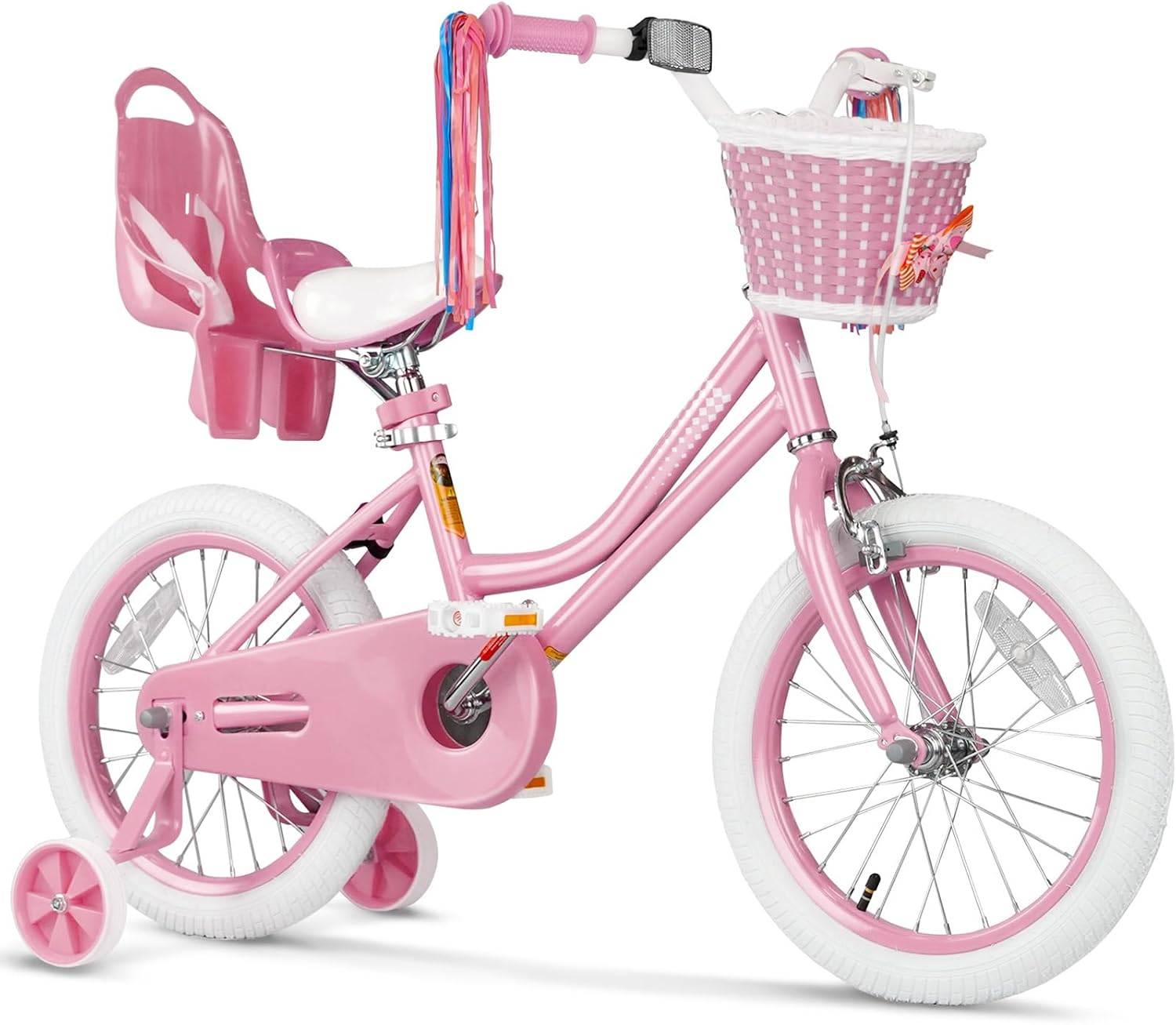
If measurement points to an 18-inch or 20-inch bicycle, this supplied product is not an equal substitute because no 18-inch or 20-inch SKU is listed for it. In that case, treat its 16-inch version only as a nearest-size comparison point and continue looking for the correctly fitting wheel-size candidate.
Check the bicycle before deciding
Confirm the exact SKU label before purchase, then have the child try that specific size. Follow the exact product manual for assembly, adjustments, maintenance, compatibility, load limits and torque. If instructions are absent, unclear or the bicycle cannot be adjusted correctly, use a qualified bicycle mechanic rather than inventing a procedure or value.
Add a properly fitting bicycle helmet. U.S. Consumer Product Safety Commission guidance says it should sit level and its straps should be used according to the helmet manufacturer’s instructions. A helmet does not correct an oversized or poorly controlled bicycle, so complete both checks separately.
The decision for your 6-year-old
Measure height and inseam now, compare the matching 16-inch and 18-inch starting ranges first, and include 14-inch or 20-inch only when the measured height supports them. Then choose the candidate the child can straddle, reach, brake and control confidently—never the larger bike merely for growing room.
Bikes for your next adventure
-

XJD Girls Bike for Kids Ages 3-8, 12/14/16 Inch with Training Wheels – Purple
The XJD Girls Bike in Purple is a training-wheel bicycle for kids ages 3 to 8, f…$149
$169 -

Pink Girls' 12/14/16" Bike by XJD – Basket & Doll Seat
The XJD Pink Girls' Bike with Basket & Doll Seat is made for riders 71–122 cm ta…$75.99
$99.99 -

Light Purple XJD Toddler Bike Helmet, Adjustable, Size XS (46–51 cm)
This Light Purple XJD toddler bike helmet is made for the smallest riders — the …$20.39