

What size bike should a 9 year old ride
Most 9-year-olds should start by trying an 18-inch or 20-inch bike, but measured height and an individual fit check—not age alone—decide the correct size.
Start with height, then narrow the choice
Measure the child’s height without shoes, standing straight against a wall. Under the XBikes starting points, an 18-inch bike covers rider heights of 43–52 inches (109–132 cm) and ages 5–9. A 20-inch bike covers 48–60 inches (122–152 cm) and ages 7–12.
That overlap matters. A shorter or less confident 9-year-old may control an 18-inch bike more comfortably, while a taller child may fit a 20-inch bike. A 24-inch bike starts at 54 inches (137 cm) in height and ages 10–14, so it may be worth trying only when the child’s measured height and control support it. Do not move up merely because a birthday is approaching.
Measure what the size label cannot tell you
Height identifies sensible bikes to try, but it does not confirm fit. Measure the child’s inseam from the floor to the crotch while the child stands in socks with feet slightly apart. Compare that measurement with the bicycle manufacturer’s stand-over information in the exact product manual.
Then assess the actual bicycle. The child should be able to stand over it comfortably, get on and off without struggling, and balance without the frame interfering. Seated, the rider should reach the handlebar without an exaggerated stretch or cramped posture.
Because frame shapes differ, two bicycles with the same wheel label can feel different. The American Academy of Pediatrics recommends having the child try the bicycle and advises against buying an oversized bike simply to allow room for growth.
Use this size comparison for a 9-year-old
| Wheel size | XBikes starting range | What it means at age 9 |
|---|---|---|
| 18 Inch | Ages 5–9; 43–52 in / 109–132 cm | A starting candidate for a child within the height range, especially when easier handling is needed. |
| 20 Inch | Ages 7–12; 48–60 in / 122–152 cm | The main starting candidate for many 9-year-olds within this height range. |
| 24 Inch | Ages 10–14; 54–64 in / 137–163 cm | Consider only for a sufficiently tall rider who passes every control check; age nine alone does not justify it. |
If the child falls in an overlapping height range, compare both sizes in person. Choose the bicycle the child can control now, rather than assuming the larger wheels are automatically preferable.
Check reach, brakes and confidence
Ask the child to hold the grips, look ahead and turn the handlebar smoothly in both directions. The rider should remain balanced and should not have to lean far forward just to steer.
Next, check brake control on the exact model. The child must be able to reach and operate the brake controls confidently while maintaining a secure grip and riding position. Do not infer suitability from wheel diameter alone. If brake adjustment, assembly, compatibility or torque is uncertain, follow the exact product manual or ask a qualified bicycle mechanic.
Current confidence can change the decision within an overlapping range. A child who is still developing balance and starting or stopping skills may be better served by the smaller properly fitting option. A confident rider may be ready for the larger candidate, but only after stand-over, reach and braking are all satisfactory.
How the supplied XBikes options help
The catalog options provide useful 20-inch, 24-inch and 26-inch comparison points for this question. They help a parent compare plausible sizes against the child’s measurements, although the supplied products do not include an 18-inch option; their other sizes are not substitutes for an 18-inch bike when that is the fit the child needs.
 Pink 12/14/16/20" XJD Girls Bike with Training Wheels & Basket
The available 20-inch option is relevant to the XBikes 48–60-inch rider-height starting range. The listing also has smaller wheel labels, but every option requires an individual fit and control check.
 26-Inch XJD Beach Cruiser Bike for Girls – Purple, V-Brake
This listing supplies 20-, 24- and 26-inch comparison options. For a 9-year-old, use measured height and hands-on control checks; 26 inches is only a starting point for riders over 60 inches.
The Pink 12/14/16/20" XJD Girls Bike with Training Wheels & Basket has available 12-inch, 14-inch, 16-inch and 20-inch labels. For a 9-year-old, only its 20-inch option aligns with the XBikes age starting point, and it still requires the same height and hands-on fit checks. The smaller options should not be chosen merely because they appear within the same listing.
The 26-Inch XJD Beach Cruiser Bike for Girls – Purple, V-Brake lists 20-inch, 24-inch and 26-inch choices across its supplied color and size labels. Its 20-inch option is the relevant starting comparison for a child measuring 48–60 inches. A 24-inch option is a possible comparison from 54 inches, subject to fit and control. A 26-inch option is for youth and adults over 60 inches (153 cm), not a default choice for a 9-year-old.
Make the final decision
- Measure height and inseam before selecting a wheel label.
- Start with 18 inches at 43–52 inches tall or 20 inches at 48–60 inches tall, testing both when the ranges overlap.
- Try the exact bicycle and reject any option that compromises stand-over, mounting, reach, steering or brake operation.
- Do not buy extra size for future growth.
- Provide a properly fitting bicycle helmet. The U.S. Consumer Product Safety Commission says it should sit level and its straps should be used according to the helmet manufacturer’s instructions.
For this 9-year-old, choose the smallest candidate that fits the measured height range and passes every hands-on control check today; if an 18-inch bike fits better, do not replace it with an available 20-inch or 24-inch catalog option.
Bikes for your next adventure
-

Pink Girls' 12/14/16" Bike by XJD – Basket & Doll Seat
The XJD Pink Girls' Bike with Basket & Doll Seat is made for riders 71–122 cm ta…$75.99
$99.99 -

XJD Girls Bike for Kids Ages 3-8, 12/14/16 Inch with Training Wheels – Purple
The XJD Girls Bike in Purple is a training-wheel bicycle for kids ages 3 to 8, f…$149
$169 -
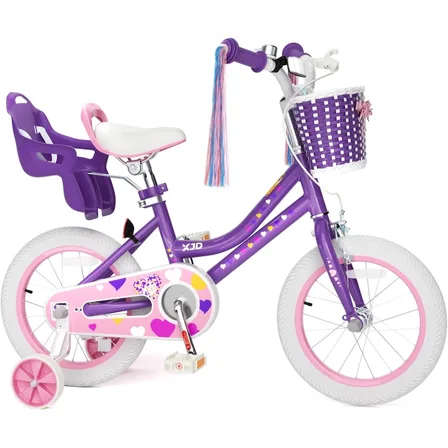
Purple XJD Girls' Bike with Doll Seat & Basket
For girls 71–122 cm tall (about ages 3–7), this XJD girls' bike in Purple pairs …$75.99
$99.99