

What size bike should a 9 year old get
Most 9-year-olds should start by trying a 20-inch bike, especially at 48–60 in (122–152 cm) tall. Measure the child and confirm stand-over clearance, reach, brake control and confidence before choosing.
Start with height, not the birthday
Age makes 20 inches the most likely starting point: the XBikes range places 20-inch bikes at ages 7–12. However, nine-year-olds vary considerably, so age cannot establish fit by itself.
Measure the child’s height without shoes, standing straight against a wall. Also measure the inseam from the floor to the crotch while the child stands naturally. The bicycle’s actual geometry must then be checked against those measurements; wheel diameter alone does not reveal stand-over height or reach.
| Wheel size | XBikes age starting point | Rider height starting point |
|---|---|---|
| 18 Inch | Ages 5–9 | 43–52 in / 109–132 cm |
| 20 Inch | Ages 7–12 | 48–60 in / 122–152 cm |
| 24 Inch | Ages 10–14 | 54–64 in / 137–163 cm |
The overlapping ranges are intentional starting points, not proof that two sizes fit equally. A shorter nine-year-old may need an 18-inch bike, while a taller child may be ready to try 24 inches based on height and individual control. Do not move up merely because the child is close to a range boundary.
Check the fit on the actual bicycle
Have the child try the bike. The American Academy of Pediatrics advises against buying an oversized bicycle simply for future growth and recommends checking stand-over, control and brake reach.
- Stand-over: With the child straddling the bicycle, confirm there is comfortable clearance rather than contact with the frame.
- Reach: The child should reach the handlebar without stretching, locking the arms or leaning excessively.
- Brake control: Confirm the child can reach and operate the fitted brakes while maintaining a secure grip. Brake details vary, so inspect the exact bicycle rather than assuming from wheel size.
- Confidence: Ask the child to start, steer, turn, stop and put a foot down without appearing overwhelmed by the bicycle.
If any check fails, compare another size or model. For assembly, adjustment, compatibility, torque and maintenance procedures, follow the exact product manual or use a qualified bicycle mechanic.
How the available 20-inch options help
The supplied catalog includes three products that let a parent compare relevant 20-inch choices. Two also offer smaller labeled sizes, which is useful when measurements or a real-world fit check show that 20 inches is too large.
 Girls' Training Wheel Bike by XJD with Basket – Purple
Available in 14 Inch, 16 Inch and 20 Inch labels. The 20-inch option is relevant to the usual starting range for a nine-year-old, while the smaller sizes help compare fit.
 Blue XJD Freestyle BMX Bike, 20-Inch – No Pegs
This Kids' BMX Bike is identified in its title as 20-inch and therefore matches the usual starting point for many nine-year-olds. Its supplied SKU label does not offer an alternate size.
 Pink 12/14/16/20" XJD Girls Bike with Training Wheels & Basket
Offered with 12 Inch, 14 Inch, 16 Inch and 20 Inch labels. Its 20-inch option is relevant for many nine-year-olds, while measurements and an individual fit check determine whether it suits the rider.
Girls' Training Wheel Bike by XJD with Basket – Purple has 14 Inch, 16 Inch and 20 Inch SKU labels. Its 20-inch option matches the usual starting range for a nine-year-old; the smaller options are comparison points if the child falls below that fit.
Blue XJD Freestyle BMX Bike, 20-Inch – No Pegs is cataloged as a Kids' BMX Bike and has a Default SKU label. Its title identifies it as 20-inch, so it is relevant to the likely size, but the catalog facts do not provide alternate sizes.
Pink 12/14/16/20" XJD Girls Bike with Training Wheels & Basket offers 12 Inch, 14 Inch, 16 Inch and 20 Inch SKU labels. For this question, the 20-inch option is the age-range starting point; the other labels should be judged separately against the child’s measurements.
When these products are not relevant
None of the supplied products has an 18-inch or 24-inch SKU label. If the child fits either of those sizes better, the listed products are nearest-size comparison points, not substitutes. A 20-inch model should not be presented as equivalent to an 18-inch or 24-inch bicycle.
The training-wheel category may also be irrelevant if the child’s current riding ability and goals call for another setup. Conversely, a category label does not demonstrate that a bike will fit or that a child can control it. Decide from the individual trial, not from the product name, color, basket or category.
Do not overlook helmet fit
A bicycle helmet must fit properly, sit level and have its straps used according to the helmet manufacturer’s instructions, as advised by the U.S. Consumer Product Safety Commission. A wheel-size choice does not determine helmet size, so fit the helmet separately.
The decision for a 9-year-old
Begin with a 20-inch bike when the rider is 48–60 in (122–152 cm), then require successful stand-over, reach, brake-control and confidence checks. If those checks point to 18 or 24 inches, choose that individually fitting size instead of forcing a 20-inch option or buying large for growth.
Bikes for your next adventure
-

Pink Girls' 12/14/16" Bike by XJD – Basket & Doll Seat
The XJD Pink Girls' Bike with Basket & Doll Seat is made for riders 71–122 cm ta…$75.99
$99.99 -

XJD Girls Bike for Kids Ages 3-8, 12/14/16 Inch with Training Wheels – Purple
The XJD Girls Bike in Purple is a training-wheel bicycle for kids ages 3 to 8, f…$149
$169 -
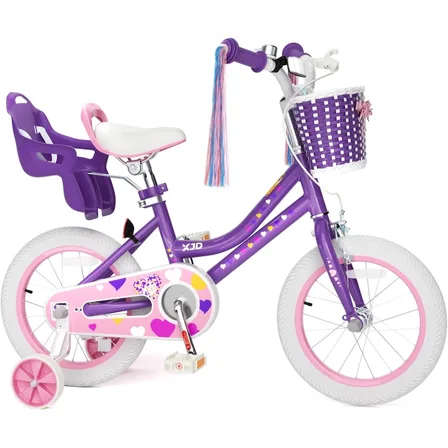
Purple XJD Girls' Bike with Doll Seat & Basket
For girls 71–122 cm tall (about ages 3–7), this XJD girls' bike in Purple pairs …$75.99
$99.99