

What size bike should i get a 6 year old
Most 6-year-olds should start by trying a 16-inch or 18-inch bike, but measured height and an individual fit check—not age alone—should decide.
Choose the starting size from height
Measure the child barefoot, standing straight against a wall. Compare that height with the XBikes starting ranges below. At age 6, several ranges can overlap, so do not select a wheel size from the birthday alone.
| Wheel size | XBikes starting range | What it means for a 6-year-old |
|---|---|---|
| 14 Inch | Ages 3–6; 37–45 in / 94–114 cm | Worth checking for a shorter rider who fits and controls it comfortably. |
| 16 Inch | Ages 4–7; 40–48 in / 102–122 cm | A common starting point within this age, subject to the fit checks below. |
| 18 Inch | Ages 5–9; 43–52 in / 109–132 cm | May suit a taller 6-year-old, but only when stand-over, reach and control are right. |
If the child is near an overlap—such as 43–45 inches (109–114 cm)—try the relevant sizes rather than automatically choosing the larger one. A 12-inch bike starts at ages 3–4 and 34–40 inches (86–102 cm), so it is generally outside the age starting point for a 6-year-old; measured fit still matters more than assumptions.
Measure inseam as well as height
For inseam, have the child stand barefoot with feet slightly apart. Place a book upright between the legs, gently raising it to simulate a saddle, then measure from the floor to the book’s top edge. Record both inseam and overall height before shopping.
Use height to identify likely wheel sizes, then use inseam during the actual stand-over and saddle check. Wheel labels do not provide a complete geometry measurement: two bicycles with the same wheel size can feel different. Follow the exact product manual for its adjustment limits, assembly instructions and compatibility details.
Check the bicycle with the child on it
Have the child try the assembled bicycle rather than buying extra size for future growth. Confirm all of these points:
- Stand-over: The child can straddle the bicycle with stable footing and comfortable clearance rather than being pressed against the frame.
- Starting and stopping: The child can get into position, start moving and stop without the bicycle pulling them off balance.
- Reach: Hands reach the handlebar naturally without locked elbows, an extreme forward stretch or loss of steering control.
- Brake control: The child can reach and operate the fitted braking controls reliably. Do not assume a control is usable merely because fingertips touch it.
- Confidence: The size should let the rider look ahead, steer and respond calmly. A technically possible fit is not useful if the bicycle feels intimidating.
If a child cannot perform these checks, move to another size or model. Do not treat a larger bicycle as acceptable simply because the child will eventually grow into it.
How the supplied bikes help with the comparison
The Flower Pink XJD Girls Bike with Doll Seat & Basket and the Purple XJD Girls' Bike with Doll Seat & Basket are both cataloged as Training Wheel Bikes and are offered with 12 Inch, 14 Inch and 16 Inch SKU labels. Their 14-inch and 16-inch choices can therefore serve as concrete comparison options for a 6-year-old whose measured height falls in those starting ranges.
Neither supplied product has an 18-inch SKU label. If the child’s measurements and hands-on fit point to 18 inches, these products are nearest-size comparison points only, not substitutes; a 16-inch bicycle is not equivalent to an 18-inch bicycle.
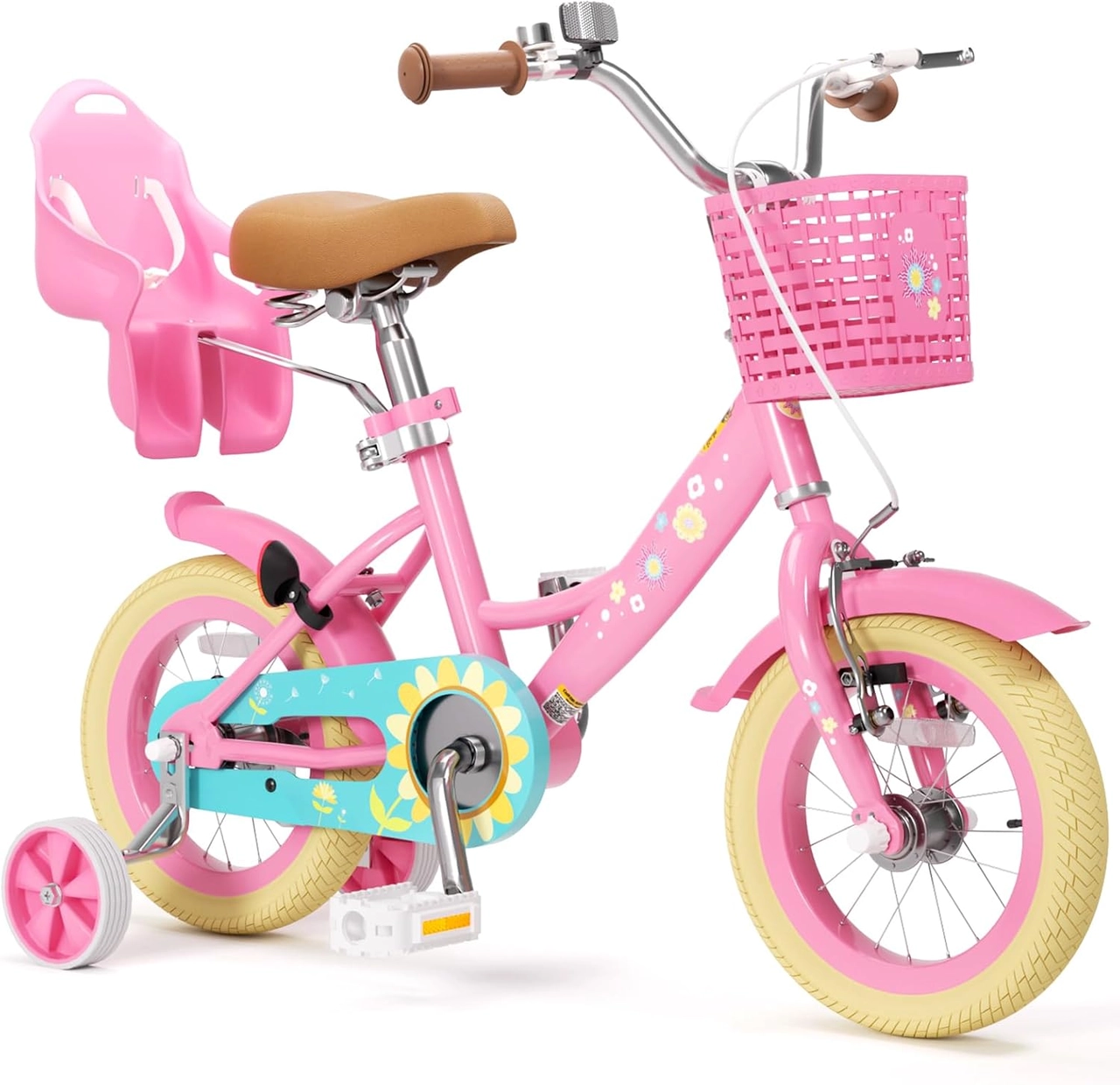 Flower Pink XJD Girls Bike with Doll Seat & Basket
Available in 12 Inch, 14 Inch and 16 Inch labels, this Training Wheel Bike offers two relevant comparison sizes for many 6-year-olds, but measured height and an individual fit check must determine suitability.
 Purple XJD Girls' Bike with Doll Seat & Basket
This Training Wheel Bike has 12 Inch, 14 Inch and 16 Inch SKU labels. Its 14- and 16-inch options may be relevant comparison points; it does not supply the 18-inch option some taller 6-year-olds may need.
Between these two supplied products, the catalog facts establish different exact titles but the same category, topic and available wheel-size labels. Choose between them only after confirming the appropriate SKU and individual fit. No supplied facts establish differences in brakes, frame geometry, weight, materials, load limits, certification or included assembly details.
Make the final decision
- Measure height and inseam.
- Use the height ranges to shortlist 14, 16 or 18 inches.
- Have the child straddle and ride each realistic candidate in a suitable supervised area.
- Compare stand-over clearance, reach, brake operation, balance and confidence.
- Select the bicycle the child controls now; do not size up solely for growth.
Before riding, provide a properly fitting bicycle helmet. It should sit level, and its straps should be adjusted according to the helmet manufacturer’s instructions. Follow the bicycle’s exact manual for assembly, maintenance, adjustment limits and torque requirements, or use a qualified bicycle mechanic where those details or procedures are uncertain.
For a 6-year-old, begin with 16 and 18 inches unless measured height points toward 14 inches, then buy only the size that passes the child’s complete hands-on fit and control check.
Bikes for your next adventure
-

Pink Girls' 12/14/16" Bike by XJD – Basket & Doll Seat
The XJD Pink Girls' Bike with Basket & Doll Seat is made for riders 71–122 cm ta…$75.99
$99.99 -

Light Purple XJD Toddler Bike Helmet, Adjustable, Size XS (46–51 cm)
This Light Purple XJD toddler bike helmet is made for the smallest riders — the …$20.39
-

Black XJD Toddler Bike Helmet, Adjustable – Kids' Protective Helmet
The XJD Toddler Bike Helmet in black is an adjustable protective helmet for kids…$20.39