

What size bike should my 5 year old be riding
Most 5-year-olds should start their fit check with a 14 Inch, 16 Inch, or 18 Inch bike, depending on measured height and individual control. Use age only as a starting point: measure your child, then have them try the bicycle before deciding.
Choose the starting size from measured height
Measure your child’s height without shoes, standing straight against a wall. Compare that measurement with the XBikes starting points below. Overlapping ranges are intentional: when a child falls into more than one range, the better choice is the bicycle they can stand over, reach and control confidently.
| Wheel size | Starting age | Rider height |
|---|---|---|
| 12 Inch | 3–4 | 34–40 in / 86–102 cm |
| 14 Inch | 3–6 | 37–45 in / 94–114 cm |
| 16 Inch | 4–7 | 40–48 in / 102–122 cm |
| 18 Inch | 5–9 | 43–52 in / 109–132 cm |
| 20 Inch | 7–12 | 48–60 in / 122–152 cm |
For example, a 5-year-old who is 39 inches tall starts in the 14 Inch range. At 44 inches, 14, 16 and 18 Inch ranges overlap, so an in-person fit check should decide. At 49 inches, the 18 Inch range is the relevant starting point; age alone should not push the child onto a smaller or larger bicycle.
Measure inseam as well as total height
Height narrows the options, but inseam helps you judge stand-over clearance. With shoes off, have your child stand with feet slightly apart. Place a straight-edged book gently between the legs, level with the floor, and measure from the floor to its top edge.
Compare that inseam with the actual bicycle’s stand-over height and saddle adjustment information. Those dimensions are not supplied here and can vary between models with the same wheel size, so consult the exact product information or manual. Your child should be able to straddle the bicycle without the frame pressing into them.
Make the final decision with a real fit check
Have your child try the bicycle rather than ordering solely from an age label. The American Academy of Pediatrics advises against buying an oversized bicycle just for future growth. A bicycle that will fit later can be difficult to manage now.
During the trial, check whether your child can:
- Get on and off without being caught by the frame.
- Reach the handlebars without stretching, locking the elbows or leaning excessively.
- Steer through gentle turns while looking ahead.
- Reach and operate the fitted brakes reliably with their hands or feet, as applicable to the bicycle.
- Start, stop and put a foot down without panic or loss of balance.
If two wheel sizes match the height chart, choose according to these control checks and current confidence—not the larger number. Follow the exact bicycle manual for saddle or handlebar adjustment, assembly and maintenance; use a qualified bicycle mechanic when the instructions or fit are uncertain.
How the supplied XBikes options relate
The catalog options below are useful comparison points because both include 14 Inch and 16 Inch labels, the two ranges that cover many measured heights at age five. One also offers 12 Inch and 20 Inch versions, while the other offers 12, 14 and 16 Inch versions. Their presence in the catalog does not establish fit for a particular child.
 Light Pink XJD Girls' Bicycle with Basket & Training Wheels
Available in 12, 14, 16 and 20 Inch versions. Its 14 and 16 Inch labels provide relevant comparison points for many 5-year-old heights, but measured fit and control must determine the size.
 Blue XJD Girls Bike with Training Wheels – 12/14/16 Inch
Available in 12, 14 and 16 Inch versions with training wheels. The 14 and 16 Inch options may suit the supplied height ranges, subject to an individual stand-over, reach, braking and confidence check.
The Light Pink XJD Girls' Bicycle with Basket & Training Wheels is listed in 12 Inch, 14 Inch, 16 Inch and 20 Inch sizes. For a 5-year-old, compare only the size matching the child’s measured-height range and successful fit check. Its 20 Inch option starts at ages 7–12 and heights of 48–60 inches, so it should not be chosen merely to allow room for growth.
The Blue XJD Girls Bike with Training Wheels – 12/14/16 Inch is listed in 12 Inch, 14 Inch and 16 Inch sizes. Its 14 and 16 Inch versions may be relevant starting points when the child’s height falls within their respective ranges. The title’s size wording is a catalog label, not proof that any version fits your child.
Training wheels are a supplied feature of both products, but they do not correct an oversized frame, excessive reach or inaccessible brakes. An 18 Inch bike may be the appropriate starting point for a child measuring 43–52 inches; neither supplied product lists an 18 Inch option, so these products are then nearest-size comparison points, not substitutes for an 18 Inch bicycle.
Do not skip helmet fit
A correctly sized bicycle still requires a properly fitting bicycle helmet. The U.S. Consumer Product Safety Commission advises that the helmet sit level and that its straps be used according to the helmet manufacturer’s instructions. Recheck the fit rather than relying only on the helmet’s age label.
What to do next
- Measure height and inseam without shoes.
- Use the height table to shortlist 14, 16 or 18 Inch options.
- Compare inseam with the specific bicycle’s stand-over dimensions.
- Have your child test mounting, reach, steering, braking and stopping.
- Select the size they can control now, even if a larger size appears to offer more growing room.
For your 5-year-old, the answer is therefore the smallest suitable option among the height-matched sizes that passes every real-world fit and control check—not whichever bicycle has the broadest age label.
Bikes for your next adventure
-
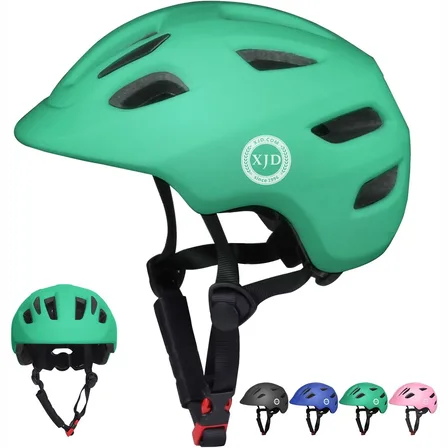
Green XJD Toddler Bike Helmet with Adjustable Fit, XS (46–51 cm)
The XJD toddler bike helmet in Green is built for the youngest riders — the size…$20.39
$23.99 -

Kids Bike Helmet by XJD for Boys & Girls – Black, Blue, Green, Pink, Purple
The XJD Kids Bike Helmet covers a wide 2-to-8-year age range thanks to two head-…$59.99
-

Kids Bike Helmet by XJD for Girls – Pink
The XJD Kids Bike Helmet in Pink is a lightweight multi-sport helmet for girls r…$59.99
$99