

What size bike should my 5 year old ride
Most 5-year-olds should start by trying a 14-, 16-, or 18-inch bike, chosen by measured height and an individual fit check—not age alone.
Match height to wheel size first
Measure your child’s standing height without estimating from clothing size or age. Compare that measurement with the XBikes starting points below. Overlapping ranges are intentional: they identify bikes worth trying, not an automatic answer.
| Wheel size | XBikes age starting point | Rider height |
|---|---|---|
| 12 Inch | Ages 3–4 | 34–40 in / 86–102 cm |
| 14 Inch | Ages 3–6 | 37–45 in / 94–114 cm |
| 16 Inch | Ages 4–7 | 40–48 in / 102–122 cm |
| 18 Inch | Ages 5–9 | 43–52 in / 109–132 cm |
| 20 Inch | Ages 7–12 | 48–60 in / 122–152 cm |
For example, a 5-year-old who is 41 inches tall falls within both the 14-inch and 16-inch height ranges, so both should be tried. A child measuring 46 inches falls within the 16-inch and 18-inch ranges. Do not move up merely because a birthday is approaching.
Measure inseam before the fit check
Height narrows the choices; inseam helps reveal whether the frame is manageable. Have your child stand upright and measure from the floor to the crotch. Keep that measurement available when comparing the bicycle’s stand-over dimensions or arranging an in-person fitting.
The child should try the actual bicycle whenever possible. While straddling it, check that the frame does not prevent a comfortable, controlled stance. Follow the exact product manual for saddle adjustment, assembly, compatibility, load limits and torque. If anything is unclear, use a qualified bicycle mechanic.
Check reach, brakes and confidence
With the child seated in a normal riding position, look for relaxed arms and easy steering rather than a stretched reach. They must be able to reach and operate the brakes provided on the bicycle without shifting into an unstable position. Confirm that they can start, steer, stop and put a foot down with control.
Current confidence can decide between two sizes whose height ranges overlap. A less-confident rider may control the smaller suitable option more readily, while a capable rider may fit the larger option—but only if stand-over, reach and braking all work now. An oversized bicycle bought for future growth can make handling and stopping harder, so do not treat “room to grow” as proof of fit.
How the supplied training-wheel bikes compare
The three supplied catalog options help because each offers 12 Inch, 14 Inch and 16 Inch SKU labels, covering several possible starting points for a 5-year-old. They are relevant when the fit process indicates one of those sizes and training wheels suit the child’s present riding needs.
 Blue XJD Girls Bike with Training Wheels – 12/14/16 Inch
A training-wheel bike offered in 12 Inch, 14 Inch and 16 Inch labels; relevant only when the child’s measurements and hands-on fit check support one of those sizes.
 XJD Boys 12/14/16" Training Wheel Bike – Blue
This training-wheel bike offers 12 Inch, 14 Inch and 16 Inch labels, providing comparison options for a 5-year-old whose height, reach, brake control and confidence indicate one of them.
 XJD Kids' Training Wheel Bike for Boys & Girls, 12/14/16 Inch – White
Available with 12 Inch, 14 Inch and 16 Inch labels in the training-wheel category; it is relevant when training wheels suit the rider and an individual check confirms the selected size.
- Blue XJD Girls Bike with Training Wheels – 12/14/16 Inch is categorized as a training-wheel bike and is offered in 12 Inch, 14 Inch and 16 Inch labels.
- XJD Boys 12/14/16" Training Wheel Bike – Blue has the same three supplied size labels and is also categorized as a training-wheel bike.
- XJD Kids' Training Wheel Bike for Boys & Girls, 12/14/16 Inch – White likewise offers 12 Inch, 14 Inch and 16 Inch labels in the training-wheel category.
These catalog facts establish size-label availability only; they do not establish fit, brake reach or suitability for a particular child. If measurement and a hands-on check point to an 18-inch bike, none of these products supplies that exact size. In that case, they are nearest-size comparison points, not substitutes for an 18-inch bicycle. Likewise, a 12-inch option should be considered only when the child’s measured height and full fit check support it.
Use this decision sequence
- Measure standing height and inseam.
- Use the XBikes height ranges to select the likely wheel sizes.
- Have the child straddle and sit on each candidate bicycle.
- Compare stand-over, steering reach, brake operation and the ability to start and stop confidently.
- Choose the size the child can control now; do not buy an oversized bike for anticipated growth.
Before riding, add a bicycle helmet that fits properly, sits level and has its straps adjusted according to the helmet manufacturer’s instructions. The practical answer for your 5-year-old is therefore the 14-, 16-, or 18-inch candidate that matches measured height and passes every hands-on control check; choose among the supplied products only if 12, 14 or 16 inches is the verified fit.
Bikes for your next adventure
-
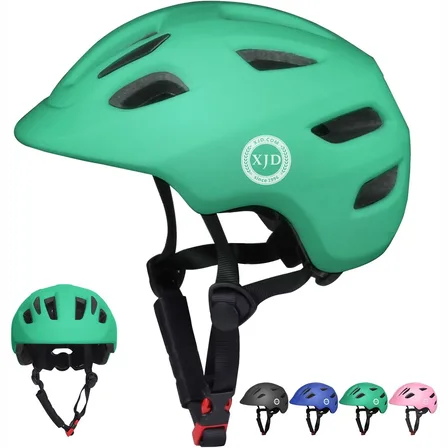
Green XJD Toddler Bike Helmet with Adjustable Fit, XS (46–51 cm)
The XJD toddler bike helmet in Green is built for the youngest riders — the size…$20.39
$23.99 -

Kids Bike Helmet by XJD for Boys & Girls – Black, Blue, Green, Pink, Purple
The XJD Kids Bike Helmet covers a wide 2-to-8-year age range thanks to two head-…$59.99
-

Kids Bike Helmet by XJD for Girls – Pink
The XJD Kids Bike Helmet in Pink is a lightweight multi-sport helmet for girls r…$59.99
$99