

What size bike to get for my toddler
Choose your toddler’s bike by measured height and an in-person fit check, not age alone. Start with the XBikes height range, then confirm stand-over room, reach, braking and confident control.
Measure your toddler before choosing
Measure standing height without shoes, with your child upright against a wall. Then measure inseam from the floor to the crotch while the child stands naturally. Record both measurements in inches or centimetres.
Height provides the starting wheel-size range. Inseam helps you judge whether the child can stand over the bicycle comfortably and reach the ground as intended. Because frame shapes and adjustment ranges can differ, an inseam measurement does not create a universal wheel-size answer by itself.
Age is only a rough reference. A tall three-year-old and a short four-year-old may need different bicycles, even if their confidence is similar.
Compare the relevant wheel sizes
| Wheel size | XBikes age starting point | Rider height starting point |
|---|---|---|
| 12 Inch | Ages 3–4 | 34–40 in / 86–102 cm |
| 14 Inch | Ages 3–6 | 37–45 in / 94–114 cm |
| 16 Inch | Ages 4–7 | 40–48 in / 102–122 cm |
| 20 Inch | Ages 7–12 | 48–60 in / 122–152 cm |
For many toddlers, the first comparison will be between 12 Inch and 14 Inch. The ranges overlap, so a child within both ranges should try both rather than automatically taking the larger option. A 16 Inch bicycle becomes a starting point only when the rider’s measured height reaches its range; the same principle applies to 20 Inch.
Do not round up simply because a child is close to the next range. The American Academy of Pediatrics advises having the child try the bicycle and not buying an oversized bike merely to allow for growth.
Perform the fit check
Have your toddler try the exact bicycle with close adult supervision. Check these points before deciding:
- Stand-over: The child should be able to straddle the bicycle without the frame preventing a stable stance.
- Reach: Hands should reach the handlebar without an exaggerated stretch or an awkwardly compressed posture.
- Brake control: If the bicycle has hand controls, the child must be able to reach and operate them. Confirm the controls fitted to the exact model rather than assuming a brake type.
- Steering and balance: The child should turn the handlebar, start, stop and support the bicycle without appearing overwhelmed by its size.
- Confidence: Choose the size the child can control now. Training wheels do not make an oversized frame fit correctly.
If either size produces uncertain stopping, strained reach or poor stand-over, reject that size even when the height chart appears to include the rider.
How the supplied catalog option helps
The XJD Kids Bike for Girls – Pink, 12/14/16/20 Inch with Training Wheels is relevant because its available labels let you compare 12 Inch and 14 Inch—the two likely starting points for many toddler-sized riders—along with 16 Inch and 20 Inch options for riders who actually meet those height ranges. Its catalog category is Training Wheel Bikes. These labels narrow the comparison, but they do not establish fit.

The 12 Inch or 14 Inch versions may be relevant after measuring your child. The 16 Inch version is relevant only from the supplied 40 in / 102 cm height starting point and after a successful individual check. The 20 Inch version starts at 48 in / 122 cm and ages 7–12, so it will not be relevant for a typical toddler; do not treat it as a growth-room substitute.
Complete the setup safely
Follow the exact product manual for assembly, adjustments, maintenance, load limits and any required torque values. If the instructions are missing, unclear or the bicycle cannot be adjusted correctly, use a qualified bicycle mechanic rather than guessing.
Add a properly fitting bicycle helmet. The U.S. Consumer Product Safety Commission advises that the helmet should sit level and that its straps should be used according to the helmet manufacturer’s instructions. Check the helmet fit each time the child rides.
Make the final size decision
- Measure your toddler’s standing height and inseam.
- Use measured height to identify the 12 Inch, 14 Inch or, for a sufficiently tall rider, 16 Inch starting range.
- Try the exact bicycle and compare stand-over, reach, brake operation, steering and present confidence.
- Choose the smaller of two overlapping candidates when the larger one compromises control; never buy an oversized bicycle solely for future growth.
Your toddler’s correct size is therefore the wheel-size starting point that matches measured height and passes every hands-on control check today. If no candidate passes, wait or try a differently proportioned bicycle instead of forcing the next size up.
Bikes for your next adventure
-
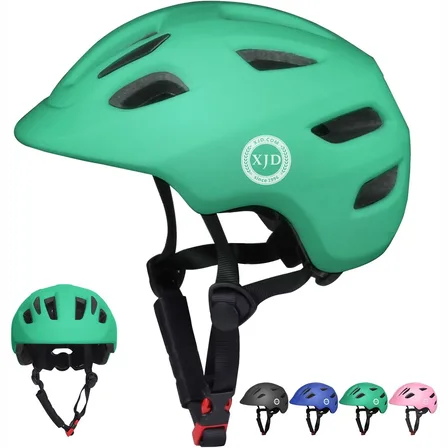
Green XJD Toddler Bike Helmet with Adjustable Fit, XS (46–51 cm)
The XJD toddler bike helmet in Green is built for the youngest riders — the size…$20.39
$23.99 -

Kids Bike Helmet by XJD for Boys & Girls – Black, Blue, Green, Pink, Purple
The XJD Kids Bike Helmet covers a wide 2-to-8-year age range thanks to two head-…$59.99
-

Kids Bike Helmet by XJD for Girls – Pink
The XJD Kids Bike Helmet in Pink is a lightweight multi-sport helmet for girls r…$59.99
$99