

What size bike wheel for 7 year old
For a 7-year-old, start by checking an 18 Inch or 20 Inch wheel bike: use 18 Inch at 43–52 in (109–132 cm) and 20 Inch at 48–60 in (122–152 cm). A shorter rider may still fit a 16 Inch bike at 40–48 in (102–122 cm). Measure the child and confirm the actual fit rather than choosing from age alone.
Choose the starting size from measured height
Have the child stand straight without shoes against a wall, then measure from the floor to the top of the head. Compare that result with the XBikes starting points below. Where height ranges overlap, either wheel size is only a candidate until the child tries the complete bicycle.
| Wheel size | XBikes age starting point | Rider height |
|---|---|---|
| 16 Inch | Ages 4–7 | 40–48 in / 102–122 cm |
| 18 Inch | Ages 5–9 | 43–52 in / 109–132 cm |
| 20 Inch | Ages 7–12 | 48–60 in / 122–152 cm |
| 24 Inch | Ages 10–14 | 54–64 in / 137–163 cm |
For example, a child measuring 46 in (117 cm) falls within both the 16 Inch and 18 Inch starting ranges. A child measuring 50 in (127 cm) falls within both the 18 Inch and 20 Inch ranges. Reach, stand-over clearance, brake control and confidence should decide between overlapping options.
Measure inseam before the fit check
Height narrows the choices; inseam helps reveal whether the frame is manageable. With the child wearing normal riding shoes, place a book firmly between the legs to simulate the saddle area. Measure vertically from the floor to the top edge of the book.
Do not turn that measurement into a frame-size promise without the exact bicycle geometry. Instead, take the inseam measurement to the fit check and compare it with how the child stands over the actual bike. There should be usable clearance, and mounting and stopping should feel controlled rather than precarious.
What the child must demonstrate
Ask the child to try the bicycle, as recommended by HealthyChildren guidance. Do not buy an oversized bike merely to allow room for growth. On the candidate bike, check whether the rider can:
- stand over the bicycle comfortably rather than being forced onto tiptoes;
- reach the handlebar without stretching, locking the elbows or losing an upright, controlled posture;
- turn the handlebar while remaining balanced and in control;
- reach and operate the fitted brakes confidently with the available hand strength;
- start, steer and stop without the bicycle feeling intimidating or unwieldy.
If the child cannot do these things, reject that particular bike even when the age or height chart appears to match. If two wheel sizes fit on paper, choose according to the better real-world control and current confidence.
How the supplied 16 Inch options are relevant
The supplied catalog contains three training-wheel bicycles in 12 Inch, 14 Inch and 16 Inch versions. For this question, their 16 Inch versions are useful comparison options only when the 7-year-old measures within the 16 Inch 40–48 in (102–122 cm) starting range and passes the individual fit check. They are not substitutes for an 18 Inch or 20 Inch bicycle when either larger size is the appropriate result.
 Blue XJD Girls Bike with Training Wheels – 12/14/16 Inch
The 16 Inch version is relevant when the rider measures 40–48 in (102–122 cm) and passes a fit check. Its 12 Inch and 14 Inch versions are smaller comparison choices.
 XJD Boys 12/14/16" Training Wheel Bike – Blue
Available in 12 Inch, 14 Inch and 16 Inch labels. For a 7-year-old, only the 16 Inch version reaches the relevant XBikes age starting point, subject to height and individual fit.
 XJD Kids' Training Wheel Bike for Boys & Girls, 12/14/16 Inch – White
This white training-wheel listing offers 12 Inch, 14 Inch and 16 Inch versions. The 16 Inch option may suit a rider within 40–48 in (102–122 cm), but cannot substitute for an indicated 18 Inch or 20 Inch bike.
Blue XJD Girls Bike with Training Wheels – 12/14/16 Inch, XJD Boys 12/14/16" Training Wheel Bike – Blue, and XJD Kids' Training Wheel Bike for Boys & Girls, 12/14/16 Inch – White all offer the same supplied wheel-size labels: 12 Inch, 14 Inch and 16 Inch. Their exact titles and color wording distinguish the listings, but the catalog facts supplied here do not establish differences in geometry, brakes, weight, materials or other fit-critical features.
At age seven, the 12 Inch and 14 Inch versions fall below the relevant age starting points in the XBikes standard, while the 16 Inch version extends through age seven. Age is still secondary to measured height and an actual trial. If the rider is taller than 48 in (122 cm), these catalog options do not supply the 18 Inch or 20 Inch size indicated by the height ranges.
Do the final safety and setup checks
Once a size looks right, confirm that the exact bicycle is assembled, adjusted and maintained according to its product manual. For any torque, load limit, compatibility, assembly or maintenance detail not stated in the supplied catalog facts, follow that manual or use a qualified bicycle mechanic.
A bicycle helmet also needs its own fit check. It should fit properly, sit level on the child’s head and have its straps used according to the helmet manufacturer’s instructions, consistent with U.S. Consumer Product Safety Commission guidance.
The decision for your 7-year-old
Measure height and inseam first. Compare 16 Inch at 40–48 in, 18 Inch at 43–52 in and 20 Inch at 48–60 in, then have the child try the candidate bike. Select only the size on which stand-over clearance, reach, braking and control all work now; if the result is 18 Inch or 20 Inch, do not replace it with one of the supplied 16 Inch products simply because those are the available comparison options.
Bikes for your next adventure
-

Pink Girls' 12/14/16" Bike by XJD – Basket & Doll Seat
The XJD Pink Girls' Bike with Basket & Doll Seat is made for riders 71–122 cm ta…$75.99
$99.99 -

XJD Girls Bike for Kids Ages 3-8, 12/14/16 Inch with Training Wheels – Purple
The XJD Girls Bike in Purple is a training-wheel bicycle for kids ages 3 to 8, f…$149
$169 -
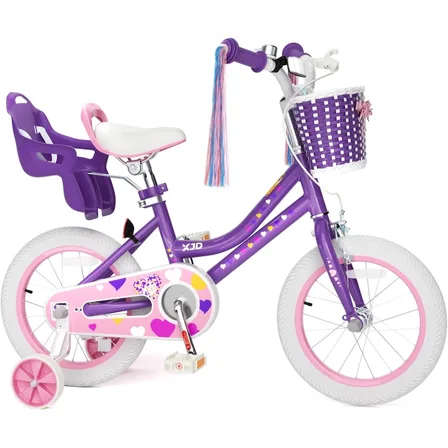
Purple XJD Girls' Bike with Doll Seat & Basket
For girls 71–122 cm tall (about ages 3–7), this XJD girls' bike in Purple pairs …$75.99
$99.99