

What size bike wheel for 9 year old
For most 9-year-olds, start with a 20-inch bike, then confirm the choice using the child’s measured height, inseam, reach, brake control and confidence.
The short answer: usually 20 inches
The XBikes starting range for a 20-inch wheel is ages 7–12 and a rider height of 48–60 inches (122–152 cm). That makes 20 inches the usual first size to try for a 9-year-old. Age is only a starting point, however; it cannot confirm that a particular bicycle fits.
A shorter 9-year-old may still need an 18-inch bike, whose starting range is ages 5–9 and 43–52 inches (109–132 cm). A 24-inch bike begins at ages 10–14 and 54–64 inches (137–163 cm), so it may be worth trying only when the child’s height, control and confidence support the larger size. Do not move up merely to leave room for growth.
Measure before comparing wheel sizes
Measure the child without shoes, standing straight against a wall. Record total height from the floor to the top of the head. Then measure inseam from the floor to the crotch, using a book held level to represent where the saddle area meets the body.
Compare measured height with these XBikes starting points:
| Wheel size | Starting age | Rider height |
|---|---|---|
| 18 Inch | 5–9 | 43–52 in / 109–132 cm |
| 20 Inch | 7–12 | 48–60 in / 122–152 cm |
| 24 Inch | 10–14 | 54–64 in / 137–163 cm |
| 26 Inch | Youth and adults | Over 60 in / 153 cm |
Overlapping ranges are normal. If the child falls into two rows, use an in-person fit check rather than automatically choosing the larger wheel.
What to check during a test ride
Have the child try the exact bicycle. Wheel diameter alone does not establish fit, because the complete bicycle must suit the rider’s body and ability. Check the following before deciding:
- Stand-over: The child should be able to straddle the bicycle without the frame preventing a stable stance.
- Starting and stopping: They should get moving, stop and put a foot down without panic or a loss of balance.
- Reach: The handlebar should be reachable without an obviously stretched, cramped or awkward position.
- Brake control: The child must be able to reach and operate the brake controls reliably while maintaining steering control.
- Confidence: Turning and riding at a slow pace should look controlled. A technically possible fit is not suitable if the larger bicycle overwhelms the rider.
If the child cannot manage these checks, try the smaller overlapping size. The American Academy of Pediatrics advises having children try bicycles and avoiding an oversized purchase made only for future growth.
How the supplied bikes help with the comparison
The Blue XJD Freestyle BMX Bike, 20-Inch – No Pegs provides an exact 20-inch catalog option, so it is directly relevant to the usual starting size for a 9-year-old. Its available SKU label is Default; the supplied facts do not establish dimensions beyond wheel size, so an individual fit check remains necessary.
The 26-Inch XJD Beach Cruiser Bike for Girls – Purple, V-Brake is listed with 20-inch, 24-inch and 26-inch variants in Mint Green or Pink, plus a Purple / 26 Inch variant. Those choices make it useful for comparing the nearby 20- and 24-inch wheel categories, while 26 inches is intended by the XBikes starting points for riders over 60 inches (153 cm). A shared model listing does not make those wheel sizes interchangeable.
These catalog options help answer the title because one is explicitly 20 inches and the other offers 20-, 24- and 26-inch size labels for comparison against the measured rider.
 Blue XJD Freestyle BMX Bike, 20-Inch – No Pegs
An exact 20-inch catalog option, matching the usual XBikes starting size for a 9-year-old. The Default SKU label supplies no further fit dimensions, so the child must try the bicycle.
 26-Inch XJD Beach Cruiser Bike for Girls – Purple, V-Brake
Offers supplied 20-, 24- and 26-inch variant labels for comparing nearby size categories. The 26-inch variants suit the XBikes starting point only for riders over 60 inches, subject to an individual fit check.
When these products are not the right reference
If the child measures within the 18-inch starting range and cannot comfortably control a 20-inch test bike, neither supplied listing offers a verified 18-inch option. In that case, treat the displayed products as larger-size comparison points, not substitutes for an 18-inch bicycle.
Likewise, do not select a 24- or 26-inch variant solely because it may last longer. Choose it only if the measured height falls within the relevant starting range and the child passes the stand-over, reach, braking and control checks on that exact bicycle.
Make the final decision
- Measure height and inseam.
- Start with 20 inches if height is 48–60 inches (122–152 cm).
- Compare 18 or 24 inches only when the measured height falls within their ranges.
- Have the child try the exact bicycle and reject any size they cannot confidently straddle, steer and stop.
- Fit a bicycle helmet so it sits level, fits properly and uses its straps according to the manufacturer’s instructions.
For a 9-year-old, choose the smallest appropriate option that provides confident control today—usually 20 inches—not a larger wheel intended mainly for future growth. Follow the exact product manual or ask a qualified bicycle mechanic about assembly, maintenance, limits or adjustments not covered by the supplied facts.
Bikes for your next adventure
-

Pink Girls' 12/14/16" Bike by XJD – Basket & Doll Seat
The XJD Pink Girls' Bike with Basket & Doll Seat is made for riders 71–122 cm ta…$75.99
$99.99 -

XJD Girls Bike for Kids Ages 3-8, 12/14/16 Inch with Training Wheels – Purple
The XJD Girls Bike in Purple is a training-wheel bicycle for kids ages 3 to 8, f…$149
$169 -
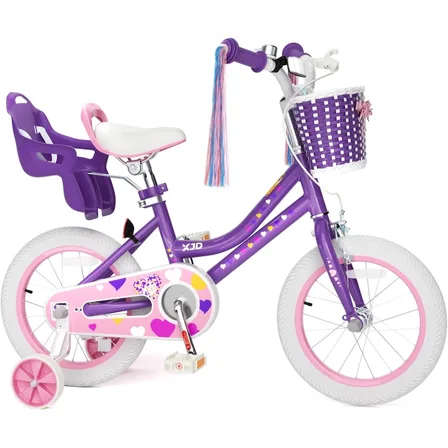
Purple XJD Girls' Bike with Doll Seat & Basket
For girls 71–122 cm tall (about ages 3–7), this XJD girls' bike in Purple pairs …$75.99
$99.99