

What size bike wheel for an 8 year old
For most 8-year-olds, start by trying a 20-inch bike, especially when the child is 48–60 in (122–152 cm) tall. Height and actual fit matter more than age, so also compare 18-inch and 24-inch bikes where the height ranges overlap.
The likely wheel size at age eight
The XBikes starting point for a 20-inch wheel is ages 7–12 and a rider height of 48–60 in (122–152 cm). That makes 20 inches the most likely answer for an average 8-year-old, but it is a starting point rather than a guaranteed fit.
An 18-inch bike corresponds to ages 5–9 and heights of 43–52 in (109–132 cm), so it may fit a shorter eight-year-old or a rider who currently needs easier handling. A 24-inch bike starts at ages 10–14 and heights of 54–64 in (137–163 cm). A tall eight-year-old may fall within that height range, but the larger bike is appropriate only if stand-over, reach, braking and control all work now.
| Wheel size | XBikes age starting point | Rider height | Relevance at age 8 |
|---|---|---|---|
| 16 Inch | Ages 4–7 | 40–48 in / 102–122 cm | Check only for a notably shorter rider whose fit requires it |
| 18 Inch | Ages 5–9 | 43–52 in / 109–132 cm | Possible for shorter riders |
| 20 Inch | Ages 7–12 | 48–60 in / 122–152 cm | Usual first size to try |
| 24 Inch | Ages 10–14 | 54–64 in / 137–163 cm | Possible by height, but only after a careful fit check |
Measure before choosing
Measure the child without shoes, standing straight against a wall, from the floor to the top of the head. Then measure inseam from the floor to the crotch while the child stands naturally. Record both measurements rather than estimating from clothing size or comparing the child with classmates.
Use measured height to select the first wheel size to try. Inseam then helps with the stand-over check: the child should be able to straddle the bicycle comfortably rather than being forced onto tiptoes or against the frame. Because frame shapes differ, wheel diameter alone cannot establish clearance.
Check the bike with the child on it
Have the child try the exact bicycle. The American Academy of Pediatrics advises against buying an oversized bike merely to allow room for growth. A bike that will fit later can be difficult to mount, steer or stop today.
- Stand-over: Ask the child to straddle the frame with both feet on the ground. There should be comfortable clearance, without the frame obstructing the rider.
- Reach: The child should reach the handlebar without stretching, locking the elbows or losing a stable riding position.
- Brake control: Confirm that the child can reach and operate the bicycle's controls confidently. Do not assume a control suits small hands merely because the wheel size looks right.
- Handling: Watch a start, straight ride, controlled turn and stop in a traffic-free area. The child should remain in control rather than fighting the bike's size.
- Confidence: If two sizes appear possible, current control and confidence should outweigh the desire to buy the larger one for future use.
How the supplied training-wheel bikes compare
The two catalog options are useful because both offer a 20 Inch variant—the usual first wheel size to try for an eight-year-old within the 48–60 in (122–152 cm) range—and smaller comparison sizes. They are training-wheel bikes, so they are relevant only when that type of setup matches the child's present riding needs.
 Girls' Training Wheel Bike by XJD, 12–20 Inch Wheels – Blue
Offers 12, 14, 16 and 20 Inch variants in Blue. Its 20 Inch option is relevant to try when the rider measures 48–60 inches tall and passes an individual fit check.
 XJD Girls' Bike with Training Wheels, 12/14/16/20 Inch – Purple
This Purple training-wheel bike is available in 12, 14, 16 and 20 Inch variants. Compare the 20 Inch version for a qualifying eight-year-old; choose a smaller variant only when measurements and actual control support it.
Girls' Training Wheel Bike by XJD, 12–20 Inch Wheels – Blue is listed in Blue with 12 Inch, 14 Inch, 16 Inch and 20 Inch choices. XJD Girls' Bike with Training Wheels, 12/14/16/20 Inch – Purple is listed in Purple with the same four wheel-size choices.
For this age question, compare their 20 Inch variants when the rider's measurements and trial support that size. Their 16 Inch variants correspond to the XBikes starting point of ages 4–7 and heights of 40–48 in (102–122 cm), so consider one only if the individual child's measured height and fit indicate it. The 12 Inch and 14 Inch variants are generally starting points for younger, shorter riders under the supplied chart; their presence does not make them age-eight recommendations.
Neither supplied product offers an 18 Inch or 24 Inch SKU. If the fit check points to either of those sizes, these products are comparison points, not substitutes: a 16-inch or 20-inch bike is not equivalent to an 18-inch bike, and a 20-inch bike is not equivalent to a 24-inch bike.
Safety and setup before the first ride
Use a bicycle helmet that fits properly, sits level and has its straps adjusted according to the helmet manufacturer's instructions, as advised by the U.S. Consumer Product Safety Commission. Recheck helmet fit rather than relying only on its labeled size.
For assembly, adjustment, maintenance, compatibility, load limits or torque settings, follow the exact bicycle manual. If the instructions are unavailable or the setup is uncertain, use a qualified bicycle mechanic rather than guessing.
Make the final size decision
Measure height and inseam, begin with a 20-inch trial when the child is 48–60 in (122–152 cm), and compare an 18-inch or 24-inch bike if the child's height falls in those ranges. Choose only the size the eight-year-old can straddle, reach, control and stop comfortably today.
Bikes for your next adventure
-

XJD Girls Bike for Kids Ages 3-8, 12/14/16 Inch with Training Wheels – Purple
The XJD Girls Bike in Purple is a training-wheel bicycle for kids ages 3 to 8, f…$149
$169 -

Pink Girls' 12/14/16" Bike by XJD – Basket & Doll Seat
The XJD Pink Girls' Bike with Basket & Doll Seat is made for riders 71–122 cm ta…$75.99
$99.99 -
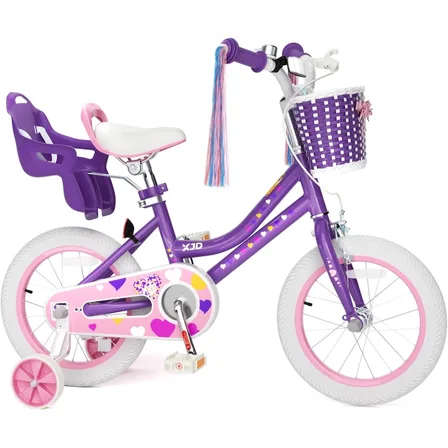
Purple XJD Girls' Bike with Doll Seat & Basket
For girls 71–122 cm tall (about ages 3–7), this XJD girls' bike in Purple pairs …$75.99
$99.99