

What size bike wheels for 10 year old
For a 10-year-old, start with 24-inch wheels if the child is 54–64 in (137–163 cm) tall. Consider 20-inch wheels at 48–60 in (122–152 cm), and decide by an individual fit check—not age alone.
Choose the starting size from measured height
Measure the child without shoes, standing straight against a wall. Compare that height with the XBikes starting points below. The age bands overlap, so a 10-year-old may fit either a 20-inch or 24-inch bicycle.
| Wheel size | XBikes age starting point | Rider height |
|---|---|---|
| 20 Inch | Ages 7–12 | 48–60 in / 122–152 cm |
| 24 Inch | Ages 10–14 | 54–64 in / 137–163 cm |
| 26 Inch | Youth and adults over 60 in / 153 cm | Over 60 in / 153 cm |
The overlap between 20-inch and 24-inch ranges is intentional: height narrows the choice, but it cannot confirm fit by itself. If the child measures 54–60 in (137–152 cm), try both sizes and choose the one they can control confidently. A rider over 60 in (153 cm) may also need to compare a 26-inch bicycle.
Measure inseam before visiting or ordering
Height is the first filter; inseam helps reveal whether the frame leaves usable clearance. Have the child stand in socks with feet slightly apart. Place a rigid book between the legs, level and raised gently to the crotch, then measure from the floor to the book’s top edge.
Compare that measurement with the bicycle manufacturer’s stand-over information for the exact model. The child should be able to straddle the bicycle as directed by its fit guidance, without being forced onto tiptoes or contacting the frame. Because frame shapes differ, wheel diameter alone cannot supply a universal stand-over number.
Perform the fit and control check
Have the child try the bicycle whenever possible. The American Academy of Pediatrics advises against buying an oversized bicycle merely for future growth. A suitable choice should let the rider mount, stop and steer without struggling.
- Stand-over: Confirm comfortable clearance while the child straddles the frame.
- Reach: Check that the child can hold the handlebar without locking the elbows, stretching the torso or losing a stable seated position.
- Brake control: Make sure the child can reach and operate the bicycle’s braking controls reliably. Follow the exact model’s manual because brake arrangements are not the same on every bicycle.
- Confidence: Ask for a controlled start, straight ride, turn and stop in a traffic-free area. Size down from an unwieldy option rather than expecting the child to grow into it.
If neither candidate permits these actions comfortably, reject both and try a different frame or size. Do not treat seat adjustment as a cure for excessive stand-over height or reach.
How the supplied 20-inch options relate
Two supplied catalog bicycles offer a 20 Inch SKU, making them relevant comparison options for a 10-year-old within the 20-inch height starting point. The third supplied bicycle has only smaller available SKU labels, so it helps show the boundary of this selection rather than providing a 20- or 24-inch substitute. None of the supplied products offers a verified 24 Inch SKU.
 XJD Girls' Bike with Training Wheels, 12/14/16/20 Inch – Purple
Available in 12, 14, 16 and 20 Inch SKU labels. Its 20 Inch version is relevant for comparison when the rider measures 48–60 in (122–152 cm), subject to an individual fit check.
 XJD Kids Bike for Girls – Pink, 12/14/16/20 Inch with Training Wheels
Its supplied sizes include a 20 Inch SKU alongside 12, 14 and 16 Inch choices. Compare the 20 Inch version only when the child's measured height and control support that starting size.
 XJD Light Purple Girls Bike with Basket, Training Wheels, 12/14/16/20 Inch
The supplied available SKU labels are 12, 14 and 16 Inch. It therefore does not provide a verified 20- or 24-inch option for this decision and serves only as a smaller-size comparison.
Available catalog comparisons
XJD Girls' Bike with Training Wheels, 12/14/16/20 Inch – Purple has available 12 Inch, 14 Inch, 16 Inch and 20 Inch SKU labels. Only its 20 Inch version is relevant to the 48–60 in (122–152 cm) starting range discussed here.
XJD Kids Bike for Girls – Pink, 12/14/16/20 Inch with Training Wheels likewise has available 12 Inch, 14 Inch, 16 Inch and 20 Inch SKU labels. Its 20 Inch version is a comparison point, subject to the same height, inseam, reach, braking and confidence checks.
XJD Light Purple Girls Bike with Basket, Training Wheels, 12/14/16/20 Inch has supplied available SKU labels of 12 Inch, 14 Inch and 16 Inch. Despite the sizes appearing in its exact catalog title, no available 20 Inch SKU is supplied here, and it is not a 24-inch option.
Training wheels appear in these catalog titles, but the titles do not establish whether they suit an individual child’s current ability. Confirm included equipment and setup in the exact product listing and manual. For assembly, compatibility, maintenance or torque questions not specified here, follow that manual or use a qualified bicycle mechanic.
Make the final decision
If the child is 48–53 in (122–136 cm), begin with a 20-inch fit check. At 54–60 in (137–152 cm), compare 20-inch and 24-inch bicycles directly. At 61–64 in (155–163 cm), start with 24-inch and consider a 26-inch comparison where appropriate. Resolve any boundary case through stand-over, reach, brake control and confidence—not birthdays or extra growing room.
Before riding, use a properly fitting bicycle helmet. The U.S. Consumer Product Safety Commission advises that it sit level and that its straps be adjusted according to the helmet manufacturer’s instructions. For this 10-year-old, measure height and inseam now, shortlist the matching wheel sizes, then choose only after the child passes the complete fit-and-control check.
Bikes for your next adventure
-

Pink Girls' 12/14/16" Bike by XJD – Basket & Doll Seat
The XJD Pink Girls' Bike with Basket & Doll Seat is made for riders 71–122 cm ta…$75.99
$99.99 -

XJD Girls Bike for Kids Ages 3-8, 12/14/16 Inch with Training Wheels – Purple
The XJD Girls Bike in Purple is a training-wheel bicycle for kids ages 3 to 8, f…$149
$169 -
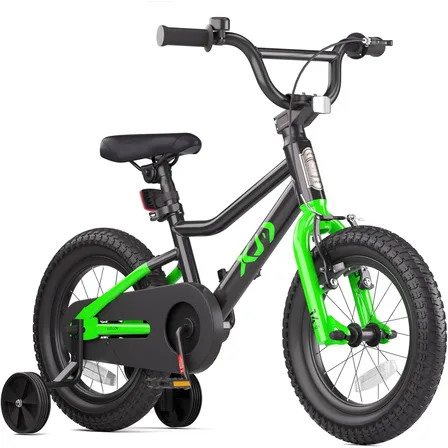
Black XJD Kids' BMX Bicycle with Training Wheels
The XJD Kids' BMX Bicycle with Training Wheels is built for children roughly 3 t…$99.99
$119.99