

What size bike wheels for 9 year old
A 9-year-old should usually compare 18-inch and 20-inch bike wheels. Choose from measured height and an actual fit check, not age alone.
The direct size answer
Under the XBikes starting points, an 18-inch bike covers ages 5–9 and rider heights of 43–52 inches (109–132 cm). A 20-inch bike covers ages 7–12 and heights of 48–60 inches (122–152 cm). That overlap means either wheel size can appear age-appropriate at nine, but the child’s height and control determine which one fits.
Start with 18 inches when the rider is below 48 inches tall. From 48 to 52 inches, compare both sizes in person. Above 52 inches, start with 20 inches. These are screening points, not a replacement for checking stand-over clearance, reach, braking and confidence on the complete bicycle.
Measure before comparing bikes
Measure the child barefoot or in the shoes normally worn for riding. For height, have the child stand straight against a wall and measure from the floor to the top of the head. For inseam, measure from the floor to the crotch while the child stands naturally.
Record both measurements in inches or centimetres. The XBikes table uses height to identify a starting wheel size; inseam then helps you judge stand-over clearance on a particular frame. Wheel diameter alone cannot reveal the height of the top tube, saddle position or distance to the controls.
| Measured height | Size to check first | Next step |
|---|---|---|
| 43–47 in / 109–121 cm | 18 Inch | Confirm stand-over, reach and control |
| 48–52 in / 122–132 cm | 18 Inch and 20 Inch | Try both complete bikes |
| 53–60 in / 133–152 cm | 20 Inch | Confirm the child remains comfortable and in control |
| Outside these ranges | Use the full XBikes starting points | Do not force an age-based choice |
What a successful fit check looks like
Have the child try the exact bicycle rather than assuming every bike with the same wheel diameter fits alike. With the child straddling the frame, check that there is usable clearance instead of contact with the top tube. Seated, the rider should reach the handlebar without stretching or becoming cramped.
Ask the child to operate the brakes comfortably and maintain a stable grip. They should be able to start, steer, stop and dismount with control. Current confidence matters: a hesitant rider may manage a smaller, easier-to-control fit better than a larger bike that merely leaves more growing room.
Do not buy an oversized bicycle just for future growth. If the rider cannot control it now, it is not the right present size. For adjustments, assembly, maintenance or torque requirements, follow the exact product manual or ask a qualified bicycle mechanic.
How the supplied XBikes options help
The supplied catalog includes several 20-inch comparison points, plus larger 24-inch and 26-inch variants. They are useful after measurements indicate that 20 inches is appropriate, or for seeing why a larger wheel should not be substituted solely to extend growing time.
 XJD Pink Beach Cruiser for Girls – Rear Rack & V-Brake
Offers 20 Inch, 24 Inch and 26 Inch SKU labels. Its 20 Inch option is the relevant starting comparison when the child’s measurements support that size; larger options require their own fit check.
 Blue XJD Freestyle BMX Bike, 20-Inch – No Pegs
A 20-inch Kids’ BMX Bikes comparison with a Default SKU label. Use the complete-bike fit check to confirm stand-over clearance, reach, brake control and rider confidence.
 26-Inch XJD Beach Cruiser Bike for Girls – Purple, V-Brake
Includes 20 Inch, 24 Inch and 26 Inch variants in supplied color combinations. Only its 20 Inch variants are directly relevant when a nine-year-old’s measured height and individual fit support 20 inches.
XJD Pink Beach Cruiser for Girls – Rear Rack & V-Brake is offered with 20 Inch, 24 Inch and 26 Inch SKU labels. For a typical nine-year-old comparison, begin only with its 20 Inch option when the measurements support it. The 24 Inch starting range is ages 10–14 and heights 54–64 inches (137–163 cm), so it requires a separate fit decision.
Blue XJD Freestyle BMX Bike, 20-Inch – No Pegs provides a 20-inch reference in the Kids’ BMX Bikes category. Its Default SKU label gives no additional sizing choice, so confirm the exact complete-bike fit rather than relying on the title alone.
26-Inch XJD Beach Cruiser Bike for Girls – Purple, V-Brake has Mint Green and Pink variants labeled 20 Inch, 24 Inch and 26 Inch, plus Purple / 26 Inch. Compare only the 20 Inch variants when that is the measured starting size. XBikes places 26 Inch at youth and adults over 60 inches (153 cm), so a 26-inch variant is not equivalent to an 18- or 20-inch bike.
None of these supplied products offers an 18-inch SKU label. If the child’s measurements and fit check point to 18 inches, the shown products are larger comparison points, not substitutes.
Helmet and final control check
A properly fitting bicycle helmet is part of the decision. It should sit level and its straps should be used according to the helmet manufacturer’s instructions. A helmet does not correct a bicycle that is too large or difficult to control.
Before choosing, repeat the practical test: can the child straddle the frame, reach the handlebar and brakes, steer steadily, stop deliberately and dismount without struggling? If any answer is no, reject that particular bike even if its wheel-size label matches the chart.
What to do next
Measure height and inseam, use 18 or 20 inches as the appropriate starting point, and try the exact bike. For a nine-year-old measuring 48–52 inches, compare both sizes directly. Choose the bike the child controls confidently today; if 18 inches fits, keep looking for an actual 18-inch model rather than sizing up to one of the supplied 20-inch options.
Bikes for your next adventure
-

Pink Girls' 12/14/16" Bike by XJD – Basket & Doll Seat
The XJD Pink Girls' Bike with Basket & Doll Seat is made for riders 71–122 cm ta…$75.99
$99.99 -

XJD Girls Bike for Kids Ages 3-8, 12/14/16 Inch with Training Wheels – Purple
The XJD Girls Bike in Purple is a training-wheel bicycle for kids ages 3 to 8, f…$149
$169 -
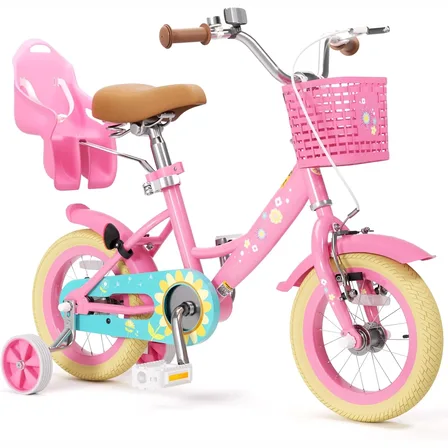
Flower Pink XJD Girls Bike with Doll Seat & Basket
The XJD Flower Pink girls' bike is made for riders 71–122 cm tall (roughly ages …$69.99