

What size kid rides a 20 inch bike
A 20-inch bike generally suits a child age 7–12 who is 48–60 inches (122–152 cm) tall, but measured fit and confident control matter more than age.
Start with the child’s current measurements
Measure height with the child standing straight against a wall, without shoes. Record the result in inches or centimetres and compare it with the XBikes 20-inch starting range: 48–60 inches (122–152 cm).
Next, measure inseam from the floor to the crotch while the child stands naturally. Inseam does not replace the height range, but it helps when checking whether the child can straddle a particular bicycle comfortably. Keep both measurements available when reviewing the bicycle’s sizing information or trying it in person.
Age is only an initial clue. Two children of the same age can differ substantially in height, leg length, reach and riding confidence. Do not choose an oversized bicycle simply because the child may grow into it.
Compare the measurement with nearby wheel sizes
| Wheel size | Starting age | Starting rider height | What the comparison means |
|---|---|---|---|
| 18 Inch | 5–9 | 43–52 in / 109–132 cm | Worth comparing when the rider is below or near the lower end of the 20-inch range. |
| 20 Inch | 7–12 | 48–60 in / 122–152 cm | The requested starting range; confirm it on the actual bicycle. |
| 24 Inch | 10–14 | 54–64 in / 137–163 cm | A nearby larger category, not an equivalent substitute for a 20-inch bicycle. |
Overlap is normal because wheel diameter alone cannot describe the frame, saddle position or handlebar reach. A child within the 20-inch height range still needs an individual fit check, while a child outside it should not be moved onto that wheel size solely because their age appears in the range.
Check the actual 20-inch bike before deciding
Have the child try the exact bicycle. When straddling it, the child should have comfortable stand-over clearance rather than being pressed against the frame. Seated riding position should allow easy steering without stretching excessively or feeling cramped.
Ask the child to hold the handlebars, operate the controls and reach the brakes. They should be able to steer predictably, start, stop and put a foot down without panic. Brake reach and control must be evaluated on the actual model; a suitable height range cannot prove that small hands can operate every setup.
Current confidence also matters. A hesitant rider may struggle with a bicycle that feels tall or cumbersome even when the height chart suggests 20 inches. A confident rider still should not skip the stand-over, reach and braking checks.
How the supplied XBikes options help
The Pink 12/14/16/20" XJD Girls Bike with Training Wheels & Basket includes 12 Inch, 14 Inch, 16 Inch and 20 Inch SKU labels, so its 20 Inch option is directly relevant to this question. The 26-Inch XJD Beach Cruiser Bike for Girls – Purple, V-Brake has Mint Green / 20 Inch and Pink / 20 Inch labels alongside 24 Inch and 26 Inch variants, making its labeled 20-inch options relevant while showing that similarly named products can span several wheel sizes. These catalog choices help identify the requested size, but their labels do not replace trying the selected variant.
 Pink 12/14/16/20" XJD Girls Bike with Training Wheels & Basket
Includes a specifically labeled 20 Inch option, plus 12, 14 and 16 Inch choices for size comparison. The selected bicycle still requires individual stand-over, reach, brake-control and confidence checks.
 26-Inch XJD Beach Cruiser Bike for Girls – Purple, V-Brake
Offers Mint Green / 20 Inch and Pink / 20 Inch labels, as well as larger variants. Purple is supplied only as 26 Inch, so confirm the exact colour and wheel-size combination before assessing fit.
Confirm the exact size and colour combination before evaluating fit. In particular, the Purple option listed for the beach cruiser is 26 Inch, not 20 Inch. The XBikes starting point for 26 Inch is youth and adults over 60 inches (153 cm), so that variant must not be treated as equivalent to either of its 20 Inch options.
Know when a 20-inch bike is not appropriate
- The measured height is below 48 inches (122 cm) or above 60 inches (152 cm), so another wheel-size range should be compared.
- The child cannot straddle the bicycle comfortably or must stretch to reach the bars or brakes.
- The child cannot start, steer, stop and put a foot down with present confidence.
- The selected SKU is actually labeled 12, 14, 16, 24 or 26 Inch rather than 20 Inch.
Do not improvise assembly, adjustment, compatibility, load-limit or torque guidance. Follow the manual for the exact product and variant, or ask a qualified bicycle mechanic to inspect and adjust it.
Make the final fit and safety check
- Measure the child’s height and inseam now.
- Use 48–60 inches (122–152 cm) only as the 20-inch starting range.
- Try the exact bicycle and check stand-over clearance, reach, brake operation and confident control.
- Choose the size the child can control today, rather than a larger size intended for future growth.
Finish by fitting a bicycle helmet properly: it should sit level, fit securely and use its straps according to the helmet manufacturer’s instructions. If the child cannot comfortably control the exact 20-inch bicycle after adjustment, compare the appropriate adjacent size instead of forcing the 20-inch choice.
Bikes for your next adventure
-

XJD Kids Bike for Girls – Pink, 12/14/16/20 Inch with Training Wheels
The XJD Kids Bike for Girls in Pink is a training-wheel bike built to carry your…$139
$159 -

Kids Bike Helmet by XJD for Girls – Pink
The XJD Kids Bike Helmet in Pink is a lightweight multi-sport helmet for girls r…$59.99
$99 -
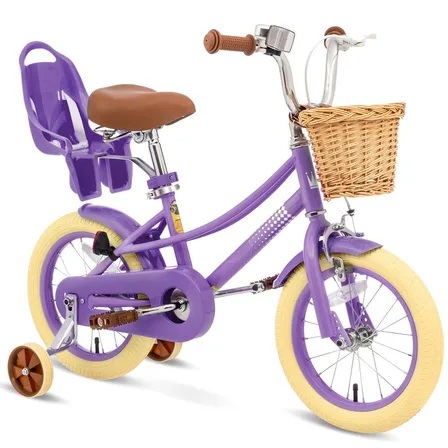
XJD Girls' Bike with Training Wheels, 12/14/16/20 Inch – Purple
The XJD girls' bike with training wheels in Purple is built to grow with your ri…$139
$159