

What size wheel bike for a 5 year old
Most 5-year-olds should start by trying a 14-inch or 16-inch wheel bike. Measure the child’s height first: 14-inch bikes suit 37–45 in (94–114 cm), while 16-inch bikes suit 40–48 in (102–122 cm). Age is only a starting point, so choose the bike the child can stand over, reach, control and brake comfortably.
Choose between 14-inch and 16-inch wheels
A 5-year-old falls within both XBikes starting ranges: 14-inch wheels cover ages 3–6, and 16-inch wheels cover ages 4–7. Height makes the comparison more useful.
| Wheel size | XBikes age starting point | Rider height starting point | What to do |
|---|---|---|---|
| 14 Inch | Ages 3–6 | 37–45 in / 94–114 cm | Try this size if the child is within the range, especially toward its shorter end. |
| 16 Inch | Ages 4–7 | 40–48 in / 102–122 cm | Compare it with a 14-inch bike if the child is at least 40 in / 102 cm tall. |
If the child measures 40–45 in (102–114 cm), both starting ranges overlap. That does not make the sizes interchangeable: have the child try each one and select the better fit. If the child is outside these ranges, use the full size standard below rather than forcing a 14-inch or 16-inch choice.
Measure before comparing bikes
Measure the child without shoes, standing straight against a wall. Record total height from the floor to the top of the head. Then measure inseam from the floor to the crotch, using a firm book held level to represent the top of a bicycle saddle.
Height identifies the wheel sizes worth trying. Inseam helps with the individual stand-over and saddle-height check, but the supplied standard does not provide a numerical inseam rule. Do not convert inseam into a wheel size using an invented formula.
Perform the fit check in person
Have the child try the exact bicycle whenever possible. A suitable wheel-size range is not enough by itself. Check all of the following:
- Stand-over: the child can straddle the bicycle rather than being forced onto tiptoes or against the frame.
- Reach: the child can hold the handlebar without stretching, locking the arms or losing a stable posture.
- Brake control: the child can reach and operate the fitted braking controls confidently. Follow the product manual for their correct use and adjustment.
- Starting and stopping: the child can get moving, steer and stop without the bicycle feeling unwieldy.
- Confidence: the size supports the child’s current ability instead of demanding skills they do not yet have.
Do not buy an oversized bicycle merely to leave room for growth. If the larger wheel size makes control, stand-over, brake reach or confidence worse, choose the smaller properly fitting option and reassess as the child grows.
How the supplied bikes help with the comparison
The catalog includes two training-wheel bike models with both 14-inch and 16-inch SKU labels, so they provide relevant options for comparing the two sizes commonly considered for a 5-year-old. Their listed accessories may distinguish the models, but they do not establish fit.
The Pink Girls' 12/14/16" Bike by XJD – Basket & Doll Seat is categorized as a Training Wheel Bike and is offered with 12 Inch, 14 Inch and 16 Inch labels. The Pink 12/14/16/20" XJD Girls Bike with Training Wheels & Basket is also categorized as a Training Wheel Bike and has 12 Inch, 14 Inch, 16 Inch and 20 Inch labels.
These particular catalog options help answer the sizing question because both let a parent compare relevant 14-inch and 16-inch variants without assuming that one wheel size fits every 5-year-old.
 Pink Girls' 12/14/16" Bike by XJD – Basket & Doll Seat
Available in 12 Inch, 14 Inch and 16 Inch labels, this training-wheel model lets parents compare the two wheel sizes most commonly relevant to a 5-year-old after measuring height and checking individual fit.
 Pink 12/14/16/20" XJD Girls Bike with Training Wheels & Basket
This training-wheel bike has 12 Inch, 14 Inch, 16 Inch and 20 Inch labels. Its 14-inch and 16-inch variants are relevant comparison options, while the child’s measured height and hands-on fit must determine the size.
Use only the exact SKU label that matches the child’s successful fit check. The 12-inch and 20-inch variants are not automatically suitable because they share a model name: XBikes lists 12 Inch for ages 3–4 and heights 34–40 in (86–102 cm), while 20 Inch starts at ages 7–12 and heights 48–60 in (122–152 cm). Treat those figures as starting points and still test the individual bicycle.
When another wheel size may be relevant
A 5-year-old measuring 43–52 in (109–132 cm) also enters the XBikes 18-inch starting range for ages 5–9. Neither supplied product lists an 18 Inch SKU, so these products are comparison points for their available sizes, not substitutes for an 18-inch bicycle. If 18 Inch appears appropriate, compare an actual 18-inch model and repeat the same stand-over, reach, brake-control and confidence checks.
A child below the 14-inch height range may need to try a 12-inch bike, whose starting range is 34–40 in (86–102 cm). Do not move up solely because the child is five.
Make the final decision
Measure height and inseam, shortlist 14 Inch or 16 Inch from the height ranges, and have the child try the exact bike. Choose the size on which stand-over, reach, braking and current confidence all work together. Fit a bicycle helmet so it sits level and secure, with straps used according to its manufacturer’s instructions. For assembly, adjustments, compatibility, load limits or torque, follow the exact bicycle manual or ask a qualified bicycle mechanic.
Bikes for your next adventure
-

Pink Girls' 12/14/16" Bike by XJD – Basket & Doll Seat
The XJD Pink Girls' Bike with Basket & Doll Seat is made for riders 71–122 cm ta…$75.99
$99.99 -

XJD Girls Bike for Kids Ages 3-8, 12/14/16 Inch with Training Wheels – Purple
The XJD Girls Bike in Purple is a training-wheel bicycle for kids ages 3 to 8, f…$149
$169 -
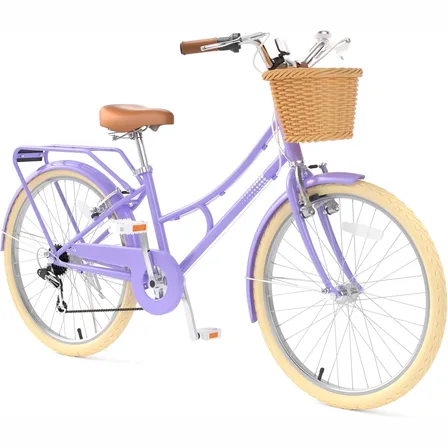
24-Inch Purple XJD Beach Cruiser Bike with U-Brake
The XJD 24-Inch Purple Beach Cruiser is built for girls and young women roughly …$159.99