

What size wheel bike for a 6 year old
Most 6-year-olds should start by trying a 16-inch bike; consider 14 or 18 inches if the child’s measured height and individual fit point that way.
Start with height, not age
At age 6, the XBikes starting ranges overlap. A 14-inch bike covers rider heights of 37–45 inches (94–114 cm), a 16-inch bike covers 40–48 inches (102–122 cm), and an 18-inch bike covers 43–52 inches (109–132 cm). Because 16 inches sits in the middle of these overlapping ranges, it is the practical first size to try for many 6-year-olds—not an automatic answer.
A shorter 6-year-old may fit a 14-inch bike better. A taller child may need to compare 16 and 18 inches. A 20-inch bike starts at 48 inches (122 cm) and ages 7–12 in the XBikes guide, so it is generally a comparison only for a particularly tall 6-year-old who can demonstrate full control during an individual fit check.
Measure your child before choosing
Measure the child without shoes, standing straight against a wall. Record total height from the floor to the top of the head. Then measure inseam from the floor to the crotch, using a book held level between the legs to represent the bicycle’s top-tube contact point.
Use height to select the first wheel size to try, then use inseam to assess stand-over clearance on the actual bicycle. Wheel diameter alone does not determine fit: frames, saddle positions and handlebar reach can differ even when their wheel labels match.
| Measured height | Starting comparison | What to do |
|---|---|---|
| 37–40 in / 94–102 cm | 14 inch | Try 14 inches first; do not move up merely for growth. |
| 40–45 in / 102–114 cm | 14 and 16 inch | Compare both and choose by stand-over, reach and control. |
| 45–48 in / 114–122 cm | 16 and 18 inch | Try both; favor the size the child can control confidently. |
| 48–52 in / 122–132 cm | 18 inch; possibly 20 inch | Compare carefully because 20 inches is a larger step. |
Check the bike with the child aboard
Have the child try the exact bicycle rather than relying on its age label. The child should be able to straddle it with suitable clearance, mount and dismount without struggling, and reach the handlebars without stretching or locking the elbows.
Ask the child to demonstrate steering at low speed, starting, stopping and maintaining balance. If the bike has hand-operated brakes, confirm that the child can reach and operate them comfortably. Current confidence matters: a rider who is technically within a height range may still have better control on the smaller overlapping size.
Do not buy an oversized bicycle with the expectation that the child will grow into it. That approach can compromise stand-over clearance, reach, braking and control. Follow the exact bicycle manual for assembly and adjustments; use a qualified bicycle mechanic when the instructions or fit are uncertain.
How the supplied bikes help with comparison
The supplied catalog options are relevant because both offer 14-inch and 16-inch versions—the two most likely comparison sizes around age 6—and a 20-inch version for a tall rider who meets that starting range. Neither offers an 18-inch option, so their 16-inch and 20-inch versions are comparison points, not substitutes for an 18-inch bike.
Girls' Training Wheel Bike by XJD, 12–20 Inch Wheels – Blue is listed in 12-, 14-, 16- and 20-inch sizes. XJD Girls' Bike with Training Wheels, 12/14/16/20 Inch – Purple has the same supplied size choices. Their catalog facts establish wheel-size availability and that both are training-wheel bikes; they do not establish fit for a particular child. Compare the exact selected size with the child’s measurements and in-person control.
 Girls' Training Wheel Bike by XJD, 12–20 Inch Wheels – Blue
Available in 12-, 14-, 16- and 20-inch versions. Its 14- and 16-inch choices are useful fit comparisons for a 6-year-old; the 20-inch version is relevant only when height and an individual trial support it.
 XJD Girls' Bike with Training Wheels, 12/14/16/20 Inch – Purple
This training-wheel bike is offered with 12-, 14-, 16- and 20-inch wheels. Compare its 14- and 16-inch versions using the child’s measurements and control; it does not provide the 18-inch option some taller 6-year-olds may fit.
When these products are not the right match
Do not select the 12-inch version for a typical 6-year-old based on age: its XBikes starting range is ages 3–4 and heights 34–40 inches (86–102 cm). Do not select a 20-inch version merely to extend usable life; the child should already meet its height starting point and pass every fit and control check.
If measurements and a trial indicate that 18 inches gives the child better stand-over, reach and control, neither supplied product provides that exact wheel size. Look for an actual 18-inch bicycle rather than treating 16 or 20 inches as equivalent. Likewise, training-wheel models may not be relevant when the child’s present balance skills and intended riding call for a different setup.
Make the final size decision
- Measure height and inseam without shoes.
- Use 16 inches as the first trial for most 6-year-olds, shifting the comparison to 14 or 18 inches when measured height indicates it.
- Confirm stand-over clearance, comfortable reach, effective brake control and confident starting, steering and stopping on the exact bike.
- Choose the size the child controls now, rather than an oversized model for future growth.
Finish by fitting a bicycle helmet that sits level and uses its straps according to the helmet manufacturer’s instructions. For a 6-year-old, buy only after the child has successfully tried the exact wheel size and bicycle—not from the age label alone.
Bikes for your next adventure
-

XJD Girls Bike for Kids Ages 3-8, 12/14/16 Inch with Training Wheels – Purple
The XJD Girls Bike in Purple is a training-wheel bicycle for kids ages 3 to 8, f…$149
$169 -

Pink Girls' 12/14/16" Bike by XJD – Basket & Doll Seat
The XJD Pink Girls' Bike with Basket & Doll Seat is made for riders 71–122 cm ta…$75.99
$99.99 -
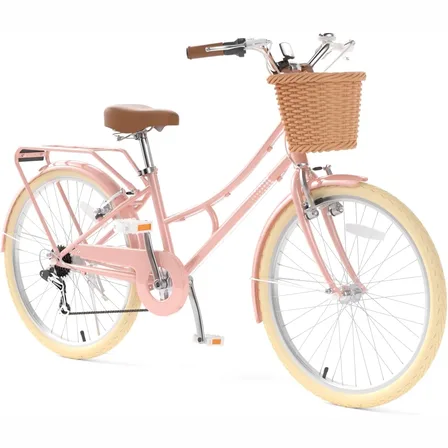
XJD Pink Beach Cruiser for Girls – Rear Rack & V-Brake
The XJD Pink Beach Cruiser for girls is the step-up bike for riders who've outgr…$179.99
$209.99