

What size wheel bike for 6 year old
Most 6-year-olds should start by comparing 14-, 16-, and 18-inch bikes. Measure the child first: height and actual fit matter more than age.
Which wheel size should you try first?
For a 6-year-old, the XBikes starting ranges overlap. A 14-inch bike covers rider heights of 37–45 in (94–114 cm), a 16-inch bike covers 40–48 in (102–122 cm), and an 18-inch bike covers 43–52 in (109–132 cm). This means age six does not identify one correct wheel size.
Use the child's measured height to narrow the choices. If the measurement falls in two or three ranges, arrange a fit check rather than automatically choosing the largest option. A smaller wheel may suit a less confident rider, while a larger candidate is relevant only if the child can stand over and control that specific bicycle comfortably.
| Wheel size | XBikes age starting point | Rider-height starting point |
|---|---|---|
| 14 Inch | Ages 3–6 | 37–45 in / 94–114 cm |
| 16 Inch | Ages 4–7 | 40–48 in / 102–122 cm |
| 18 Inch | Ages 5–9 | 43–52 in / 109–132 cm |
Measure before comparing bicycles
Measure the child without shoes, standing straight against a wall, to get current height. Then measure inseam from the floor to the crotch. Record both measurements rather than relying on clothing size, an old growth-chart entry, or the height of another six-year-old.
Height helps select likely wheel sizes, but inseam helps assess whether the child can stand over the bicycle. The supplied standard does not provide a numerical inseam rule, so do not invent one or assume that wheel diameter determines clearance. Compare the measurement with the actual bicycle's geometry and fitting guidance.
Check the individual fit
Have the child try the exact bike. With the child straddling it, confirm there is comfortable stand-over clearance. On the seat, check that starting, stopping and putting a foot down feel controlled rather than precarious.
Next, watch the child's upper body and hands. The child should be able to reach the handlebar without an awkward stretch, steer predictably and operate the brakes comfortably. Check brake reach on the actual model; wheel size alone cannot establish it. Current confidence matters too: a child who is still learning should not be pushed onto a bicycle that feels intimidating.
Do not buy an oversized bike merely to allow room for growth. A bicycle that will fit later does not necessarily provide suitable control now. If the child is between sizes, compare both candidates during a supervised fitting and choose according to present control.
How the supplied catalog bike helps
The XJD Kids' Training Wheel Bike for Boys & Girls, 12/14/16 Inch – White is listed in 12 Inch, 14 Inch and 16 Inch options. For a typical six-year-old comparison, its 14- and 16-inch labels let you examine two overlapping starting ranges. The 12-inch option starts at ages 3–4 and heights 34–40 in (86–102 cm), so it is relevant only when the child's measurement and individual fit support that smaller size.
These catalog options help answer the title because they provide nearby wheel sizes to compare against the child's height, inseam, reach, brake control and confidence. They do not remove the need to try the bicycle, and this supplied product does not include an 18-inch option.

When an 18-inch bike may be the better comparison
If the child measures 43–52 in (109–132 cm), an 18-inch bike falls within the XBikes height starting point and deserves a fit check. The supplied XJD product is not an 18-inch substitute; its 14- and 16-inch versions are smaller, distinct comparison points.
A 20-inch bike starts at ages 7–12 and rider heights of 48–60 in (122–152 cm). Even if a tall six-year-old reaches the lower height boundary, age and height alone are insufficient. Only consider it after checking stand-over clearance, reach, braking and confident control on that exact bicycle.
What to do next
- Measure the child's current height and inseam without shoes.
- Use height to shortlist 14, 16 or 18 inches from the supplied ranges.
- Have the child straddle and ride each realistic candidate in a controlled setting.
- Compare stand-over clearance, handlebar reach, brake reach, starting, steering and stopping.
- Select the size the child controls now, rather than an oversized bike intended for future growth.
Before riding, fit a bicycle helmet so it sits level and its straps follow the helmet manufacturer's instructions. For assembly, adjustment, maintenance, load limits or torque details, follow the exact bicycle manual or consult a qualified bicycle mechanic.
For your 6-year-old, measure first, shortlist the overlapping sizes, and make the final choice only after the child demonstrates comfortable control of the exact bike.
Bikes for your next adventure
-

XJD Girls Bike for Kids Ages 3-8, 12/14/16 Inch with Training Wheels – Purple
The XJD Girls Bike in Purple is a training-wheel bicycle for kids ages 3 to 8, f…$149
$169 -

Pink Girls' 12/14/16" Bike by XJD – Basket & Doll Seat
The XJD Pink Girls' Bike with Basket & Doll Seat is made for riders 71–122 cm ta…$75.99
$99.99 -
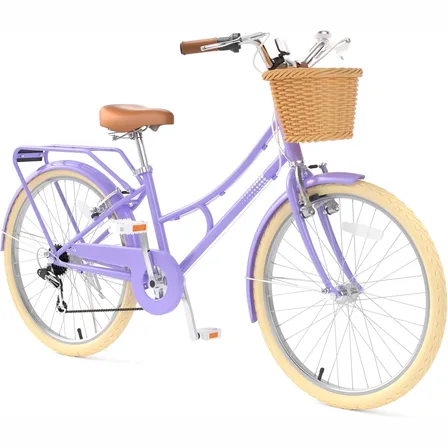
24-Inch Purple XJD Beach Cruiser Bike with U-Brake
The XJD 24-Inch Purple Beach Cruiser is built for girls and young women roughly …$159.99