

What size of bike should a 6 year old have
A 6-year-old will usually compare 14, 16 and 18 Inch bikes, with 16 Inch often the first size to check. Measure height and inseam, then confirm fit on the actual bicycle.
Choose by measured height, not the birthday
The XBikes starting points overlap at age six because children of the same age can differ considerably in size and riding ability. A 14 Inch bike covers riders 37–45 in (94–114 cm), a 16 Inch bike covers 40–48 in (102–122 cm), and an 18 Inch bike covers 43–52 in (109–132 cm).
| Wheel size | XBikes age starting point | Rider height |
|---|---|---|
| 14 Inch | Ages 3–6 | 37–45 in / 94–114 cm |
| 16 Inch | Ages 4–7 | 40–48 in / 102–122 cm |
| 18 Inch | Ages 5–9 | 43–52 in / 109–132 cm |
These ranges are starting points, not a substitute for trying the bike. If the child's height falls in two ranges, compare both sizes in person instead of automatically choosing the larger one.
Measure before comparing bikes
Measure the child without shoes, standing straight against a wall. Record total height from the floor to the top of the head. For inseam, have the child stand with feet slightly apart and measure from the floor to the crotch along the inside of the leg.
Bring both measurements when shopping. Wheel size is only a category: frame shape and riding position can differ between bicycles with the same wheel label. The inseam helps you assess stand-over room, while total height narrows the XBikes wheel-size range.
Do an individual fit check
Have the child try the exact bicycle. Do not buy an oversized bike solely so they can grow into it. While standing over the bike, the child should not be forced against the frame. Follow the bicycle's manual for the intended stand-over and adjustment checks rather than relying on an invented clearance number.
Next, check the riding position. The child should be able to reach the handlebar without an extreme stretch, steer deliberately, and operate the brakes with control. Ask them to demonstrate these actions rather than simply saying the bike feels fine. Current confidence matters too: a size that makes starting, stopping or turning intimidating is not a good present fit merely because height falls inside a chart range.
If seat, handlebar, brake or training-wheel adjustment is needed, follow the exact product manual. Use a qualified bicycle mechanic when the instructions are missing, unclear or beyond your experience.
How the available XBikes options compare
The supplied catalog options are useful because all three include 14 Inch and 16 Inch variants—the two most likely comparison sizes around age six—while one also offers 20 Inch. They help narrow the choice, but their wheel labels do not replace measurements or a hands-on fit check.
 XJD Boys 12/14/16" Training Wheel Bike – Blue
Available in 12, 14 and 16 Inch labels. Its 14 and 16 Inch variants are relevant comparison points for a 6-year-old, subject to measured height and an individual fit check.
 XJD Kids' Training Wheel Bike for Boys & Girls, 12/14/16 Inch – White
This Training Wheel Bike has 12, 14 and 16 Inch SKU labels. Compare the 14 and 16 Inch versions using the child's height, inseam, reach, brake control and confidence.
 Girls' Training Wheel Bike by XJD, 12–20 Inch Wheels – Blue
Offered in 12, 14, 16 and 20 Inch labels. The 14 and 16 Inch versions are immediate comparisons; consider 20 Inch only when the supplied height range and hands-on fit both support it.
XJD Boys 12/14/16" Training Wheel Bike – Blue is listed as a Training Wheel Bike with 12 Inch, 14 Inch and 16 Inch SKU labels. For a 6-year-old, compare its 14 Inch and 16 Inch versions against the child's measured height and actual control.
XJD Kids' Training Wheel Bike for Boys & Girls, 12/14/16 Inch – White is also a Training Wheel Bike offered in 12 Inch, 14 Inch and 16 Inch labels. Its catalog wording does not prove fit; the chosen variant still needs the same stand-over, reach and brake-control checks.
Girls' Training Wheel Bike by XJD, 12–20 Inch Wheels – Blue is listed with 12 Inch, 14 Inch, 16 Inch and 20 Inch labels. The 14 Inch and 16 Inch versions are the immediate six-year-old comparison points. XBikes places 20 Inch at ages 7–12 and heights 48–60 in (122–152 cm), so do not treat it as equal to 16 Inch. Consider it only when the rider's measured height and an individual fit check support it.
None of these three products has an 18 Inch SKU label. If an 18 Inch bike is indicated by the child's measurements and fit, the catalog products above are nearest-size comparison points, not substitutes for that exact size.
Make the final decision
- Measure height and inseam.
- Use the XBikes ranges to shortlist 14, 16 or 18 Inch.
- Try every shortlisted bike and compare stand-over, reach, steering, brake operation and confidence.
- Reject a larger option if the child cannot control it comfortably now.
Before riding, provide a bicycle helmet that fits properly, sits level and has straps used according to its manufacturer's instructions. For this 6-year-old, choose the size that passes today's measurements and control check—even when that means leaving growth room out of the decision.
Bikes for your next adventure
-

XJD Girls Bike for Kids Ages 3-8, 12/14/16 Inch with Training Wheels – Purple
The XJD Girls Bike in Purple is a training-wheel bicycle for kids ages 3 to 8, f…$149
$169 -

Pink Girls' 12/14/16" Bike by XJD – Basket & Doll Seat
The XJD Pink Girls' Bike with Basket & Doll Seat is made for riders 71–122 cm ta…$75.99
$99.99 -
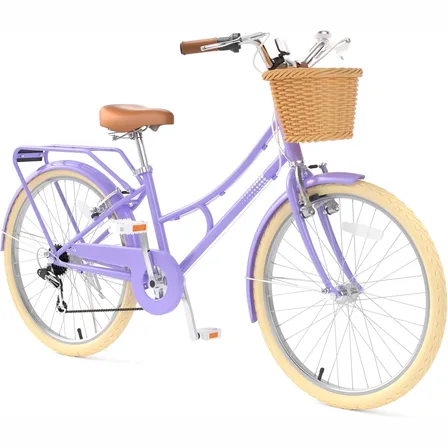
24-Inch Purple XJD Beach Cruiser Bike with U-Brake
The XJD 24-Inch Purple Beach Cruiser is built for girls and young women roughly …$159.99