

What size wheels on bike for 6 year old
For a 6-year-old, compare 14-, 16-, and 18-inch wheels first. Measure the child’s height, then confirm stand-over clearance, reach, braking control, and confidence on the actual bike before choosing.
Start with height, not the sixth birthday
Wheel size is only a starting point because children of the same age can differ greatly in height, proportions, strength, and riding experience. Under the XBikes starting points, a 14-inch bike covers ages 3–6 and heights of 37–45 inches (94–114 cm). A 16-inch bike covers ages 4–7 and heights of 40–48 inches (102–122 cm). An 18-inch bike covers ages 5–9 and heights of 43–52 inches (109–132 cm).
Those ranges overlap, so age six does not produce one automatic answer. A child measuring 42 inches might begin by trying both 14- and 16-inch bikes. At 46 inches, compare 16 and 18 inches. At 50 inches, the 18-inch starting point is the relevant one. These are comparisons to try, not guarantees of fit.
| Wheel size | XBikes age starting point | Rider height starting point |
|---|---|---|
| 14 Inch | Ages 3–6 | 37–45 in / 94–114 cm |
| 16 Inch | Ages 4–7 | 40–48 in / 102–122 cm |
| 18 Inch | Ages 5–9 | 43–52 in / 109–132 cm |
| 20 Inch | Ages 7–12 | 48–60 in / 122–152 cm |
Measure before comparing bikes
- Height: Have the child stand straight without shoes against a wall. Mark the top of the head and measure from the floor.
- Inseam: With feet slightly apart, measure from the floor to the crotch. Compare this measurement with the bicycle’s stand-over space and its manual rather than guessing from wheel diameter.
- Reach: On the bike, check that the child can hold the handlebar naturally without stretching, locking the elbows, or leaning excessively.
- Brake control: Confirm that the child can reach and operate the fitted controls reliably. Follow the exact product manual for adjustment instructions.
Do not substitute a trouser size or an old bike’s wheel size for these checks. Frame geometry varies, so two bicycles with equal wheel diameters can feel different.
What the test ride must show
The American Academy of Pediatrics recommends having the child try the bicycle and not buying an oversized bike merely for future growth. During the fit check, the child should be able to stand over the bike appropriately, get on and off without struggling, steer without wobbling from overreaching, and use the brakes with control.
Confidence matters alongside dimensions. A newer or cautious rider may control a smaller option within the appropriate height range more comfortably. A capable rider should still not be moved up if the larger bicycle compromises stand-over clearance, reach, mounting, steering, or braking.
A 20-inch bike begins at ages 7–12 and heights of 48–60 inches (122–152 cm) in the XBikes starting points. For a tall six-year-old, measured height may justify trying one, but only an individual fit and control check can confirm it. Do not choose it simply to allow room for growth.
How the supplied catalog option helps
The XJD Light Purple Girls Bike with Basket, Training Wheels, 12/14/16/20 Inch is categorized as a Training Wheel Bike. Its supplied available SKU labels are 12 Inch, 14 Inch, and 16 Inch, making those three versions useful comparison points when a six-year-old’s measurement falls near the lower or middle ranges. Although “20 Inch” appears in the exact catalog title, it is not among the supplied available SKU labels, so this article does not treat a 20-inch version as available.
These catalog options help answer the sizing question by letting you compare 14 and 16 inches against the child’s measured height and current control; the 12-inch label is relevant only when its smaller starting range genuinely matches the rider.

For context, the 12-inch XBikes starting point is ages 3–4 and 34–40 inches (86–102 cm). It is therefore generally outside the age starting point for a six-year-old, though height and an actual fit check remain more important than age alone. The supplied product has no 18-inch SKU label, so it is not a substitute when the child’s measurements and test ride indicate an 18-inch bike.
Make the final decision
- Choose among 14, 16, and 18 inches according to measured height first.
- Keep only sizes on which stand-over, reach, steering, and brake operation all work for this child.
- If assembly, adjustment, compatibility, or maintenance details are unclear, follow the exact product manual or use a qualified bicycle mechanic.
- Use a properly fitting bicycle helmet. It should sit level, with straps used according to the helmet manufacturer’s instructions, consistent with U.S. Consumer Product Safety Commission guidance.
For this six-year-old, measure height and inseam today, shortlist the overlapping wheel sizes, and buy only after the child demonstrates comfortable stand-over, reach, braking, and control on the exact bicycle.
Bikes for your next adventure
-

XJD Girls Bike for Kids Ages 3-8, 12/14/16 Inch with Training Wheels – Purple
The XJD Girls Bike in Purple is a training-wheel bicycle for kids ages 3 to 8, f…$149
$169 -

Pink Girls' 12/14/16" Bike by XJD – Basket & Doll Seat
The XJD Pink Girls' Bike with Basket & Doll Seat is made for riders 71–122 cm ta…$75.99
$99.99 -
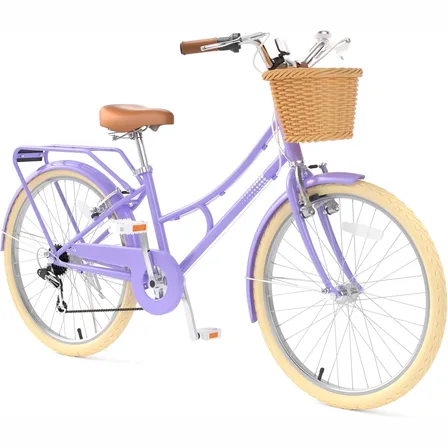
24-Inch Purple XJD Beach Cruiser Bike with U-Brake
The XJD 24-Inch Purple Beach Cruiser is built for girls and young women roughly …$159.99