

What to do with old kids bike
Inspect the old kids bike, check whether it still fits, then choose to adjust, pass it on, sell or donate it, or recycle it responsibly.
First, decide whether the bike is still usable
Clean the bike enough to see its condition, then look for a cracked or badly bent frame, loose or damaged parts, worn tires, and controls that do not work normally. Do not let a child ride it while anything appears unsafe or uncertain.
If it seems serviceable, follow the bike’s exact manual for inspection, maintenance, compatibility and assembly. Where the manual is missing, the damage is unclear, or parts need replacement, ask a qualified bicycle mechanic to assess it. Do not guess at torque settings or assume that a part fits.
A usable bike may remain with its current rider, be handed down, sold or donated. A bike with a questionable frame or damage that cannot be repaired economically should be directed to a bicycle recycler or an appropriate local recycling service rather than passed to another family.
Measure the child before keeping or replacing it
Record the child’s height and inseam while they are wearing the shoes normally used for riding. Then have the child try the bike. Height and age ranges are only starting points; actual stand-over clearance, reach, brake control and confidence determine whether the fit works.
The child should be able to mount and stop under control, reach the handlebars without stretching, and operate the brakes comfortably. Do not keep an undersized bike merely because it still rolls, and do not buy an oversized replacement for the child to grow into. If the child cannot control the bike confidently, change the fit or size before the next ride.
Compare the old wheel size with the next size
| Wheel size | Starting age | Starting rider height |
|---|---|---|
| 12 Inch | 3–4 | 34–40 in / 86–102 cm |
| 14 Inch | 3–6 | 37–45 in / 94–114 cm |
| 16 Inch | 4–7 | 40–48 in / 102–122 cm |
| 18 Inch | 5–9 | 43–52 in / 109–132 cm |
| 20 Inch | 7–12 | 48–60 in / 122–152 cm |
| 24 Inch | 10–14 | 54–64 in / 137–163 cm |
| 26 Inch | Youth and adults | Over 60 in / 153 cm |
Find the child’s measured height in the table, but compare every plausible overlapping size in person. Wheel size alone does not prove fit, and two children of the same age may need different choices because their inseam, reach, coordination and confidence differ.
When the supplied bike is relevant
The Black XJD Kids Bike for Boys – 12, 14 & 16 Inch Sizes is a training wheel bike offered in 12 Inch, 14 Inch and 16 Inch SKU labels. It is relevant when the old bike falls within those sizes, or when the child’s measured height indicates that one of them is worth trying. Compare the applicable labeled size against the old bike, then confirm stand-over, reach, brake operation and control with the child present.
These particular catalog options help because they provide three adjacent wheel-size comparison points for families deciding whether an old small bike still fits or whether a differently sized training wheel bike should be tried. They do not cover 18, 20, 24 or 26 Inch needs, so they are not substitutes when an individual fit check points to one of those sizes.

The available catalog facts do not establish weight, materials, brake type, load limits, certifications or compatibility with parts from the old bike. Consult the exact product manual or a qualified bicycle mechanic for those questions.
Choose a useful next life for the old bike
- Keep it: Do this only if it passes inspection and the current rider can still stand over, reach, brake and steer confidently.
- Hand it down: Repeat the complete fit and condition check for the next child; family relationship and age do not establish fit.
- Sell or donate it: Describe its size and known condition honestly. Include the manual and matching parts if available, without making unsupported safety or compatibility claims.
- Recycle it: Choose this when the frame is seriously damaged, repair is not practical, or a mechanic advises against reuse. Ask a local bike shop or recycling service how it accepts bicycles and separate components.
Do not leave a visibly unsafe bike where someone may take and ride it without understanding its condition.
Prepare for the child’s next ride
Once the bike choice is settled, check assembly and maintenance against its exact manual or have a qualified mechanic do so. The child also needs a bicycle helmet that fits properly, sits level, and has straps adjusted according to the helmet manufacturer’s instructions.
Your next action is simple: measure the child today, compare that result with the old bike’s wheel size, and arrange an in-person fit check. Keep or pass on the bike only if both its condition and the next rider’s control support that decision; otherwise repair, replace or recycle it.
Bikes for your next adventure
-

Blue XJD Girls Bike with Training Wheels – 12/14/16 Inch
If you're shopping for a first pedal bike for a daughter roughly 3 to 8 years ol…$149
$169 -

26-Inch XJD Beach Cruiser Bike for Girls – Purple, V-Brake
This XJD 26-inch purple beach cruiser is sized for big kids and teens — suggeste…$218.49
$229.99 -
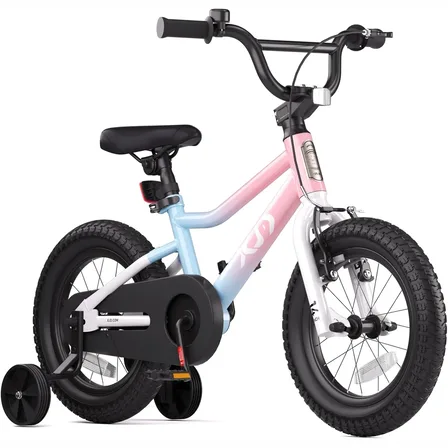
XJD Girls BMX Bike 12/14/16 Inch with Training Wheels – Pink Blue
The XJD Girls BMX Bike in Pink/Blue is built as a first pedal bike for kids roug…$99.99
$119.99