

What wheel size bike for 5 year old
For a 5-year-old, compare 14-, 16- and 18-inch bikes first, then choose by measured height and an individual fit check—not age alone.
Which wheel size should you try first?
Measure your child’s standing height without shoes and use it to narrow the choices. Under the XBikes starting points, all three common candidates overlap age five: 14 Inch covers 37–45 in (94–114 cm), 16 Inch covers 40–48 in (102–122 cm), and 18 Inch covers 43–52 in (109–132 cm).
Where height ranges overlap, do not automatically select the larger wheel. Start with the size on which the child can stand over the bike, reach the controls comfortably and steer without stretching. Current confidence matters too: a cautious or new rider may control a correctly fitted smaller option more easily than an oversized bike.
Measure height and inseam before shopping
- Measure standing height: Have the child stand straight against a wall without shoes. Mark the top of the head and measure from the floor.
- Measure inseam: With feet slightly apart, measure from the floor to the crotch. This helps you assess stand-over clearance on the actual bicycle.
- Record both measurements: Wheel-size charts narrow the search, but an inseam must be compared with the real bike rather than converted into a wheel size by guesswork.
These are XBikes starting points, not a promise of fit:
| Wheel size | Age starting point | Rider-height starting point |
|---|---|---|
| 12 Inch | 3–4 | 34–40 in / 86–102 cm |
| 14 Inch | 3–6 | 37–45 in / 94–114 cm |
| 16 Inch | 4–7 | 40–48 in / 102–122 cm |
| 18 Inch | 5–9 | 43–52 in / 109–132 cm |
| 20 Inch | 7–12 | 48–60 in / 122–152 cm |
What to check on the actual bike
Have your child try the bicycle while wearing the shoes they will normally ride in. Check that there is practical stand-over clearance, that mounting and stopping feel controlled, and that the seated position does not force an awkward stretch toward the handlebar.
Ask the child to hold the grips, turn the handlebar in both directions and operate each brake control provided on the bike. Their hands should reach and use the controls without releasing the grips or straining. Observe a start, straight ride, turn and stop in a traffic-free area with close adult supervision.
The American Academy of Pediatrics advises trying the bicycle, checking stand-over and control, and avoiding an oversized bike bought merely for future growth. If the child cannot manage the bike now, growing into it later does not make it an appropriate current fit.
How the supplied XBikes options compare
The XJD Kids Bike for Girls – Pink, 12/14/16/20 Inch with Training Wheels offers 12 Inch, 14 Inch, 16 Inch and 20 Inch SKU labels. The XJD Pink Girls' Bike – Kids 12/14/16 Inch Training Wheel Bicycle offers 12 Inch, 14 Inch and 16 Inch labels. These catalog options are useful comparison points when measurements indicate 14 or 16 Inch, and they let you compare those two sizes within each listed model.
 XJD Kids Bike for Girls – Pink, 12/14/16/20 Inch with Training Wheels
Offers 12, 14, 16 and 20 Inch SKU labels with training wheels. Its 14- and 16-inch options are relevant comparison points for many measured 5-year-olds, subject to an individual fit check.
 XJD Pink Girls' Bike – Kids 12/14/16 Inch Training Wheel Bicycle
Offers 12, 14 and 16 Inch SKU labels with training wheels. Compare its 14- and 16-inch options when the rider-height starting points apply; it does not provide the 18 Inch comparison size.
Neither supplied product lists an 18 Inch SKU. If your child’s measurements and hands-on check point to 18 Inch, these products are nearest-size comparison points only—not substitutes for an 18 Inch bike. A 20 Inch label appears only on the first product, but the XBikes starting point for 20 Inch is ages 7–12 and 48–60 in (122–152 cm); age five alone is not a reason to move up to it.
Training wheels are stated in both catalog titles, but their presence does not correct poor frame fit, excessive reach or inaccessible controls. Use the exact product manual for assembly, adjustment, maintenance, load limits, compatibility and torque information. If anything is unclear, use a qualified bicycle mechanic rather than inventing an adjustment.
Helmet fit belongs in the final check
A properly fitting bicycle helmet is required regardless of wheel size or whether training wheels are used. U.S. Consumer Product Safety Commission guidance says the helmet should fit properly, sit level and have its straps used according to the manufacturer’s instructions. A loose, tilted or incorrectly strapped helmet needs correction before riding.
Make the size decision
Begin with the child’s measured height: try 14 Inch at 37–45 in, 16 Inch at 40–48 in, or 18 Inch at 43–52 in. Where ranges overlap, choose only after comparing inseam, stand-over, reach, brake operation and riding confidence on the actual bicycle. For a 5-year-old, the right decision is the size they can control today—not the largest size they may eventually grow into.
Bikes for your next adventure
-

Pink Girls' 12/14/16" Bike by XJD – Basket & Doll Seat
The XJD Pink Girls' Bike with Basket & Doll Seat is made for riders 71–122 cm ta…$75.99
$99.99 -

XJD Girls Bike for Kids Ages 3-8, 12/14/16 Inch with Training Wheels – Purple
The XJD Girls Bike in Purple is a training-wheel bicycle for kids ages 3 to 8, f…$149
$169 -
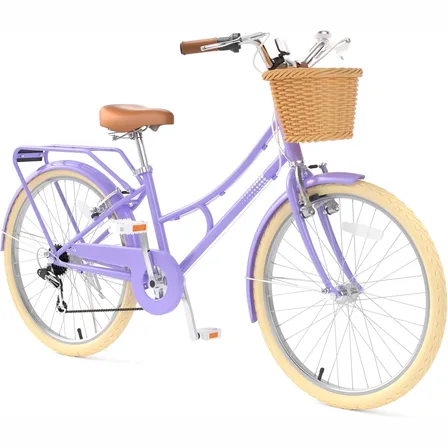
24-Inch Purple XJD Beach Cruiser Bike with U-Brake
The XJD 24-Inch Purple Beach Cruiser is built for girls and young women roughly …$159.99