

When are kids ready for a two wheel bike
Kids are ready for a two-wheel bike when they fit the bike, can control it confidently, and can start, steer, stop and balance without training wheels.
Check readiness before age
Age can suggest a wheel-size starting point, but it cannot decide readiness. A child should be able to follow simple directions, look ahead while moving and respond calmly when asked to stop. They should also show interest in riding without being pressured.
Look for practical balance skills: gliding with both feet lifted, steering around a gentle turn and placing a foot down deliberately when slowing. A child who still depends on training wheels for every turn or becomes frightened as soon as the bike leans may benefit from more practice before riding on two wheels.
Measure height, inseam and bike fit
Measure the child’s height without shoes. Measure inseam from the floor to the crotch while the child stands straight. Use height to choose a starting wheel size, then have the child try the actual bicycle; wheel size alone does not establish fit.
| Wheel size | Age starting point | Rider height |
|---|---|---|
| 12 Inch | 3–4 | 34–40 in / 86–102 cm |
| 14 Inch | 3–6 | 37–45 in / 94–114 cm |
| 16 Inch | 4–7 | 40–48 in / 102–122 cm |
| 18 Inch | 5–9 | 43–52 in / 109–132 cm |
| 20 Inch | 7–12 | 48–60 in / 122–152 cm |
| 24 Inch | 10–14 | 54–64 in / 137–163 cm |
| 26 Inch | Youth and adults | Over 60 in / 153 cm |
Overlapping ranges are normal. Prioritize measured height, inseam, reach, brake control and present confidence over age. Do not move up simply because a child is near a birthday or because a larger bicycle might last longer.
Have the child try the bicycle
A useful fit check happens with the real bike, not beside a size chart. The American Academy of Pediatrics advises having the child try the bicycle and avoiding an oversized bike bought for growth.
- Stand-over: The child should be able to straddle the bike with stable footing and adequate clearance, following the bicycle manual’s fit directions.
- Reach: Seated in a normal riding position, the child should reach the handlebar without stretching, locking the elbows or losing comfortable steering control.
- Brake control: The child must be able to reach and operate the fitted braking system reliably. Follow the exact product manual for its controls and adjustments.
- Mounting and stopping: Ask the child to get on, begin moving, stop and get off several times without an adult holding the bike.
If reach, stand-over or braking is marginal, the bike is not the right fit now even when the chart includes the child’s age or height.
Use a short two-wheel practice test
Choose a flat, open area away from traffic and obstacles. Start with a properly fitting helmet and close adult supervision. A bicycle helmet should sit level, fit properly and have its straps used according to the manufacturer’s instructions, as directed by the U.S. Consumer Product Safety Commission.
- Let the child practice mounting and placing both feet securely.
- Ask for several controlled glides, with eyes ahead rather than down.
- Practice gentle steering in both directions.
- Have the child start independently, ride a short line and make a planned stop.
Readiness is shown by repeatable control, not one lucky attempt. If the child cannot stop on request, repeatedly falls because they cannot correct a lean, or needs continuous adult support, return to balance and control practice before trying again.
How the supplied bike helps with the decision
The XJD Girls' Bike with Training Wheels, 12/14/16/20 Inch – Purple is relevant as a training-wheel bicycle offered in 12 Inch, 14 Inch, 16 Inch and 20 Inch labels. Those options let a parent compare several XBikes height starting points while considering whether the child still needs training-wheel support. The product title and category do not prove that an individual child is ready to remove that support, and the listed sizes still require an actual fit check.
These particular catalog options help answer the readiness question because they combine multiple wheel-size comparison points with a training-wheel format, making fit and the child’s current support needs separate decisions.

If the child’s measured starting point is 18 Inch, 24 Inch or 26 Inch, this product does not supply that exact wheel-size label. Its listed sizes are comparison points, not equal substitutes. Do not size up or down merely to choose an available label.
Make the decision
Choose two wheels now only if the child fits the specific bicycle, reaches and controls its brakes, glides and steers with balance, starts without being held and stops reliably. If any one of those checks fails, select the correctly fitting practice setup, keep training-wheel or balance practice focused on that missing skill, and reassess after the child can repeat it confidently. Follow the exact product manual or use a qualified bicycle mechanic for assembly, adjustment, compatibility and maintenance.
Bikes for your next adventure
-
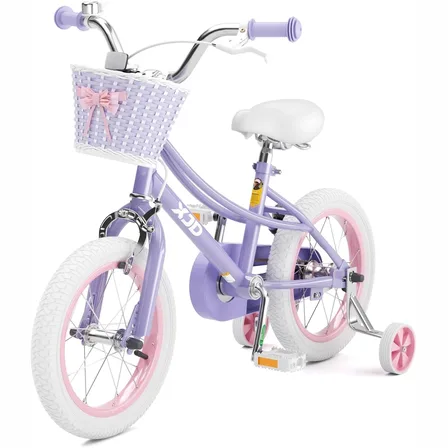
Girls' Training Wheel Bike by XJD with Basket – Purple
If you're shopping for a first bike for a girl roughly 3 to 12 years old (91–152…$75.99
-

XJD Kids Bike for Girls – Pink, 12/14/16/20 Inch with Training Wheels
The XJD Kids Bike for Girls in Pink is a training-wheel bike built to carry your…$139
$159 -

XJD Girls Bike for Kids Ages 3-8, 12/14/16 Inch with Training Wheels – Purple
The XJD Girls Bike in Purple is a training-wheel bicycle for kids ages 3 to 8, f…$149
$169